


In order to bring privacy-focused cryptocurrencies further into the financial mainstream, Grayscale Investments has filed with the U.S. Securities and Exchange Commission to convert its Grayscale Zcash Trust into a spot exchange-traded fund.
This groundbreaking Zcash ETF filing, submitted on November 26, 2025, positions Grayscale to create the first U.S.-listed fund of its kind, offering investors a new way to gain exposure to the Zcash digital asset.
The Grayscale playbook
Grayscale’s bid to convert its Zcash Trust into a Zcash ETF is part of a broader company strategy. Following its successful launch of a spot Bitcoin ETF, the asset manager has been actively working to transform several of its single-asset cryptocurrency trusts into more accessible ETFs.
The Grayscale Zcash Trust, which trades under the ticker ZCSH, has been operating since October 2017 and currently manages approximately $196 million in assets. The trust has delivered impressive returns recently, surging 917.1% over the past year through October 2025, significantly outperforming its category average.

Understanding the privacy proposition
Zcash stands apart in the crowded cryptocurrency landscape through its focus on privacy. Using advanced zk-SNARK zero-knowledge proof technology, the network allows users to verify transactions without revealing sensitive information about the sender, receiver, or transaction amount.
Unlike many cryptocurrencies that operate on fully transparent blockchains, Zcash offers users a choice between transparent transactions, similar to Bitcoin, and shielded transactions that provide enhanced financial privacy.
Zcash’s native token, ZEC, has experienced substantial market activity, currently ranking among the top 25 digital assets with a market capitalization of approximately $8.46 billion. The token’s price has seen significant volatility, reaching a high of $742 in September 2025 before settling around $516 as of November 26, 2025.
The regulatory hurdle
The path to approval for this innovative Zcash ETF may face challenges. Regulators have historically approached privacy-focused cryptocurrencies with additional caution, and the SEC will likely scrutinize how the fund addresses potential concerns about transaction anonymity.
Grayscale will need to convincingly demonstrate that its product can comply with regulatory standards while preserving the unique value proposition of the Zcash technology. The current favorable regulatory environment, including recent streamlined listing standards for digital asset products, could work in the company’s favor.
What this means for investors
For everyday investors, the creation of a Zcash ETF would dramatically simplify access to Zcash exposure. Currently, investors in the Grayscale Zcash Trust face several limitations compared to what an ETF structure would offer:
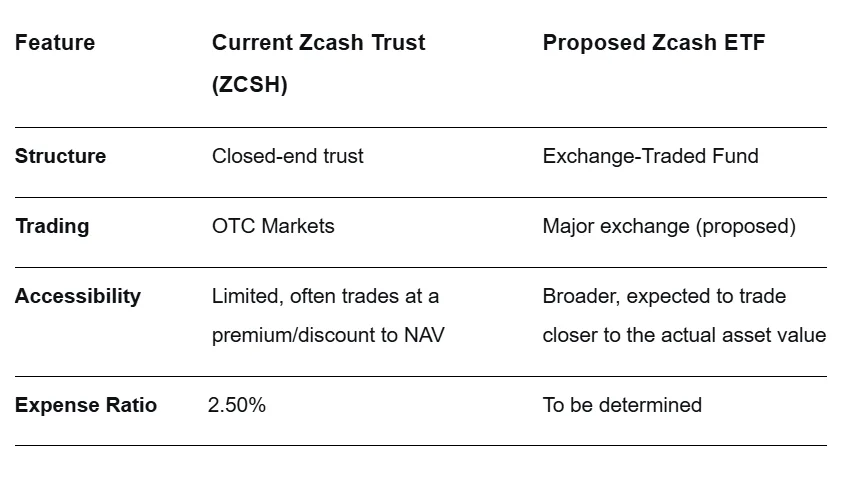
The 2.50% annual fee charged by the current trust is significantly higher than typical ETF expense ratios, creating potential for cost savings if the conversion is approved.
Market outlook
Analysts are watching this development closely, though opinions on the immediate price impact vary. Some technical analysis suggests Zcash may face short-term price pressure despite the positive news, with one analyst projecting a potential retreat to the $380 support level.
The filing comes as interest in privacy technologies grows within digital finance. Recent data shows the shielded supply of ZEC has jumped to over 4 million tokens, up from below 3 million just months ago, indicating strengthening adoption of its privacy features.
Zcash ETF: A new frontier
Grayscale’s push for a Zcash ETF represents more than just another product expansion; it tests the boundaries of how privacy and regulation coexist in the evolving digital asset landscape. This initiative would mark a milestone for privacy-preserving technologies in mainstream finance.
As the SEC reviews the application, the financial and crypto communities will be watching closely. Approval of this first Zcash ETF could signal a new chapter of acceptance for privacy-focused digital assets, potentially reshaping how investors think about confidentiality in their portfolios.