

The new tokenized trading trial brings blockchain into the stock market, but only through the same old gates, rules, and institutions. The US Securities and Exchange Commission has approved Nasdaq’s plan to begin a tokenized trading trial for certain stocks and exchange-traded funds, marking one of the clearest signs yet that Wall Street wants blockchain technology inside the regulated financial system, not outside it.
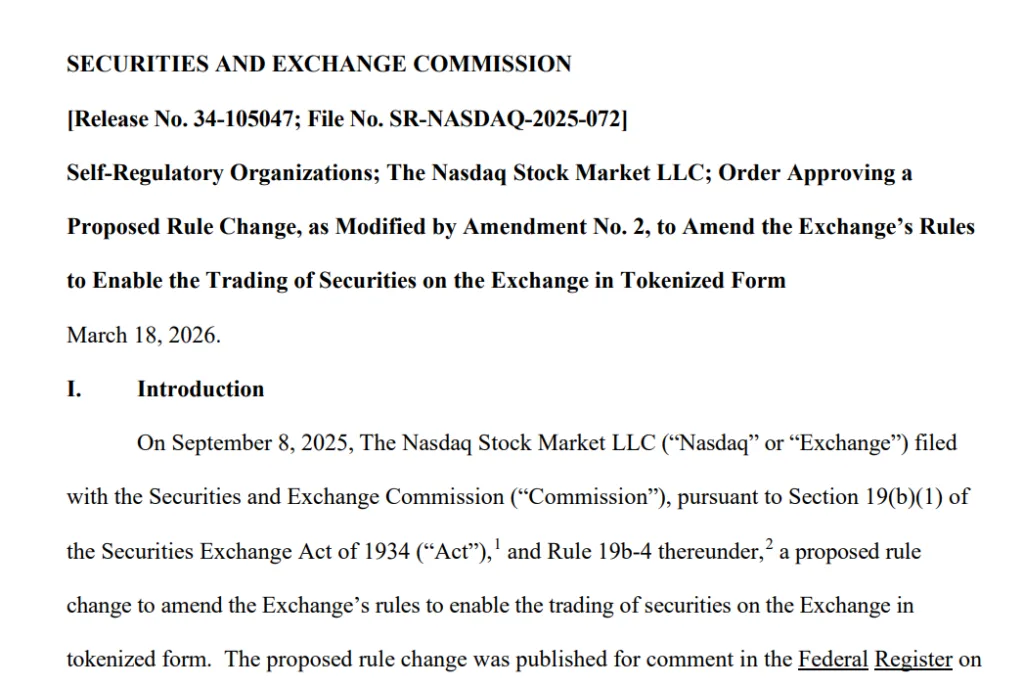
The approval, issued on March 18, 2026, allows eligible Nasdaq participants to trade some securities in either traditional form or tokenized form under a tightly limited pilot tied to the Depository Trust Company, better known as DTC.
A big milestone with a very small gate
This is a major moment for tokenized trading, but it is also much narrower than the headlines may suggest. The SEC did not approve a free-roaming market for on-chain stocks. It approved a specific Nasdaq rule change, known as SR-NASDAQ-2025-072, that works only within DTC’s tokenization pilot and under existing securities law. That means the old market structure stays in place, and the blockchain piece is added carefully inside it.
Under the approved setup, tokenized shares will trade on the same Nasdaq order book as regular shares. They will carry the same ticker, the same CUSIP, the same rights, and the same execution priority as the traditional version. In simple terms, investors are not looking at a separate token market. They are looking at the same market with a new settlement option attached to it.
Who actually gets access
The answer is not retail traders, at least not now. This tokenized trading pilot is built for institutions first. Only DTC-eligible participants can request tokenized settlement, and only DTC-eligible securities can take part. Nasdaq’s system also does not decide tokenization eligibility at the moment an order is placed. If the participant, the security, the blockchain choice, or the wallet does not fit DTC’s rules, the trade simply settles in the usual non-tokenized form.
The securities allowed at launch are also limited. Nasdaq said the pilot covers stocks in the Russell 1000 at the time the service begins, along with later additions to that index, plus certain ETFs tied to major benchmarks such as the S&P 500 and Nasdaq 100. Reuters reported the same framework, describing the approval as a step toward trading high-volume stocks either as traditional shares or as blockchain-based digital tokens.
Why DTC is the real backbone
The real engine behind this story is DTC. Nasdaq’s approval depends on a December 11, 2025, SEC staff no-action letter that gave DTC room to run a limited version of DTCC Tokenization Services for three years from launch. That relief came with strict conditions, including allowlisted wallets, compliance-focused tokenization protocols, quarterly reporting, and a narrow operational scope. DTC said its preliminary service is expected to launch in the second half of 2026.
That matters because the token does not change the legal nature of the stock. The SEC and Commissioner Hester Peirce have both made clear that tokenized securities are still securities. In other words, this is not crypto replacing Wall Street. It is Wall Street absorbing blockchain on its own terms.
How the approval came together
Nasdaq first filed the proposal in September 2025. The SEC published it for comment later that month, then extended its review and opened formal proceedings in December before finally approving the rule after Nasdaq submitted Amendment No. 2 in January 2026. The SEC said that the amendment helped answer concerns raised by commenters by giving more detail on tokenization requests, post-trade processing, and the fact that only DTC-eligible participants can use the pilot.
Not everyone was comfortable. Better Markets warned about the risk of price divergence, weaker investor protection, and regulatory arbitrage. SIFMA and Cboe were less hostile but still wanted more clarity on the plumbing. The SEC ultimately said those concerns had been addressed well enough for this limited trial to move forward.
The bigger race is already on
This tokenized trading approval is also part of a broader push across US market operators. On March 9, Nasdaq unveiled an equity token design that puts issuers at the center of tokenized ownership, governance, and investor experience, with a target rollout in 2027. At the same time, exchange rivals are chasing similar plans, showing that the race to bring tokenized finance into regulated markets is heating up fast.
The larger message is simple. The first real test of tokenized trading in US public markets is beginning, but it is beginning in a very Wall Street way. The rules are still there. The gatekeepers are still there. The technology is new, but the control is not. For now, that may be exactly why the SEC was willing to say yes.