


To finally deliver long-sought crypto regulation clarity, federal regulators have officially declared that the majority of digital assets fall outside securities laws.
For more than a decade, the crypto industry has operated under a cloud of uncertainty. Entrepreneurs built products not knowing if regulators would suddenly shut them down. Investors bought tokens without understanding whether they were buying a security or a commodity. And two federal agencies spent years fighting over who had jurisdiction.
That era may finally be starting to end.
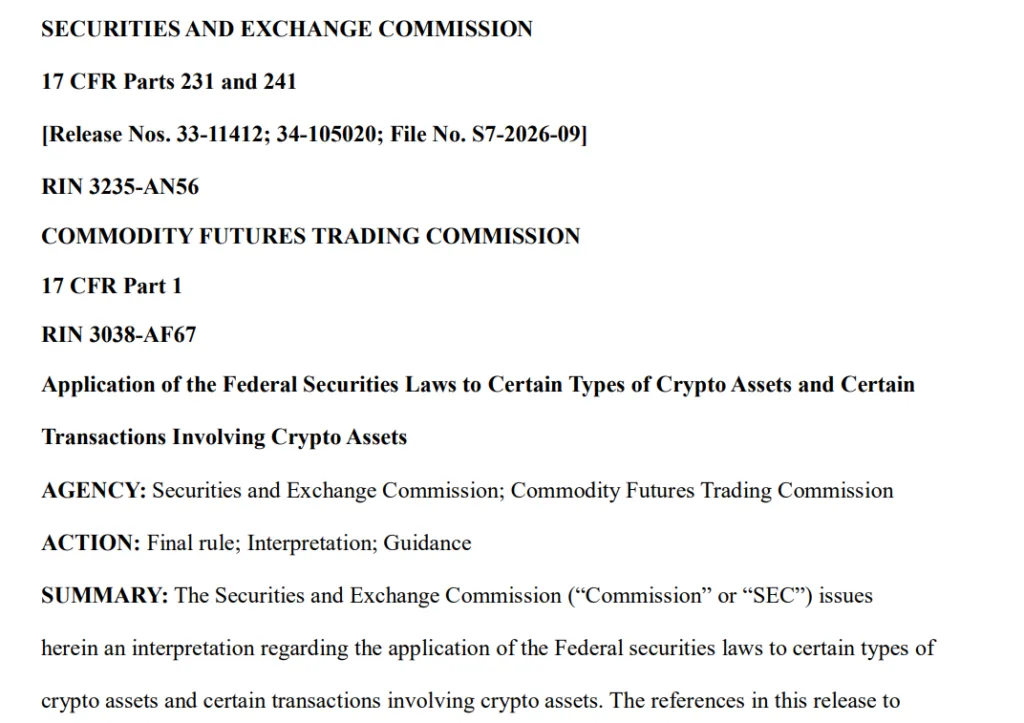
The Securities and Exchange Commission and the Commodity Futures Trading Commission jointly issued a 68-page interpretive release that fundamentally rewrites how the US government views crypto assets. The document, released at the DC Blockchain Summit in Washington, provides something the industry has begged for since Bitcoin first appeared: clear categories with clear rules.
“After more than a decade of uncertainty, this interpretation will provide market participants with a clear understanding of how the Commission treats crypto assets under federal securities laws,” SEC Chairman Paul Atkins said in a statement. “This is what regulatory agencies are supposed to do: draw clear lines in clear terms.” This move marks a turning point for crypto regulation clarity.
The five categories that change everything
The framework outlines four main categories that are generally not securities, while keeping digital securities under existing rules.
- Digital commodities sit at the top of the list. These include major network tokens such as Bitcoin and Ethereum, along with similar assets that derive their value from the programmatic operation of a functional network rather than someone else’s managerial efforts. The interpretation makes clear that these are not securities.
- Digital collectibles get similar treatment. Think CryptoPunks, Chromie Squiggles, or memecoins that people buy for fun rather than for investment. If someone acquires an asset for artistic, entertainment, or cultural purposes, it generally falls outside securities laws.
- Digital tools cover tokens that serve practical functions as membership passes, tickets, or identity credentials. These are not securities either.
- Payment stablecoins that qualify under the GENIUS Act, the stablecoin law Congress passed last July, are explicitly placed in the non-security bucket.
- That leaves digital securities, which are exactly what they sound like: tokenized versions of traditional securities like stocks and bonds. Those remain fully under SEC jurisdiction.
Staking, airdrops, and NFTs get a green light
Beyond the basic categories, the interpretation addresses specific activities that have long worried crypto businesses.
Protocol staking does not involve the offer or sale of a security, the SEC said. This covers solo staking, delegating to third parties, custodial staking arrangements, and even liquid staking tokens, though the agency cautioned that receipt tokens can become securities depending on what they represent.
On airdrops, the SEC took a surprisingly narrow view of enforcement. There is no investment of money when recipients give no consideration, the agency said, meaning most airdrops do not trigger securities laws at the moment of distribution. However, the same asset could become subject to investment contract analysis in later transactions.
NFTs and meme coins received what amounts to a regulatory hall pass. The interpretation treats digital collectibles as generally non-securities and explicitly mentions CryptoPunks and meme coins as examples of assets acquired for social or cultural purposes rather than profit expectations.
The catch: Investment contracts still matter
Here is where nuance matters. The SEC did not throw out the Howey test, the Supreme Court standard that defines what counts as an investment contract. That precedent remains binding.
A token that is not itself a security can still be sold as part of an investment contract. The classic example is a project that raises money by promising to build something and deliver profits to early backers. During that fundraising phase, securities laws apply.
But here is the innovation in the new framework: that status can end. Once the promised managerial efforts are completed or permanently stopped, the asset can shed its investment contract character and live freely as a non-security. The interpretation calls this the “separation” mechanism, and it solves a long-standing problem where projects feared they would be forever tainted by their fundraising origins.
The turf war that finally gives crypto regulation clarity
Perhaps as significant as the substance is the symbolism. The SEC and CFTC have spent years fighting over who gets to regulate crypto. That conflict produced contradictory statements, jurisdictional grabs, and enforcement actions that often seemed designed to score bureaucratic points rather than protect investors.
The March 17 release came with a companion document that matters almost as much: a formal memorandum of understanding signed March 11, in which the two agencies agreed to coordinate on interpretations, rulemakings, and enforcement. They will jointly clarify product definitions, modernize clearing frameworks, and reduce friction for companies that need to deal with both regulators.
For an industry accustomed to watching agencies bicker, this counts as a minor miracle.
What comes next?
The interpretation is final and effective immediately. But SEC Chairman Atkins used his DC Blockchain Summit speech to preview what comes next: a possible “token safe harbor” proposal that would create time-limited exemptions for startups and a clear, rule-based standard for when assets exit securities laws entirely.
That proposal remains in the speech stage for now. Atkins said he expects the commission to consider releasing it for public comment in the coming weeks.
Congress also remains part of the story. The CLARITY Act, a comprehensive market structure bill, has faced Senate delays and political disagreements. The agencies themselves acknowledge that legislation remains necessary for a truly durable framework.
What the crypto regulation clarity means for ordinary people
For the average person holding crypto, this interpretation provides something previously unavailable: clarity.
If you own Bitcoin, Ethereum, or similar major tokens, the government now says those are commodities, not securities. If you have staked assets to help secure a network, that activity does not make you part of an unregistered securities offering. If you received an airdrop, you did not automatically participate in an illegal transaction. If you bought an NFT because you liked the art, you are probably fine.
The assets that remain clearly under securities laws are tokenized stocks and funds. If someone offers you a token that represents shares in a company or entitles you to dividends, that is a digital security and is subject to the full weight of SEC regulation.
For investors, the bottom line is this: after years of guessing, the rules of the road are finally visible. The Wild West era of crypto regulation in America did not end with a bang. It ended with a 68-page government document that, for once, actually clarified things. For many, this is the first real crypto regulation clarity.