

A French banking giant just made Bitcoin collateral legal in DeFi lending, and it might be the moment traditional finance stopped resisting the future.
Something remarkable just happened in the world of finance, and hardly anyone noticed. On October 31, Société Générale-Forge, the digital asset arm of France’s second-largest bank, announced it would now accept Bitcoin-backed assets as collateral for stablecoin loans. That single move could change how banks, regulators, and crypto communities interact for years to come.
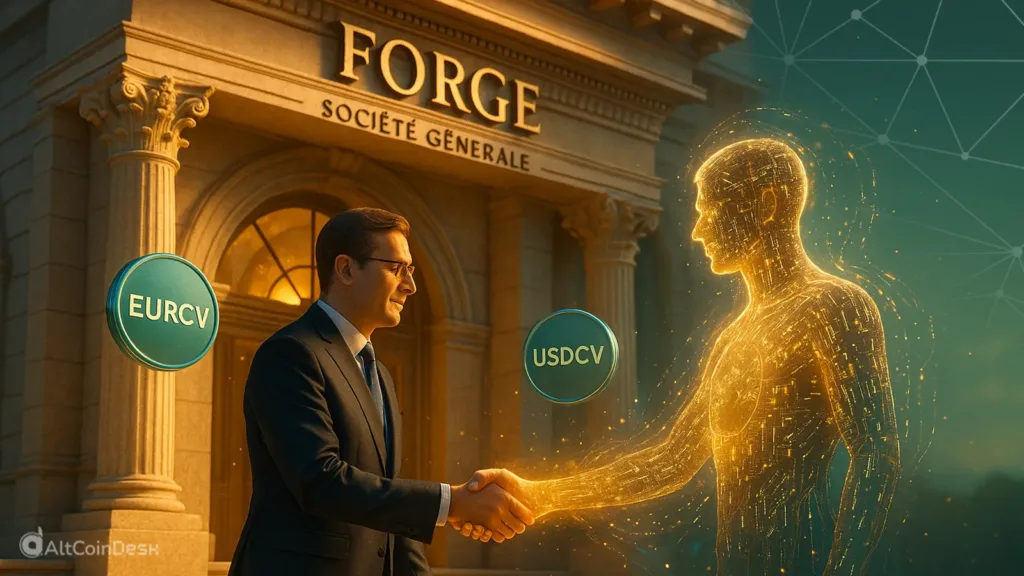
Société Générale-Forge partnered with Morpho, a decentralized lending platform curated by MEV Capital, to enable borrowers to use the LBTC token, created by Bitcoin infrastructure firm Lombard, to secure loans in two regulated stablecoins: EURCV and USDCV. These digital euros and dollars are fully compliant under the European Union’s MiCA framework, which sets strict standards for crypto assets. In short, this means a fully licensed European bank has now opened its doors to decentralized finance while staying within the law.
It is the kind of story that could quietly mark the start of a new financial era.
Bridging two worlds
For years, traditional banks treated crypto like an unpredictable guest at a formal dinner. But Société Générale-Forge just pulled out a chair and asked it to stay. The bank’s move to adopt LBTC as collateral is not a wild experiment; it follows months of due diligence, security checks, and risk analysis. Every smart contract, liquidity pool, and vault involved was inspected and approved.
This isn’t about hype or speculation. It’s about trust, compliance, and the slow but certain merging of two systems that once seemed incompatible.
The idea is simple: a Bitcoin holder can now use tokenized BTC (LBTC) to borrow MiCA-compliant stablecoins. The loans run through Morpho’s regulated lending infrastructure and are overseen by MEV Capital, a risk management firm specializing in DeFi operations.
This partnership shows that DeFi can meet traditional banking standards when built with care. Société Générale-Forge is not chasing memes or market swings; it’s building a foundation for what many call “RegFi”, regulated decentralized finance.
Why this matters
The MiCA framework gave European banks a legal structure to operate in crypto, and Société Générale-Forge is leading the charge. Its stablecoins already hold more than 100 million dollars in circulation, and the bank’s integration with DeFi protocols like Morpho signals that on-chain lending is maturing fast.
Meanwhile, Lombard’s LBTC has emerged as a star player. Its acceptance by one of Europe’s oldest banks is a major milestone for tokenized Bitcoin. It transforms BTC from a speculative asset into a working part of global liquidity networks.
A turning point hidden in plain sight
It’s tempting to think this story is just another partnership update, but it’s much bigger. It means regulated stablecoins can now move through public blockchains. It means banks can safely engage with decentralized markets. And it means Bitcoin, once seen as a threat to traditional finance, is now helping build the next generation of banking infrastructure.
When Société Générale-Forge accepted LBTC as collateral, it did more than enable loans. It redefined trust. The message is clear: the wall between banks and blockchain is falling. Slowly, quietly, and legally.
To sum up
Société Générale-Forge may have just started something the whole world will eventually follow. By merging Bitcoin liquidity with regulated stablecoins, the bank has proven that compliance and innovation can coexist. It is not a revolution shouted from rooftops but a transformation whispered through smart contracts.
And for the first time in decades, it feels like traditional finance is not fighting crypto; it is learning from it.