


The divide inside America’s fast-growing crypto fund market is becoming clearer. New data shows Solana ETF institutional investment is rising quickly as professional money managers increase exposure, while XRP exchange-traded funds are seeing stronger participation from everyday investors. Meanwhile, Goldman Sachs stands out as a major institutional holder in both funds. The contrast is not about which asset is better. It is about who is buying and why.
Recent Bloomberg Intelligence data cited by CoinDesk shows that nearly half of U.S. spot Solana ETF assets can be traced to institutional investors through regulatory filings. Only a small portion of XRP ETF assets appear in the same filings. This gap suggests that large asset managers, hedge funds, and advisory firms are leaning more toward Solana products, while XRP funds rely more heavily on individual investors and loyal community members.
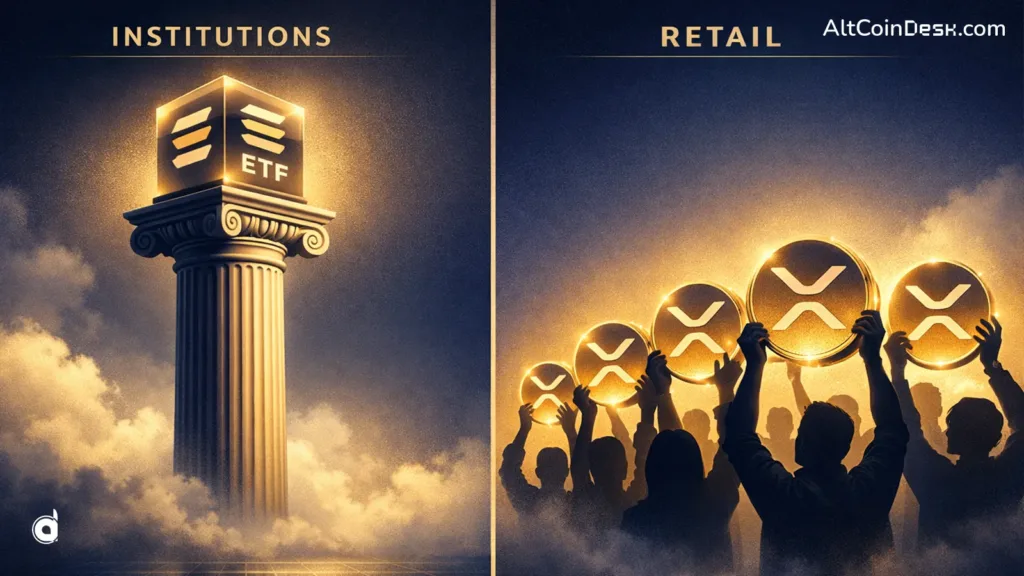
The difference in ownership structure is now shaping how analysts describe each market. Solana ETF institutional investment is often viewed as a professional allocation trend. XRP ETFs, on the other hand, are seen as conviction-driven vehicles powered by a passionate retail base.
Goldman Sachs Leads Both Worlds
The most surprising figure in the data is Goldman Sachs itself. The Wall Street giant now holds roughly $107 million in Solana ETFs and nearly $154 million in XRP ETFs, making it the largest disclosed institutional holder of both. That alone tells you institutions are not avoiding either token.
But here is where the paths diverge. Electric Capital leads all Solana ETF holders with about $138 million, followed by Goldman Sachs. Elequin Capital ranks among the other notable holders. Other familiar Wall Street names like Morgan Stanley, Citadel, and SIG also appear on the Solana holder lists.
For XRP, after Goldman’s massive position, the next biggest holders are Millennium Management at around $23 million and Logan Stone Capital at roughly $5 million. The drop-off is dramatic, and the vast majority of XRP ETF assets simply cannot be traced to any institutional filer.
What the 13F Data Actually Tells Us
To understand why this matters, you need to know what a 13F filing is. Investment firms managing more than $100 million in U.S. securities must file these quarterly reports with the SEC, listing their public holdings. When only 16 percent of XRP ETF assets show up in these filings, it means the other 84 percent are held by people and firms that do not meet that threshold.
Bloomberg analyst Eric Balchunas put it bluntly when he suggested the invisible holders are likely “XRP super fans versus casual retail.” That phrase keeps surfacing because it captures something real about XRP’s history. The token has one of the most passionate communities in crypto, forged partly through years of legal battles with the SEC and a belief in Ripple’s cross-border payment vision.
Solana’s holder base looks fundamentally different. The institutional money visible through 13F filings represents traditional investment advisers with roughly $270 million, followed by hedge funds at about $186 million. These are not crypto natives swapping existing holdings into ETF wrappers, at least not entirely. This is new money, making a calculated bet.
Two Different Kinds of Demand
The contrast shows up in how the funds have held up under pressure. Solana ETFs launched in October 2025 and have accumulated roughly $1.45 billion in inflows despite the sharp price volatility of more than 50% since then. That resilience through ugly price action suggests a holder base that does not panic easily.
XRP ETFs launched slightly later in November and pulled in more than $1.4 billion within six weeks. The funds have largely held those assets, despite recent market declines. But the stability comes from a different place. Analysts describe it as directional demand, meaning people are buying because they believe in XRP, not because they are running arbitrage trades or hedging other positions.
The futures market tells part of the story. The basis yields that hedge funds use for arbitrage have compressed, meaning less incentive for those mechanical strategies in Solana ETFs. For XRP, the futures activity matters less because the holders appear less focused on derivatives strategies.
Why Solana Looks Different Now
Three factors help explain why Solana ETFs attracted institutional money faster. First, regulated derivatives matured quickly. The CME launched Solana futures in February 2025, with trading beginning on March 17, and volumes grew through the year. Institutions like having regulated hedging tools.
Second, the launch sequence gave Solana a first-mover advantage in the institutional narrative. Bitwise launched BSOL on October 28, 2025, drawing $420 million in its first week and trading on NYSE Arca. That kind of early momentum with a compliant structure matters when allocators are deciding where to place bets.
Third, Solana’s pitch fits traditional investment frameworks. It is a high-performance blockchain for apps and trading, something institutions can evaluate based on usage metrics and developer activity. XRP’s story is different, built around cross-border payments and a decade-long regulatory saga that turned holders into believers.
What This Means for Ordinary Investors
If you are trying to make sense of where crypto ETFs are heading, the divergence between Solana and XRP funds offers a useful lesson. Solana ETF institutional investment is following a path similar to what Bitcoin and Ethereum ETFs experienced: gradual accumulation by advisers and hedge funds building long-term positions.
XRP is charting its own course. The retail-heavy base means flows can be faster and louder, driven by community sentiment and news cycles. But it also means less visibility into who is holding and whether they will hold through the next downturn.
The numbers do not say one fund is better than the other. XRP ETFs have gathered enormous assets in a short time, and having Goldman Sachs as the largest holder provides a legitimacy that did not exist a year ago. But the ownership mix matters for how these funds will behave when markets get choppy.
Looking Ahead
JPMorgan analysts estimated last year that XRP and Solana ETFs could attract up to $13.6 billion in the first year of demand if approved. We are still early in that process, with combined assets well below that figure. But the institutional infrastructure is expanding quickly.
For now, the market is treating Solana ETFs as a professional allocation trade and XRP ETFs as a conviction trade. One is building a strong base of advisers and hedge funds. The other is riding the energy of a community that never stopped believing. Both are growing. They are just growing in different directions.