

Thanks to ‘vibe coding,’ AI can handle several complex coding tasks and simplify them for developers. This perspective sounds confident, but to some extent, it remains debatable.
In a recent podcast, Coinbase CEO Brian Armstrong said that AI agents write over 50% of the platform’s code (smart contracts) and resolve 60% of support tickets, showing the high-end use cases of the technology.
Brian Armstrong’s AI claims appear bold, but a twist awaits
Certainly, AI performs multiple tasks in the blockchain ecosystem. When the manual process takes more time to complete writing a smart contract, AI finishes the task in mere moments.
Armstrong is proud to see how AI agents are already assisting the company in executing several tasks fast. He calls AI “digital employees” who do 50% of coding autonomously and handle 60% of customer complaints and queries.
On top of that, something interesting unfolds. Instead of giving corporate credit cards, AI agents get stablecoin-funded crypto wallets. This will benefit the agents to purchase data, deploy cloud services, execute machine-to-machine transactions, and communicate with other blockchain systems.
“We’re giving them all stablecoin wallets. If you really want to treat them like digital employees, they need to have a corporate card. But traditional corporate cards can’t be issued to non-human entities.”
“If we want non-human entities to operate independently, they must be able to do transactions independently.” This is the core concept behind Armstrong’s claims.
However, in contrast, AI can deploy incorrect codes, signaling the dangerous side of AI’s use cases.
AI‑linked smart contract exploit on Moonwell
You might have seen some viral video clips of AI robots moving erratically, smashing objects due to logic errors or miscalibrated sensors. These same malfunctions can happen in a blockchain system as well.
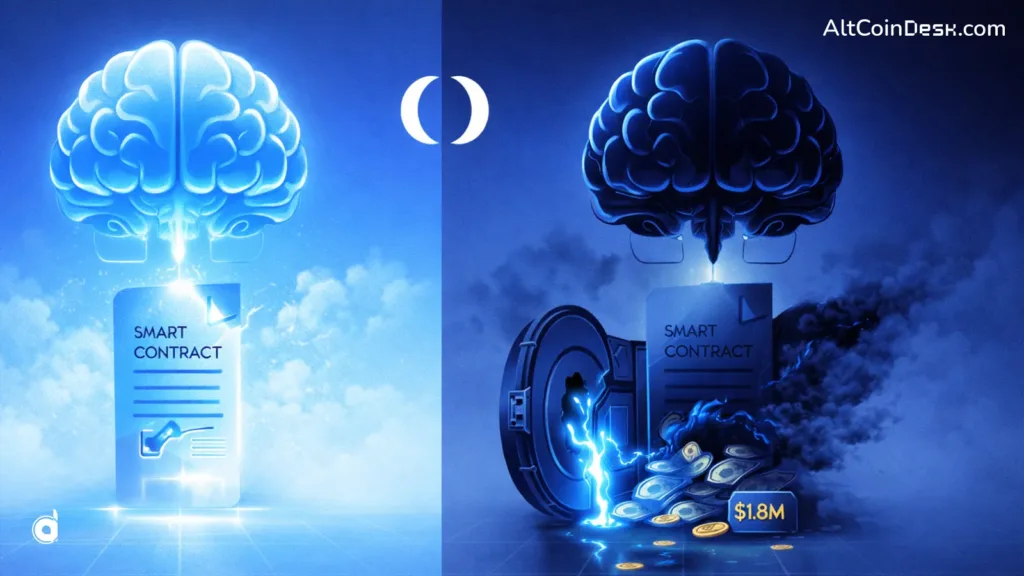
DeFi platform Moonwell runs on Coinbase’s Base blockchain and Optimism. Unfortunately, the platform suffered a major exploit due to a vulnerable smart contract in February. Here, the astonishing part is that AI wrote the code. Quite surprising, right?
Clause Opus 4.6 co-wrote the code for Moonwell, and the AI tool accidentally wrote an incorrect price to the oracle. And the result? Nearly $2 million loss.
Instead of writing $2,200 as the value for the cbETH token, the code read $1.12. Attackers used this moment to drain millions through arbitrage and liquidation.
This incident shows that a lack of robust human audits and reliance on AI-assisted smart contract coding can cause peril.
SCONE-bench, an AI framework to monitor smart contracts
In late 2025, AnthropicAI and scholars from the MATS research program introduced SCONE-bench (Smart CONtracts Exploitation), a research tool to measure vulnerabilities in smart contracts.
In a simulated environment/controlled experiment, the team used a forked blockchain that contained simulated funds. They used real smart contracts and executed them on the blockchain.
The researchers then ran advanced AI models against the SCONE-bench contracts and AI agents could find vulnerabilities, exploit code, and steal nearly $4.6 million in simulated funds.
In brief, Brian Armstrong’s vision for AI is ambitious, but there could be underlying risks that emerge unexpectedly. Heavy reliance on AI to create codes is precisely what the Moonwell incident and the SCONE-bench experiment highlight.