

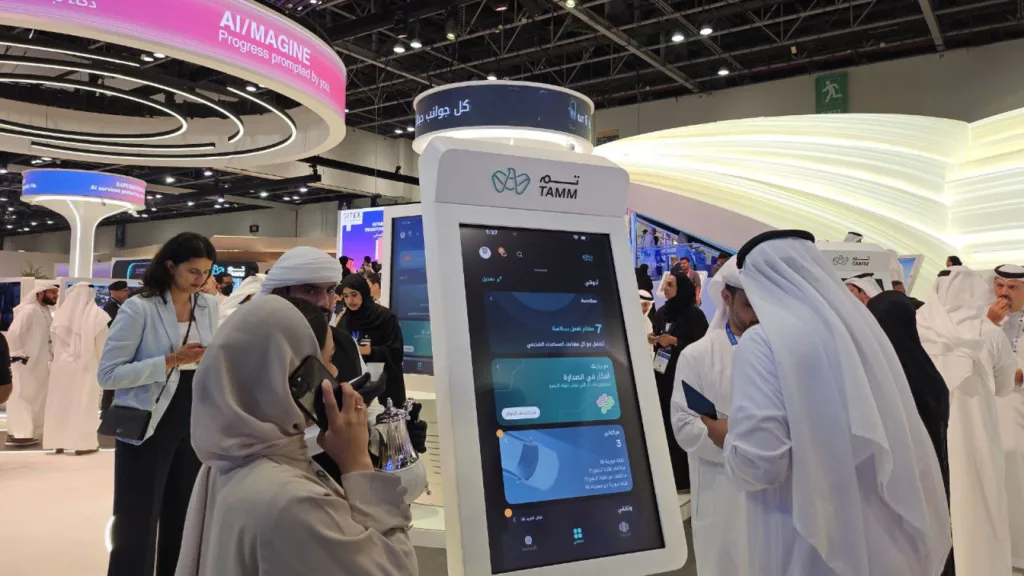

When the Abu Dhabi government unveiled TAMM 4.0 AutoGov at GITEX Global 2025, the announcement wasn’t just another smart service upgrade. It was a declaration that the government itself is evolving from a reactive administrator into an intelligent, autonomous partner.
Billed as the world’s first “AI Public Servant,” AutoGov is the latest evolution of Abu Dhabi’s unified government services platform, TAMM, and the clearest expression yet of the emirate’s ambition to become the world’s first AI-native government. It’s a bold experiment in what experts call anticipatory governance: a model where government doesn’t wait for citizens to act — it acts for them.
From digital convenience to proactive partnership
For years, digital transformation in government has meant moving paperwork online and creating mobile apps. With TAMM AutoGov, Abu Dhabi has gone a step further — beyond digitization and even beyond automation.
The new system can renew licenses, schedule health checkups, and pay recurring bills once activated. It anticipates a citizen’s needs based on life events and available data, then quietly handles the bureaucracy in the background.
“Government is no longer reactive,” said Ahmed Tamim Hisham Al Kuttab, Chairman of the Department of Government Enablement (DGE). “It’s a partner that is intelligent, human-centered, and present at the moments that matter most.”
The promise is simple but profound: a government that gives people back time — their most valuable and finite resource.
A vision rooted in strategy
Behind the glamour of the GITEX launch lies a carefully engineered policy foundation: the Abu Dhabi Government Digital Strategy 2025–2027. Backed by AED 13 billion in funding, the plan aims to re-architect the state around artificial intelligence.
Its pillars include:
- 100% sovereign cloud adoption to keep all citizen data within national borders.
- Full AI integration across public services.
- Data-driven decision-making and predictive policymaking.
- A unified digital framework, embodied in TAMM, to dissolve agency silos.
- It’s not just modernization — it’s redesigning governance itself for a post-digital era.
The road to AutoGov
TAMM’s transformation has been gradual and deliberate. TAMM 3.0, launched at GITEX 2024, introduced the first AI assistant — a conversational agent that guided users through over 800 services. It was helpful but reactive: citizens still had to initiate every action.
By contrast, AutoGov, unveiled in 2025, represents the leap from “assistive” to agentic intelligence. The AI doesn’t just help citizens complete forms — it completes them automatically. The ecosystem has expanded to include 1,100 services and over 90 public and private sector partners, enabling end-to-end transactions across banking, legal, and municipal services.
The one-year interval between these versions wasn’t an accident. It gave millions of users time to get comfortable with AI handling official business, building the trust necessary for autonomous action.
How the AI public servant works
At its core, AutoGov automates the administrative routine of life. It can:
- Renew driver’s licenses or business permits before expiry.
- Handle recurring payments for utilities and fees.
- Schedule annual medical appointments or vaccinations.
- Coordinate multi-step government processes across agencies.
Users retain control and consent — every automated action is opt-in. Through the TAMM app, citizens can customize their automation levels: full automation, approval-based, or manual. Personalized dashboards ensure transparency, showing exactly what the AI is doing on their behalf.
This “human-in-command” design balances efficiency with accountability — a crucial step in earning public trust for a self-operating state.
The invisible architecture behind the scenes
Powering this system is one of the most sophisticated government tech stacks in the world.
TAMM’s AI “brain” uses LangChain and LangGraph, frameworks that coordinate multiple specialized AI agents. These agents manage workflows for service queries, document processing, and real-time decision-making.
Under the hood lies a hybrid AI model strategy as Microsoft Azure OpenAI provides access to frontier language models, and G42’s Compass 2.0, including JAIS, the world’s most advanced Arabic LLM, ensures cultural and linguistic depth.
All of this runs on Oracle’s sovereign cloud in Abu Dhabi, secured with NVIDIA’s Blackwell GPUs for high-performance AI computing. The result is a vertically integrated, sovereign AI stack — from cloud infrastructure to application layer — that keeps data local, private, and fast.
Human touch in a high-tech world
Despite its automation, TAMM’s ecosystem preserves human connection. TAMM Hologram, a network of mobile service pods, enables residents to speak with live government agents via holographic projection, merging digital speed with real empathy.
Meanwhile, TAMM by You invites citizens to co-create the platform by suggesting and voting on new services. It’s participatory governance in action — ensuring the system evolves with its community, not apart from it.
A glimpse of the automated state
TAMM AutoGov isn’t just a platform — it’s a prototype for a new kind of state. One where governance is quiet, predictive, and deeply personalized. One where citizens spend less time filling forms and more time living their lives.
It’s anticipatory governance, made real. And as the world watches Abu Dhabi’s experiment unfold, the question isn’t whether others will follow — it’s how soon.