

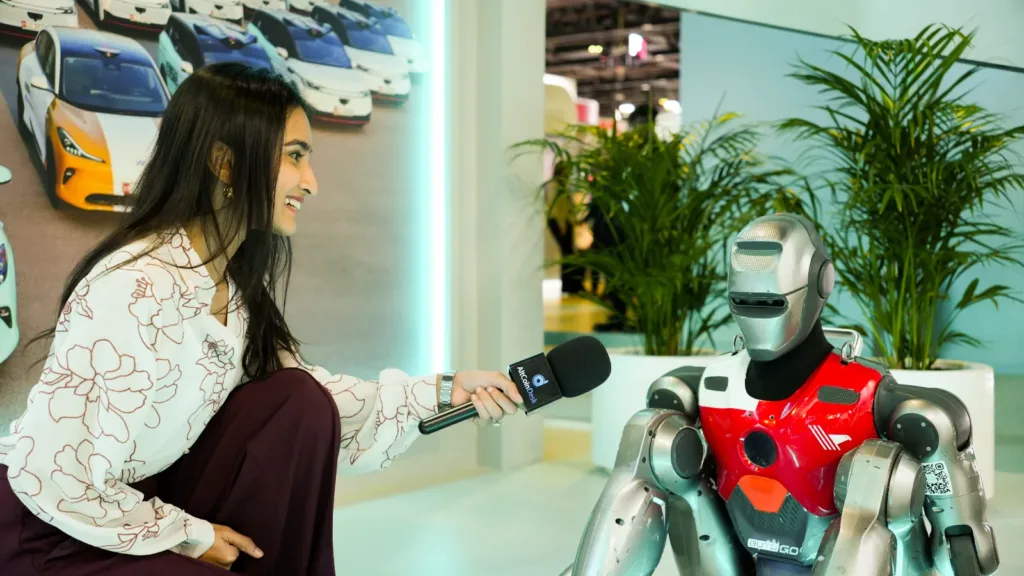

Humanoid robots were the undeniable stars of GITEX Global 2025, blurring the line between mechanical precision and human expression.
Elon Musk’s Optimus set the trend this year. Following the social media frenzy (on X, formerly Twitter) around Optimus’s human-like capabilities, GITEX Global 2025 featured numerous humanoid prototypes. These robots were seen serving coffee, giving fist bumps, answering questions like a chatbot, playing soccer, and even dancing for audiences, redefining what it means to be human-like.
Robots designed to mimic human behavior
The emergence of humanoids seems to stem from a human need for connection. Afreed Ali, Account Manager at Leader Edutech (the exclusive and authorized distributor of Booster Robotics) and one of the humanoid exhibitors, highlighted this trend, noting that humanoids are one of the biggest emerging technologies in the UAE.
“Especially in Dubai and Abu Dhabi, there is interest in replicating human behavior in robots: not to replace people, but to work alongside them, utilizing their intelligence, strength, and capabilities for physical activities,” he said.
While the company works with diverse robotic systems, Ali traced their development from drones to robotic arms and quadrupeds, emphasizing that the growing fascination with robotics is spreading into every sector, including security, healthcare, and education.
Robots designed to assist, not replace humans
In parallel, businesses are exploring how humanoids can bring tangible value to the workforce. Kareem Abu Alragheb, founder of Mangobot LLC, believes humanoid robots are the most commercially valuable segment in robotics, with the potential to dominate the business landscape.
“They can serve as receptionists, manufacturing assistants, workers in hazardous environments, and caregivers in nursing homes. They’re designed to perform repetitive or dangerous tasks, freeing humans for more complex and creative work,” he explained.
However, he noted that the early demos, such as coffee-serving or dancing, are meant to familiarize people with the technology before moving on to more advanced and specialized tasks.
“It needs to be friendly and human-like for people to get comfortable with it,” he said. “When it’s more advanced, it can start performing much more complex tasks. It’s a brand new industry, and we’re still learning its limits. The only way to know is to find out sooner or later.”
Blurring the line between human touch and artificial intelligence
The question now is: how far have we come in transferring human skills into humanoid robots? With technology advancing rapidly, Afreed Ali believes we are “almost there” in terms of giving robots human-like capabilities, especially as developers delve into the integration of humanoids into life sciences.
“It’s almost there. They now play soccer. Who would have thought a year ago that robots would play soccer using their vision, locomotion, and physical strength? They get back up just like real players do. They can play boxing, kung fu, or whatever you want them to do,” he said.
“The future is here,” says Kareem Abu Alragheb. “We at Mangobot Trading are already at mass production. We have software that’s integrated, localized, and built specifically for the Middle East,” he added.
GITEX Global 2025 proved that humanoids are no longer science fiction, but the start of a journey from curiosity to complexity, with the UAE continuing to push the integration of AI across industries.