
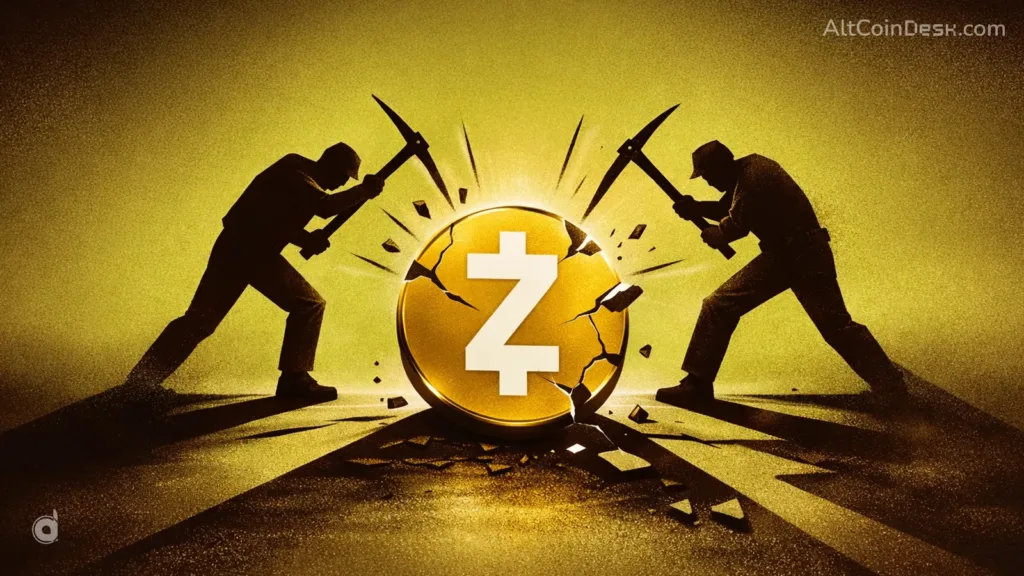

The Foundry Zcash mining pool launch could bring institutional mining infrastructure to privacy coins for the first time. The biggest player in Bitcoin mining is about to shake up a corner of crypto that most Wall Street types quietly wrote off years ago.
Foundry Digital, the New York-based company that runs the world’s largest Bitcoin mining pool, announced that it will launch a dedicated Foundry Zcash mining pool next month. It marks the first time the Digital Currency Group subsidiary has expanded beyond Bitcoin since its founding in 2019.
For the thousands of everyday miners running machines in homes, garages, and small warehouses.
Why a Bitcoin giant is moving to Zcash
Mike Colyer, Foundry’s chief executive, put it simply in the company’s announcement. Zcash has matured into something institutions want to touch, but the mining tools available to them still look like they’re from 2017.
Colyer said institutional investors want exposure to Zcash but have lacked a U.S.-based compliant mining pool built for them.
The new Foundry Zcash mining pool changes that. It launches in April with the same compliance framework Foundry built for its Bitcoin pool, which now controls roughly 30 percent of all Bitcoin mining power worldwide. That means know your customer checks, anti-money laundering procedures, transparent payout systems, and reporting dashboards. These things are boring, essential, and exactly what public companies need.
The privacy coin that wouldn’t die
Zcash launched in 2016 with technology that still sounds like science fiction. It uses something called zero-knowledge proofs, or zk-SNARKs, which let you verify a transaction is real without revealing who sent it, who got it, or how much was moved.
For years, that privacy feature made exchanges nervous. Some exchanges have delisted privacy coins in certain jurisdictions due to regulatory pressure. Regulators gave privacy coins the side-eye.
But something shifted recently. Zcash’s price climbed roughly 600 percent before settling back. The network’s hashrate, the total computing power securing it, more than doubled. A new development group called ZODL raised $25 million from major venture firms, including Paradigm and a16z crypto.
Then there’s Barry Silbert, the founder of Foundry’s parent company, Digital Currency Group. Silbert has publicly argued that privacy-focused digital assets could become a significant part of the crypto market over time.
What the Foundry Zcash mining pool actually looks like
The pool itself has some specific design choices worth understanding. Foundry is expected to use a payout structure similar to the model used in its Bitcoin mining pool. It’s a common model in Bitcoin mining but less common in Zcash. There’s no minimum hashrate requirement, meaning a guy with a few machines in his garage can join alongside a public company running warehouses full of equipment.
Importantly, mining rewards will be paid out through transparent Zcash addresses, not shielded addresses. That’s a compliance decision. It means the pool can show exactly where money is going, which auditors like.
Zooko Wilcox, who created Zcash and now works at Shielded Labs, welcomed the move publicly. He noted that Zcash mining has been concentrated in a single pool for too long, and Foundry’s entry spreads that risk around.

The internal drama nobody talks about
Here’s the part that doesn’t show up in press releases. Much of the Electric Coin Company team resigned earlier this year. They immediately formed a new organization called ZODL and kept building the same wallet software they’d always built. It was messy. It looked bad from the outside. And it’s exactly the kind of turbulence that scares off institutional money.
The Foundry Zcash mining pool launch lands right in the middle of that cleanup effort. When a publicly traded mining company sees an SOC 2-certified, U.S.-based pool run by the same people who handle a third of Bitcoin’s hashrate, the governance drama matters less. The infrastructure matters more.
What this means for regular people
If you’re mining Zcash today, or thinking about it, this changes your options. You now have a pool that’s probably not going to get raided by regulators, not going to run off with your payout, and not going to disappear when the market gets rough.
If you’re just watching from the sidelines, this is a signal. Privacy coins aren’t dead. They’re not just for dark web boogeyman stories. They’re attracting real infrastructure money from real companies with real compliance departments.
Zcash trades around $212, as of this writing, down about 10 percent on the week but still dramatically higher than where it sat a year ago.
The bigger picture
Foundry’s move raises a question the crypto industry hasn’t really answered. Can privacy and regulation coexist?
The company seems to think yes. Their argument goes like this: You can have private transactions on the network while maintaining compliant, transparent operations at the pool level. The mining pool knows who you are. The blockchain doesn’t have to.
It’s a bet that institutions want exposure to privacy technology, but only if they can do it through clean, auditable pipes. The Foundry Zcash mining pool is those pipes.
April is when we find out how many miners actually show up.