

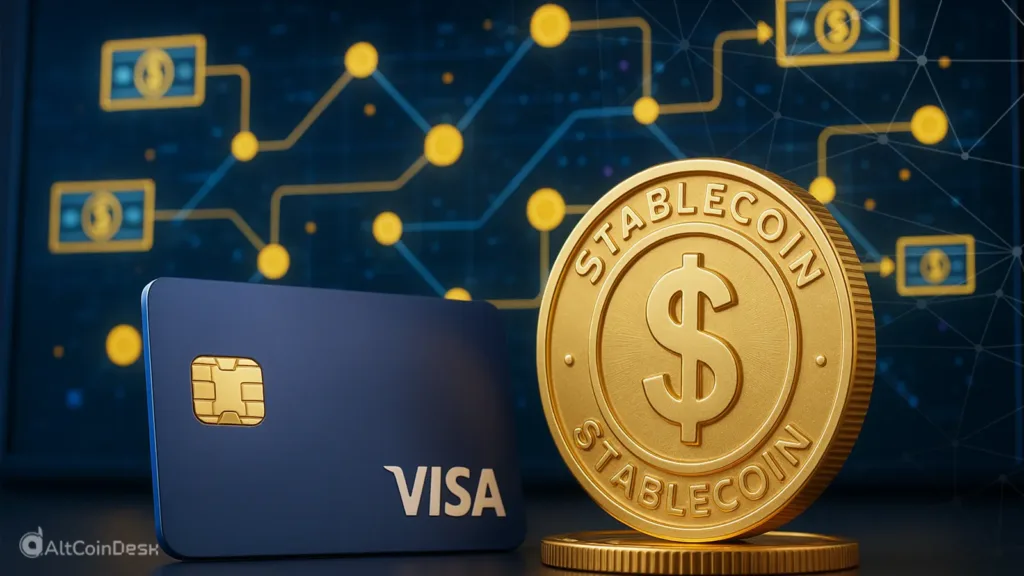

Visa announced Tuesday that it has begun testing a new system that lets businesses fund international payments with stablecoins instead of pre-depositing cash in local accounts.
The move comes after the United States passed the Genius Act, a law that created clear rules for stablecoin issuers. The legislation has given traditional institutions confidence to adopt digital tokens, signaling their growing role in mainstream finance.
Under Visa’s pilot, banks, remittance firms, and other financial institutions can pre-fund Visa Direct with stablecoins such as USDC and EURC, issued by Circle. These balances are treated as spendable funds, allowing payouts to be made instantly while recipients still receive money in their local currencies. The company said the program aims to cut settlement times from days to minutes, freeing up working capital and reducing the need for businesses to hold large cash reserves across multiple markets.
Genius Act changed everything
Mark Nelsen, head of product for Visa’s commercial and money movement solutions, told Reuters, “The Genius Act changed everything. It made everything so much more legitimate. Before that regulatory clarity, all the big institutions were sort of on the fence.”
A Visa spokesperson described the initiative as “real-time, programmable money movement across billions of endpoints.” The pilot will be available in limited form by April 2026, with some partners already running trials. Visa plans to expand the program next year.
The rise of stablecoins—digital tokens pegged to assets like the U.S. dollar—has raised concerns that they could erode the dominance of traditional payment companies and regional banks. Some investors are even betting against regional banks, citing the growing use of blockchain-based finance. Still, Visa’s approach shows how established players may integrate rather than compete with stablecoin technology.
“The amount of software and technology that’s been deployed globally for payments is hard to recreate,” Nelsen said. “So it seems more likely to just incorporate stablecoin technology into existing flows.”
Visa’s pilot could mark a turning point, moving stablecoins from a crypto niche into the backbone of global payments.