
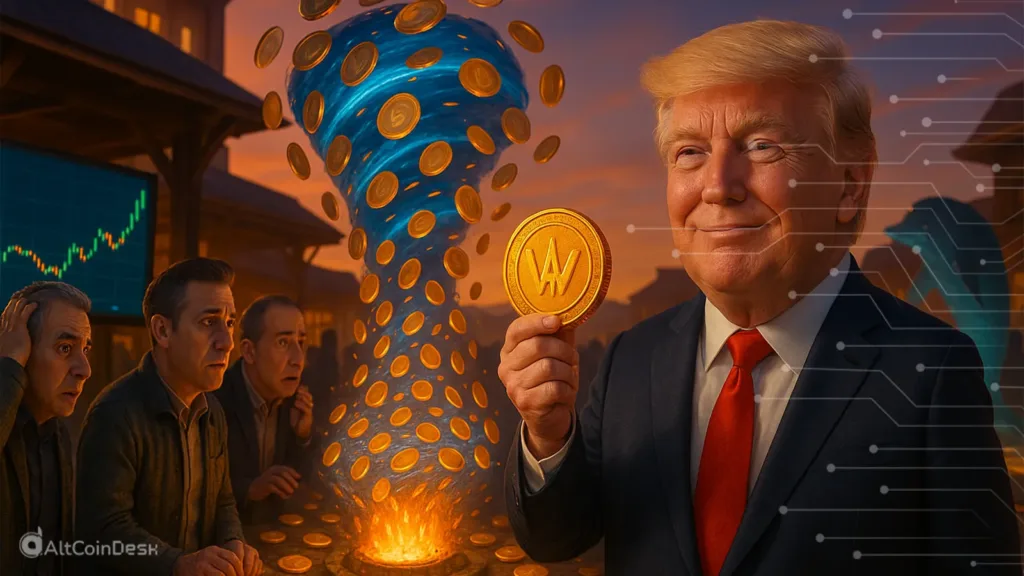

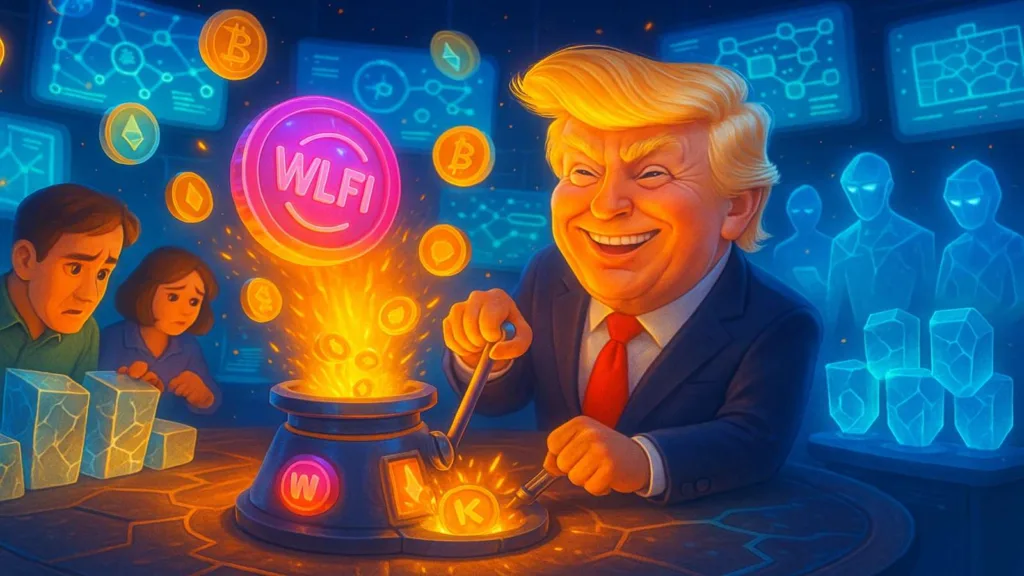
The glaring contradiction at the heart of a $10 million crypto buyback. This move screams confidence. In just six hours, the Trump-family-backed World Liberty Financial (WLFI) deployed a staggering $10 million to repurchase its own tokens.
The immediate effect was predictable: an 8% price surge, breaking a month-long slump and sending chatter across crypto forums into a frenzy. This aggressive crypto buyback was pitched as a masterstroke of tokenomics. But beneath the surface, this maneuver raises a critical question for every investor: are we witnessing a clever strategy to build long-term value or a high-stakes magic trick designed to create the illusion of it?
Breaking news: A $10 million crypto buyback
On November 26, the WLFI project used $10 million of its own USD1 stablecoin to buy back nearly 59 million WLFI tokens on decentralized exchanges. This wasn’t a slow accumulation.
Data from platforms like Arkham Intelligence shows the buying was fast and concentrated, with over $7.79 million spent in one five-hour window alone. This crypto buyback was executed through CoW Swap, a tool that facilitates large trades, and it immediately tightened the available supply of WLFI on the market.
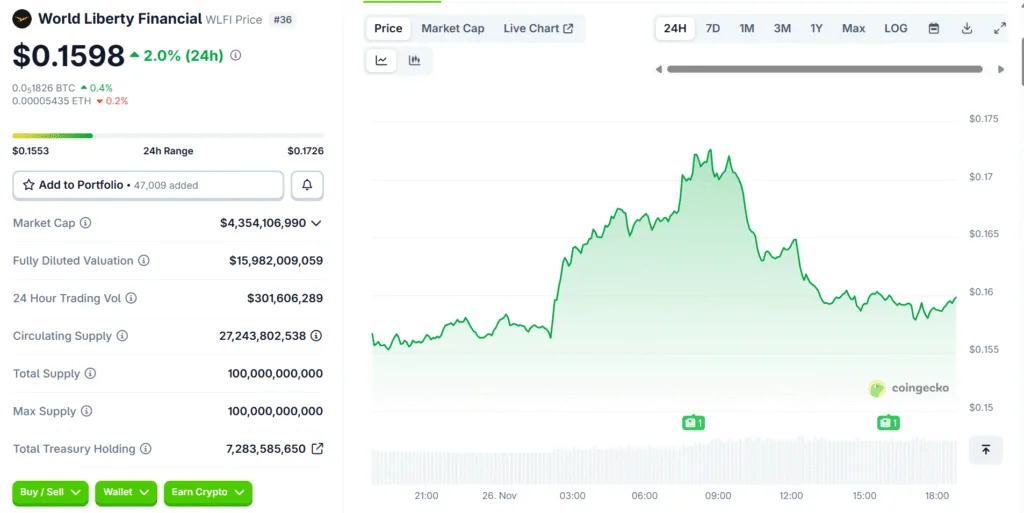
The result was a classic supply-and-demand shock. The token’s price jumped by more than 8%, its trading volume spiked by more than 25% to over $320 million, and it technically broke out of a symmetrical triangle pattern it had been trapped in for weeks.
This crypto buyback operation wasn’t a random act; it was the direct result of a September governance vote in which 99% of participants approved a plan to use all protocol fees to buy back and burn tokens. The message was simple: we believe in our product so much, we’re putting our money where our mouth is.
Beyond the price pump: The crypto buyback playbook
On the surface, the mechanics are sound. By permanently removing tokens from circulation through burns, WLFI aims to create a deflationary model. The theory is simple: if the value of the ecosystem stays constant or grows while the number of tokens shrinks, each remaining token should be worth more. It’s a long-term play to reward loyal holders and signal strength.
The market wasn’t just watching the project’s own moves. On-chain data revealed that large investors, often called “whales,” were also accumulating heavily. In the three days surrounding the crypto buyback, whales snapped up nearly 298 million WLFI tokens, worth about $32 million.
When both the project’s treasury and large, savvy investors are buying at the same time, it creates a powerful narrative of shared confidence. It suggests that those with the most skin in the game see current prices as a bargain.
The Trump card: Political branding as double-edged sword
You cannot discuss WLFI without acknowledging its political heartbeat. The project was founded by Donald Trump and his sons, who serve as co-founders and “Web3 ambassadors.” This connection provides an unparalleled level of visibility and a built-in base of supporters. However, this political backing is a double-edged sword.
The project is now under a microscope. A recent report from House Democrats alleges Trump-linked ventures earned over $800 million from crypto, putting WLFI squarely in the crosshairs of potential regulatory scrutiny.
Furthermore, senators have escalated probes into whether WLFI tokens were sold to sanctioned entities, casting a shadow over its compliance controls. The very political branding that gives it momentum also makes it a target, meaning every crypto buyback headline is balanced on a knife’s edge with regulatory risk.
The other side of the coin: Risks behind the rally
For all the bullish signals, this is far from a safe bet. Let’s not forget WLFI’s history of extreme volatility. After its hyped launch, the token soared to $0.46 before promptly tumbling more than 50% within weeks. A crypto buyback can provide a temporary floor, but it cannot guarantee long-term value without genuine utility and adoption.
Security is another glaring concern. Just in November, the team executed an emergency burn and redistribution of over 166 million tokens after user wallets were reportedly compromised. While the team blamed third-party wallets, the incident shook user confidence.
Perhaps most contradictory for a project in the “decentralized” finance space is its centralized control. The team demonstrated the power to freeze wallets, famously locking Tron founder Justin Sun’s $107 million stake. This ability to blacklist is a powerful compliance tool, but it starkly contrasts with the decentralized ethos of crypto.
The verdict: Smart strategy or speculative theater?
So, where does this leave us? World Liberty Financial’s crypto buyback is a bold, technically proficient move to create a deflationary ecosystem and restore market confidence. It has provided a short-term jolt, demonstrated a clear mechanism for supporting the price, and attracted whale attention.
However, the fundamental challenges remain. The project’s value is inextricably linked to a polarizing political figure, inviting regulatory risks that could overwhelm any tokenomic strategy. Its history of volatility and security scares cannot be ignored.
The current crypto buyback strategy is a powerful engine, but it remains to be seen if the WLFI project has built a car worthy of it, or if it’s simply revving the engine while parked on shaky ground. For investors, the thrill of the buyback must be weighed against the sobering reality of these underlying tensions.