


As the push to adopt cryptocurrencies into the mainstream is becoming increasingly visible, some countries are piloting, while others are launching their own Central Bank Digital Currencies (CBDC). However, if the CBDCs are integrated into the mainstream, privacy will be lost, says a hedge fund manager.
In the backdrop of 49 countries testing CBDCs, including China, Russia, India, and Brazil; about 20 nations already in CBDC development; and 36 researching them, hedge fund manager Ray Dalio raised concern about privacy.
CBDC is an effective controlling mechanism
In an interview, Dalio stated that there is a great deal of appeal because it’s easy for transactions. However, “there will be no privacy, and it will be a very effective controlling mechanism by the government.” By this, he meant that all transactions would be transparent and known to the government, which in a way is beneficial for controlling illegal activities.
Explaining the downside, he stated, “they can take your money” by way of tax, which could be an issue. And in addition, if “you are politically disfavored, you could be shut off,” added the host.
CBDC don’t meaningfully add value for day-to-day money
Analyst Lavneet Bansal mentioned that in many countries, real-time payment systems like UPI, Pix, and PromptPay already handle instant, low-cost payments at scale, so CBDCs don’t meaningfully improve day-to-day money movement.
What they do add is programmability at the state level, the ability to monitor, restrict, or condition how money is used. That shifts digital money from neutral infrastructure to a policy and enforcement tool. Combined with full transaction visibility, CBDCs risk becoming a surveillance layer rather than a genuine innovation.
Analyst Lavneet Bansal
Further, Bansal added that the real question is what problem they solve for users that existing payment rails don’t, beyond giving the state more direct control.
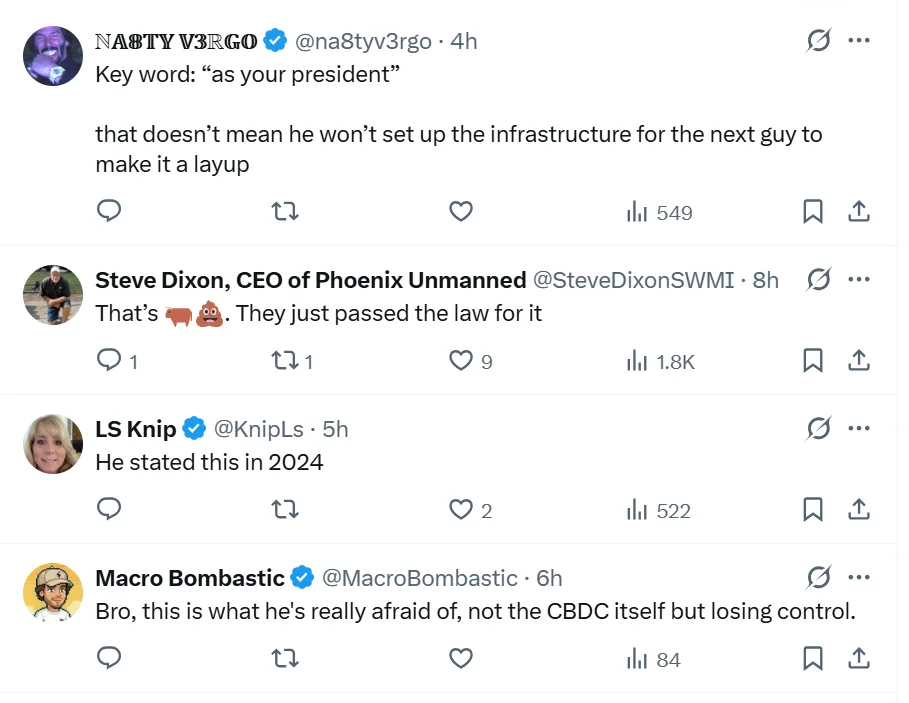
Meanwhile, President Trump promised that he would never allow the federal government to launch a stablecoin. He even signed an executive order titled “Strengthening American Leadership in Digital Financial Technology,” which prevents the federal government from endorsing or issuing a CBDC.
The comments section of the above tweet had some interesting feedback.