



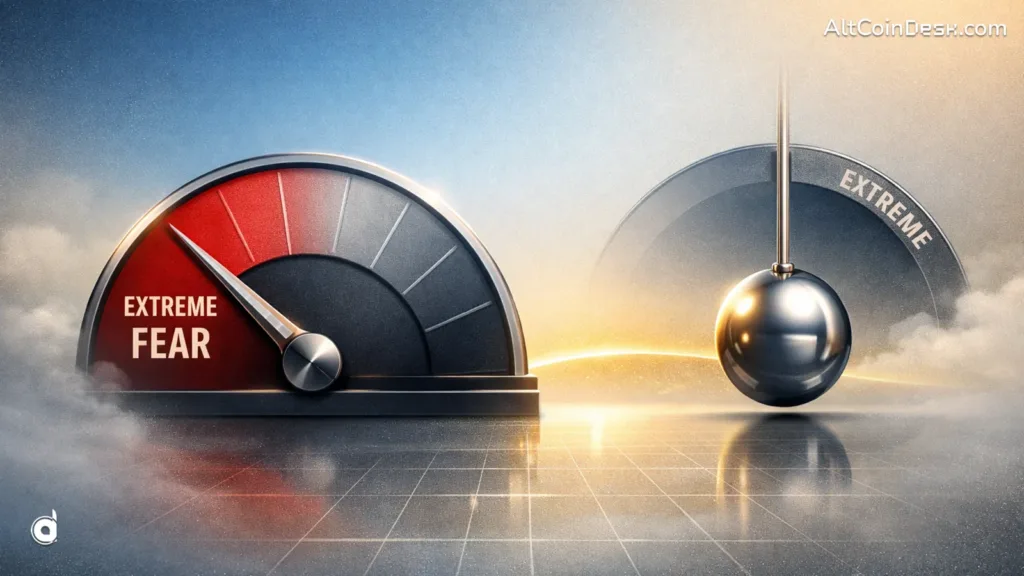
Crypto extreme fear is back in the headlines. This week, Matrixport’s latest alert argued that panic is peaking, which may be signaling a crypto inflection point, the kind that often appears near a crypto market bottom. Basically, they are telling us that when everyone feels sick about their portfolio, we might actually be closer to the end of the pain than the beginning.
Markets are rarely that simple. Crypto extreme fear can hint at opportunity, but it can also linger. The firm’s research notes that when its sentiment indicator’s 21-day moving average drops below zero and then turns upward, durable bottoms have historically formed soon after. But does a scared market really mean it’s time to buy? Could this moment represent a genuine crypto inflection point or another false start in a volatile cycle?
So, let’s sit down and look at what “extreme fear” actually means, whether it has worked before, and what needs to happen next for this signal to turn into real money.
What does crypto extreme fear mean?
To understand where we are, we have to look at the tools we use to measure the room.
You have likely seen the “Crypto Fear & Greed Index” floating around. It is a tool that aggregates market volatility, momentum, social sentiment, and search trends into a 0–100 score. When it is around 80 and above, it means we are greedy and it is party time, usually a top. When it drops below 10, it means we are in crypto extreme fear territory. That is the zone where people stop believing.
Matrixport has its own version of this gauge. According to the notes released this week, their indicator just flashed a very specific technical event: the 21-day moving average of their fear index dipped below zero and is now starting to turn back up.
To a chartist, that “hook” is the story. It suggests that the wave of selling is losing power. The sellers are exhausted. There’s no one left to panic sell because everyone has already sold.
Has extreme fear predicted bottoms before?
Let’s test this theory. I don’t want you to take Matrixport’s word for it, or mine. Let’s look at the tape. Here are the records of the last few times we hit this kind of panic:
- First, look back at March 2020. Remember “COVID Black Thursday”? The world was shutting down, and nobody knew if cash would even work tomorrow. The Fear & Greed Index hit a score of 8 . Bitcoin crashed to $3,800. If you bought that fear and held until April 2021, you were sitting on a 1,400% gain.
- Then there was the FTX collapse in November 2022. The index dropped to 12. Sam Bankman-Fried was on the news, and everyone said crypto was over. Bitcoin traded around $15,500. It took time, almost a year, but the market eventually climbed back to $40,000 and then boomed .
- Sentiment indicators during the 2018 bottom reflected extreme pessimism, similar to what today’s index calls extreme fear. History shows that crypto extreme fear has often appeared near long-term lows, though timing those reversals remains difficult. It doesn’t mean the price rips tomorrow, but it means the selling pressure has historically eased during extreme fear phases, though confirmation typically comes from liquidity and capital flows.
Is this a Real Inflection Point or a False Signal?
Here is where I earn my keep by playing devil’s advocate. While the sentiment signal is flashing “buy,” we have to look at why we are scared.
If you read the macro headlines today, there is plenty to be scared about. We have tariff tensions between fed rate expectations that are making global markets jittery. Bond yields in Japan and the U.S. are rising, which sucks money out of risky assets like crypto.
Here is the catch: In previous cycles, when the index drops into single digits (like it did just last week), the bounce was explosive . But this time, institutions are acting differently. In the past, “smart money” stepped in to buy the dip. Recent ETF flow data has shown periods of net outflows, suggesting that large institutional buyers are not yet aggressively stepping in.
So, is it a false signal? Possibly, if the macro situation gets worse. Extreme fear tells us sentiment is washed out. It doesn’t tell us that the Fed is going to cut rates tomorrow. We need to separate the signal from the noise.
What indicators confirm a crypto bottom?
If you are sitting on cash right now, and I hope you kept some powder dry, you don’t want to catch a falling knife. You want to wait for confirmation.
So, what confirms the “inflection point” that Matrixport is talking about?
- First, watch the ETF flows. We need to see a consistent turn from outflows to inflows. Right now, we are seeing the opposite; Recent ETF flow data has shown mixed signals, with some sessions seeing net outflows. When that reverses, that is your first clue.
- Second, look at stablecoin supply. If you see the total supply of USDT and USDC start to pump, it means money is moving back into the crypto ecosystem, ready to buy .
- Third, watch the whales. On-chain data from late 2025 showed significant whale accumulation during dips. If you see that accumulation continuing even as prices stay low, it tells you that the people with the biggest wallets think the worst is over.
The verdict: Where does that leave us?
The crypto extreme fear signal is a powerful emotional compass. It tells us we are at the part of the movie where the hero has lost everything and is about to get back up. Matrixport is right to highlight it. Historically, these are inflection points.
But we are living in a different world now. Crypto is tied to the stock market and interest rates. We cannot just rely on a sentiment index.
My take? Be cautiously optimistic. The fear is fuel. But wait for the macro engine to turn over before you step on the gas. Watch those ETF flows. If they turn green, the smart money is confirming what the fear index is suggesting: that this is the bottom.