


There is a strange place on the internet where revolutions go to update their resumes. It is called LinkedIn.
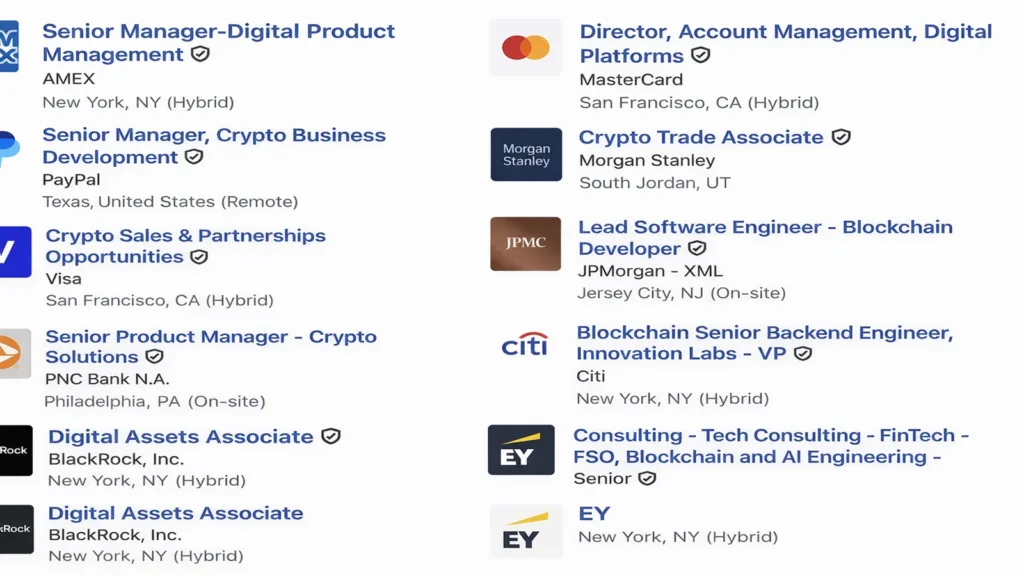
A few years ago, cryptocurrency was considered a controversial topic. In 2017, it was called a scam. In 2021, it was a bubble. In 2026, something quieter is happening. JPMorgan is hiring blockchain engineers. BlackRock is recruiting digital asset associates. Visa wants crypto sales teams. Morgan Stanley is building out trade roles. Citi is staffing innovation labs.
You can ignore prices. You can argue about cycles. But you cannot ignore crypto talent migration. Because when the biggest financial institutions in the world begin hiring for blockchain and digital asset roles, that is not a meme. That is structural. And structural shifts rarely come with fireworks. They come with job descriptions.
This is the real bull market, not candles, not hype, but crypto talent migration.
The day the revolution got a corporate badge
A young blockchain developer walking into a glass tower with a JPMorgan badge clipped to her jacket. Somewhere, a 2017 Reddit thread just fainted. The irony is delicious. Crypto promised to remove the middleman. Now the middleman is hiring.
But here is where it gets interesting. When I asked Emre Davide Oral whether Wall Street’s entry into crypto strengthens the ecosystem or dilutes its mission, he did not hesitate.
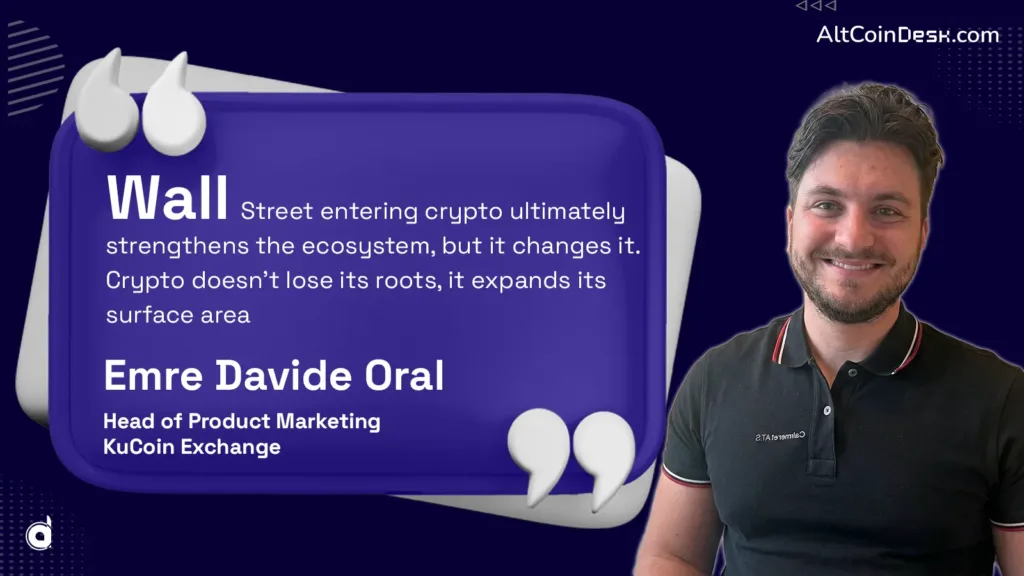
“I believe Wall Street entering crypto ultimately strengthens the ecosystem, but it changes it,” he said. “Institutional capital brings compliance frameworks, liquidity, infrastructure, and legitimacy. That accelerates adoption.”
Strengthens it. Changes it. That is not surrender. That is evolution. He added something even sharper. “Does it dilute the original mission of decentralization? It can if the industry forgets why crypto was built in the first place. But I see it more as evolution than dilution. Crypto doesn’t lose its roots; it expands its surface area.” Expands its surface area. That line alone is a thesis.
Crypto did not abandon its roots. It grew new branches. And those branches are now growing inside banks.
Follow the job listings, not the charts
We obsess over price. We argue about volatility. We treat Bitcoin like a mood ring. Meanwhile, something calmer is happening in the background. BlackRock does not hire digital asset associates for fun. JPMorgan does not post blockchain engineering roles as a hobby. Morgan Stanley does not build crypto trade desks because someone tweeted bullish emojis. Hiring is expensive. Training is expensive. Strategy is expensive.
Crypto talent migration is not retail speculation. It is boardroom approval. This is not fear of missing out. This is the fear of being left behind. Or is it?
Is crypto talent migration driven by conviction or competitive fear?
On crypto talent migration, it’s rarely just one thing. Some are driven by conviction in the long-term shift toward digital assets. Others are driven by competitive pressure and the realization that ignoring crypto is no longer an option.
Emre Davide Oral: Head of Product Marketing—KuCoin Exchange
That is refreshingly honest.
Then he added the part that matters. “In my experience, the smartest institutions aren’t moving because of fear. They’re moving because they see structural change happening in finance.” Structural change. Not hype. Not a trend. Not an experiment. Structural.
When institutions talk about structure, they are not talking about a weekend trade. They are talking about the next decade. That is why crypto talent migration feels different this time.
Crypto did not win; it got hired
There is an uncomfortable truth hiding in all this optimism. If Wall Street builds the rails, does crypto still feel rebellious? The cypherpunks imagined freedom from banks. Now, banks are building custody, tokenization platforms, and compliant trading desks.
The revolution did not overthrow the system. It got absorbed into it. But maybe absorption is how ideas scale. Maybe decentralization was never about eliminating institutions entirely. Maybe it was about forcing them to evolve. If JPMorgan hires blockchain engineers and launches products on public rails, that is not a defeat. That is adaptation. Crypto did not disappear. It walked into the boardroom.
Identity crisis meets corporate strategy
Now that institutions are here, crypto has an identity problem. Is it a parallel system? Is it fintech with better marketing? Is it just infrastructure inside traditional finance?
If crypto becomes fully integrated into the financial system, what exactly changes? Perhaps the change is subtle. Settlement times shrink. Transparency improves. Access widens. Or perhaps the deeper change is psychological.
When a young graduate chooses between a hedge fund analyst role and a digital asset strategy role at the same bank, that choice matters. Crypto talent migration is shaping the next generation of financial decision-makers. The people who once mocked tokens are now building them. That shift is cultural, not just technical.
Crypto jobs do not equal freedom
Let us not romanticize everything. More crypto jobs do not automatically mean more decentralization. Institutions bring compliance. Compliance brings oversight. Oversight can bring control.
A token issued by a bank is not the same as a token born on a permissionless network in someone’s garage. There is a risk that crypto becomes cleaner, safer, and more regulated, but also more centralized.
Emre acknowledged that tension. Institutional participation can change the ecosystem. It can dilute the mission if the industry forgets why crypto was built. That warning matters. Crypto talent migration can either strengthen the roots or pave over them. The outcome depends on whether builders remember the original promise.
The real bull market is human
Here is the quiet punchline. Markets rise and fall. Narratives flip. Headlines scream.
But people move slowly. When engineers, product managers, compliance officers, and executives shift their careers toward digital assets, they are voting with something more serious than capital. They are voting with time. Time is harder to reverse than price.
Crypto talent migration is not loud. It does not trend every day. It does not come with laser eyes. It comes with contracts. Salaries. Strategy decks. And that may be the most bullish signal of all. Because revolutions that survive do not stay underground forever. They build teams. They hire. They integrate.
Crypto talent migration is not just a workforce trend. It is a signal that finance itself is being rewired from the inside. You can call it evolution. You can call it absorption. You can call it an institutional takeover. But you cannot call it irrelevant. The real bull market is not in the tokens. It is in the talent.