
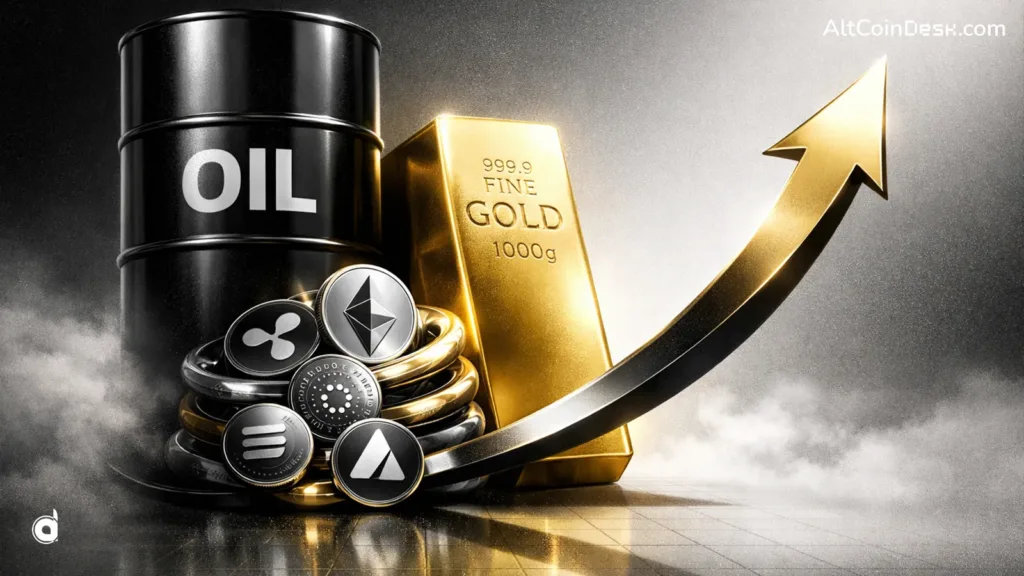

As war premiums build in commodities, traders now ask whether altcoins after Iran strikes could outperform if oil and gold reverse.
The news hit like a thunderclap. Last weekend, strikes in the Middle East reignited the fuse on an already smoldering geopolitical powder keg. And just like the textbooks say, the old-world assets jumped. Gold, the eternal safe haven, shot higher. Oil, the lifeblood of the global economy, spiked on fears that the Strait of Hormuz, through which a fifth of the world’s crude flows, might get squeezed.
But if you were watching the crypto tickers late Sunday and into Monday, you saw a different story. Bitcoin didn’t act like gold. It acted like a scared tech stock, dipping below $63,000 before catching a shaky bid.
This split personality, old money running to metals, new money running for cover, creates the most fascinating setup I’ve seen in years. It forces us to ask a question that could define your portfolio in March: If oil and gold reverse, do altcoins become the smartest trade in the room? What do we expect from altcoins after Iran strikes?
Let’s break this down, the way we used to do on the desk before algos took over.
The “panic trade” is crowded
First, we have to look at what just happened in the commodities pits. There’s a concept veteran strategist Mike McGlone from Bloomberg Intelligence keeps hammering home, and it’s worth listening to. His thesis, which Bitcoin.com and others picked up, is simple: Gold and oil were already “priced for” an Iran escalation.
Think of it like air in a balloon. Before the strikes, a lot of fear, what traders call “war premium,” was already blown into gold and oil. When the actual event happened, the question wasn’t “will they spike?” It was “Can they spike higher?”
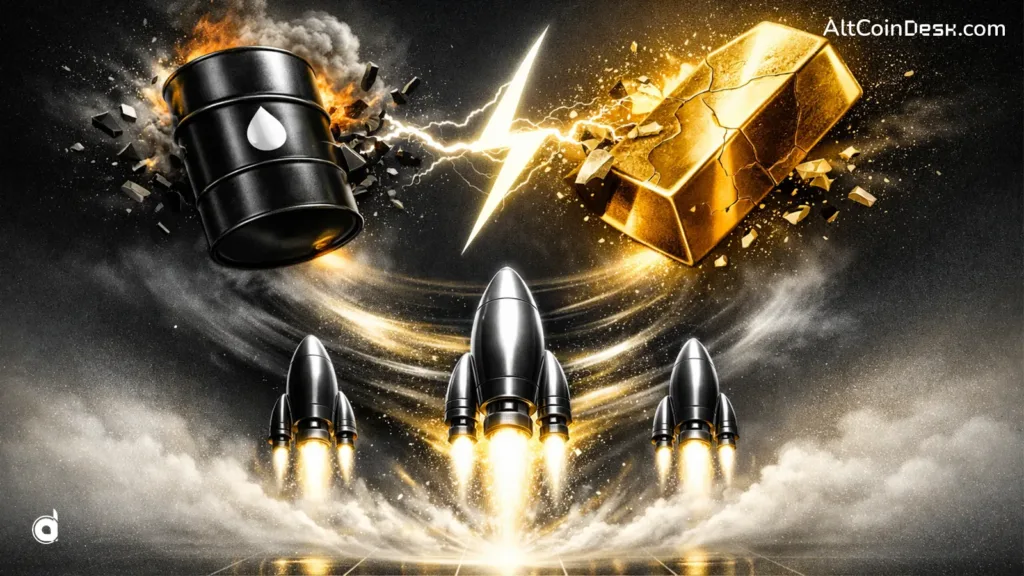
If the conflict doesn’t actually shut the Strait, if the tankers keep moving, that air comes out of the balloon. That’s “mean reversion.” And when money flees a crowded trade in commodities, it has to go somewhere.
Why Bitcoin flinched (and why that matters for alts)
So, if commodities are looking toppy, why did Bitcoin look shaky? Because in the first 24 hours of a “risk-off” shock, computers sell first and ask questions later. Bitcoin is still treated by the big Wall Street algos as a high-beta tech trade. When the VIX (the fear index) jumps, they liquidate the volatile stuff to raise cash.
We saw it in the data. Spot Bitcoin ETFs saw outflows. Leverage got cleaned out. But here is the secret the headlines won’t tell you: That flush might have been the fake-out.
If you believe the macro thesis, that oil is about to cool off and gold is due for a breather, then the liquidity dynamics flip 180 degrees. If oil drops back toward $65 and the inflation panic subsides, the narrative around Fed rate cuts comes roaring back. The dollar softens. The “risk-on” switch flips.
And what is the most “risk-on” asset class in the history of financial markets? Altcoins.
The technical setup: Watching the dominoes fall
I’m looking at three charts right now that tell me the pieces are in place for a potential altcoin rally.
- First, Oil (WTI). It gapped up on the news, but the Relative Strength Index (RSI) is flirting with overbought territory. If we get a headline suggesting diplomacy, that gap could fill fast. A 5% to 8% drop in oil this week would be the green light.
- Second, Bitcoin Dominance (BTC.D). This measures Bitcoin’s share of the total crypto market. During the panic, dominance usually spikes because people sell their risky alts for “safer” Bitcoin. But if you look at the long-term trends, analysts at Talos point out that while dominance is high, the market is hungry for altcoins with real utility. If dominance rolls over and starts heading down from that peak, it means money is rotating out of Bitcoin and into the altcoin sea.
- That brings us to the third chart: TOTAL3 (the market cap of all crypto except Bitcoin and Ethereum). This is the altcoin barometer. It got knocked down this weekend, but it’s holding a crucial support level.
If the dominoes fall, oil is down, the DXY (Dollar Index) is down, and Bitcoin dominance is down, TOTAL3 should rip higher.
The play: Not all alts are created equal
We aren’t in 2021 anymore. You can’t just throw darts at a board of meme coins and call it a day. Data shows that capital is concentrating in the top tier of altcoins; the top 10 altcoins now make up over 80% of the sector’s value.
So, when we look for altcoins after Iran strikes, we need to be surgical. Look for the liquid, high-beta plays that got washed out but have strong fundamentals.
- Solana (SOL): The ecosystem took some hits, but it’s battling to hold that $80 support level. If risk appetite returns, SOL is the Ferrari of the altcoin world; it accelerates fast.
- Ethereum (ETH): The laggard. It’s frustrating to hold, but if the macro tide lifts all boats, the ETH/BTC ratio is so beaten down that a mean reversion trade here could be explosive.
- The Layer-2s (ARB, OP): These are the leveraged plays on Ethereum. If ETH breathes, these could sprint.
To sum up: Analysing altcoins after Iran strikes
Here is the takeaway for the layman. We are at a crossroads. If the Middle East situation spirals into a true supply crisis, oil goes to $100, and everything risky, including altcoins, gets crushed by the inflation wave.
But right now, the market is priced for the worst. And as any old trader will tell you, when everything is priced for the apocalypse, and the apocalypse doesn’t come, the reversal can be violent. The altcoin market outlook for 2026 doesn’t have to be bleak. It might just depend on whether oil and gold decide to give back their war gains.
Watch oil this week. If it cools, don’t chase the spike. Chase the rotation. The money leaving the bomb shelters in commodities might just find its way into the casino. And right now, the casino is selling altcoins at a discount.