


Crypto wallets were once simple tools, quiet digital vaults designed to store assets and little more. Jamie Elkaleh believes that era is over.
Speaking with AltCoinDesk, the Chief Marketing Officer of Bitget Wallet describes a shift that is already reshaping how people interact with digital finance. Wallets are no longer passive storage. They are becoming active, everyday financial tools, capable of paying bills, earning yield, and replacing traditional banking touchpoints.
“If I had to describe Bitget Wallet in a few words,” Elkaleh says, “it would be the freedom of finance when it matters most in everyday life.”
From storage to daily utility
Elkaleh argues that wallets have evolved alongside user behavior. Early crypto users needed fast access to assets for trading. Today’s users want far more. They want to trade across chains, earn on idle funds, and spend digital assets without friction.
Bitget Wallet now supports activity across more than 130 chains, but the company’s focus is less about scale and more about relevance. According to Elkaleh, the real transformation lies in payment and remittance.
Based in Dubai, he sees firsthand how broken traditional remittance systems remain. Sending money home can still be slow, expensive, and unpredictable. Digital currencies, he says, solve that problem by settling payments in seconds.
“In regions like the Middle East, remittance is not theoretical; it is a daily reality for millions of people.”
Jamie Elkaleh (CMO – Bitget Wallet)
Inflation, access, and choice
Elkaleh points to countries such as Turkey to illustrate why access matters. High inflation has steadily eroded the value of local savings, pushing people to search for alternatives.
Digital currencies and stablecoins offer that choice. For the first time, users can hold dollar-denominated value digitally, earn yield on it, and withdraw at any moment. In some cases, Bitget Wallet users can earn yields approaching 10% APY, a feature largely unavailable through local banking systems.
“Choice is powerful,” Elkaleh says. “But choice only matters if it comes with services.”
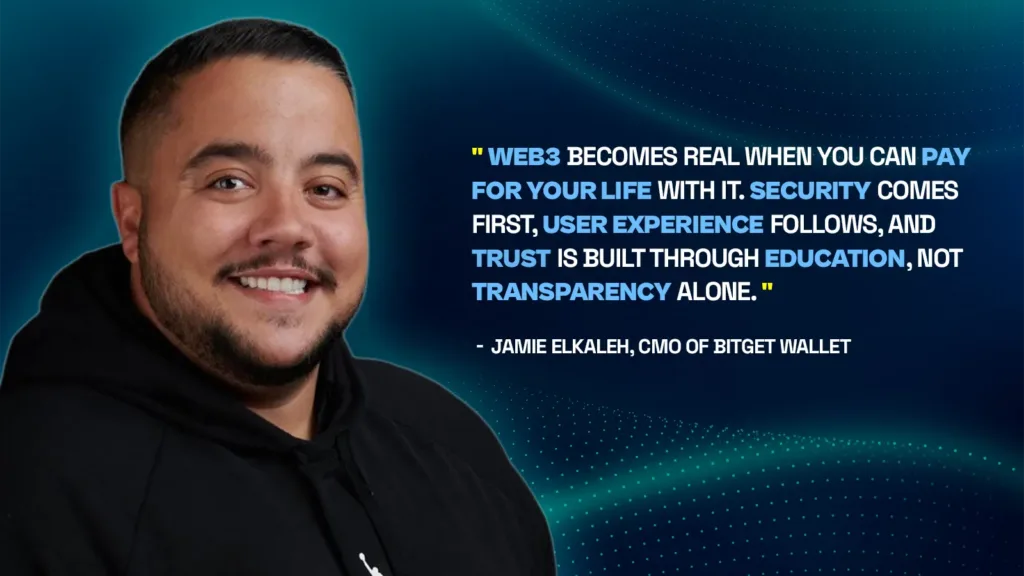
Paying with crypto, not just holding it
The wallet’s payment features are where Elkaleh believes Web3 becomes tangible. Users can pay through crypto cards linked to global payment networks or scan QR codes for daily purchases. For him, this is not a future vision. It is how he lives today.
He has paid for flights, hotels, theme park tickets, and even his car using crypto via Bitget Wallet. The experience, he says, benefits both sides. Merchants receive instant settlement. Users live fully within the digital economy.
“This is what a Web3-native life actually looks like,” he says.
Trust, transparency, and responsibility
Transparency alone does not create trust, Elkaleh argues. Everything Bitget Wallet builds is on-chain and publicly verifiable, but education and responsibility matter just as much.
The company invests heavily in educational content, in-app warnings, and user guidance. It has also established a protection fund backed by approximately $700 million to cover potential product-related incidents.
“Security is always number one,” Elkaleh says. “User experience never comes at the expense of safety.”
A personal mission shaped by inequality
Elkaleh’s passion for Web3 is deeply personal. Before crypto, he spent 11 years in professional rugby. His perspective on finance, however, comes from family.
English by nationality and Egyptian by heritage, he has seen how access to financial services varies drastically based on geography, sometimes even within the same city.
“That inequality never made sense to me; I believe in free, open, and fair finance built for everyone.”
Jamie Elkaleh (CMO – Bitget Wallet)
Looking toward 2026
Bitget Wallet plans to roll out an expanded suite of payment-focused products in 2026, guided heavily by user feedback and regional needs. Elkaleh believes stablecoin adoption will continue accelerating, following significant growth already seen in 2025.
More broadly, he sees on-chain identity and self-custody unlocking services that mirror, and in some cases improve on, traditional banking.
“This is not about replacing banks overnight,” he says. “It is about giving people real options.”