



Recently, AltCoinDesk had the opportunity to speak with Ethan Buchman, the co-founder of Cosmos – an enterprise-grade blockchain – and the founder of Cycles Protocol, an open clearing protocol enabling the clearance of debts in a private, secure, and accessible way.
In the interview, Buchman touched on the factors that inspired him to build Cycles, the impact of real-world assets (RWAs) on decentralized finance (DeFi), potential regulatory challenges facing Cycles, and a lot more. The interview follows below.
Conversation with Ethan Buchman, Founder of Cycles Protocol
1) What inspired you to build Cycles as an on-chain clearing protocol rather than using existing DeFi infrastructure?
Buchman: The most powerful financial technology in existence is clearing. It’s what allows banks to be banks, and they’ve been clearing for hundreds of years, allowing them to net out huge amounts of debt with little or no money. But no one else has access to clearing.
The only ability you have to clear is if you use Splitwise to net out expenses with small groups of friends. Everyone in between the largest financial institutions and small groups of trusted friends is systematically cut off from clearing.
An on-chain Cycles Protocol fundamentally changes all that. But existing DeFi apps are built for a world without clearing – they’re stuck in the same worldview as mainstream economics, that we live in a spot-market of assets flying around.
2) What were the hardest technical challenges in building a generalized clearing protocol?
Buchman: We’ve built the world’s first Shielded Graph, a privacy-preserving, graph-based clearing and settlement system. It’s an implementation of the core insights from the Cycles Whitepaper, allowing capital-efficient multi-lateral settlement across a wide range of participants, liquidity sources, and credit lines.
Making all of that fully privacy-preserving via encryption and zero-knowledge proofs was quite an engineering lift, especially proving that large multi-lateral settlements are valid in ZK. We’re currently using a circuit with ~2M constraints for that.
Making the Cycles Protocol more programmable is an ongoing R&D. Cycles enables entirely new ways to approach building financial applications that allow capital-efficiency to be built in from the start – that means more capital-efficient DEXs and lending protocols.
Surfacing all that to devs is an ongoing technical challenge 🙂
3) How do you see the rise of RWAs impacting DeFi over the next 12–24 months?
Buchman: The focus on RWAs is a symptom of a broader misconception. What we really need are Real World Liabilities (RWLs). And not so they can be turned into assets and traded, but so that we can unlock the liquidity hidden in the obligation graph via cyclic settlement flows.
While RWAs are one of the industry’s most exciting developments, they do not address the deep problem in the economy: hidden liquidity bottlenecks. Until that is addressed, both on and off-chain commerce will continue to operate inefficiently, using more capital than necessary, stifling long-term potential, and bearing unnecessary liquidity risk.
That said, once we bring the obligation network on-chain, we can also use RWAs as a liquidity source themselves, allowing them to be used for settlement within the wider obligation graph. Cycles makes it possible to use any asset as a medium of exchange!
4) Are there regulatory challenges that Cycles needs to navigate as adoption grows?
Buchman: For Cycles, we have the same regulatory challenges that everyone in this industry has right now, which is a lack of clarity. We, like most teams building in this industry, are closely monitoring where the regulatory landscape will settle (pun intended) in the coming weeks and months.
Ultimately, clear regulatory standards help the industry evolve from the same baseline and framework. We believe privacy, self-custody, and open-source development are fundamental human rights that need to be protected.
5) How has your experience co-founding Cosmos informed your thinking on Cycles?
Buchman: I built Cosmos to solve hard problems in blockchain infrastructure. We completely changed the landscape of how people think about and build blockchains, and I’m proud of that.
Now I’m turning my attention to hard problems in settlement infrastructure. Cosmos at its heart followed a vision of crypto beyond speculation and hype, connecting fragmented systems in a multi-chain world. Cycles is a natural extension to that thinking.
We are going back to the very basics, combining the first principles of double-entry bookkeeping with graph theory to unlock hidden liquidity and enable new ways to build financial applications that serve the world’s communities.
6) Are there misconceptions about clearing or capital coordination in crypto that you want to debunk?
Buchman: The biggest misconception is that crypto models the world in the same way as mainstream economics – two unlikely bedfellows. They both view the world as a giant multi-asset spot market, where goods are bartered in real-time.
Hence all the rhetoric about counterparty-free assets that can settle instantly, 24/7. But the world doesn’t work like that – most of commerce runs on credit, and the largest form of financing for non-financial companies is actually trade credit, where they’ve shipped goods/services and are owed later (say in 30 days).
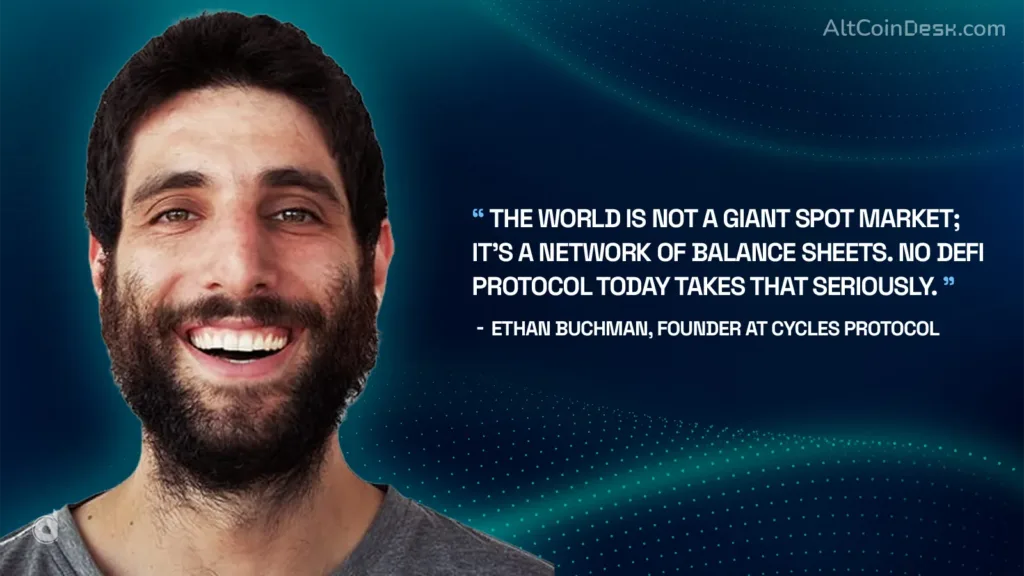
It’s these liabilities that represent untapped liquidity, and almost nobody’s talking about them. The world is not a giant spot-market of goods, it’s a network of balance sheets! Everyone, crypto included, seems stuck in a bilateral, transactional view of the world and settlement. We’re trying to zoom out and look at things from a multilateral, network view.
The thing blockchains do really well is atomic multilateral settlement – but we haven’t begun to really take advantage of this because we’re only thinking about assets, and not the liabilities. Cycles refocuses on the liabilities. In fact, in the Cycles model, every asset can itself be represented as a liability, and thus incorporated into the clearing!
7) Do you have a bold prediction for institutional adoption of DeFi in 2026?
Buchman: Cycles will clear millions 🙂