


In a crypto industry that has largely embraced transparency as the norm, Zano is going in the opposite direction. The project is built on a simple idea: privacy shouldn’t be optional – it should be the default.
In a conversation with AltCoinDesk, Quentin Van Welson explains why that distinction matters and how Zano is trying to push privacy beyond a niche use case into something far more practical.
From privacy coin to something bigger
At first, Zano sounds like something the market has seen before. “The easiest way to explain it is that it’s a privacy coin,” Quentin says. But he quickly adds that this framing doesn’t quite capture what the project is trying to do.
Zano is a Layer 1 blockchain where users and developers can launch their own tokens – except those tokens inherit the same built-in privacy as the base network. “You can tokenize pretty much anything,” he says, “but with real privacy, not as an add-on.”
That “always-on” aspect is key. Unlike many projects that treat privacy as a feature you can toggle, Zano enforces it at the protocol level. Quentin compares it to Monero, but with a broader scope. The connection isn’t accidental – the project’s founder created the Cryptonote codebase that underpins Monero itself.
Why privacy still matters
Quentin is aware of the stigma around privacy coins. The assumption, he says, is that if you want privacy, you must have something to hide. He doesn’t buy that argument.
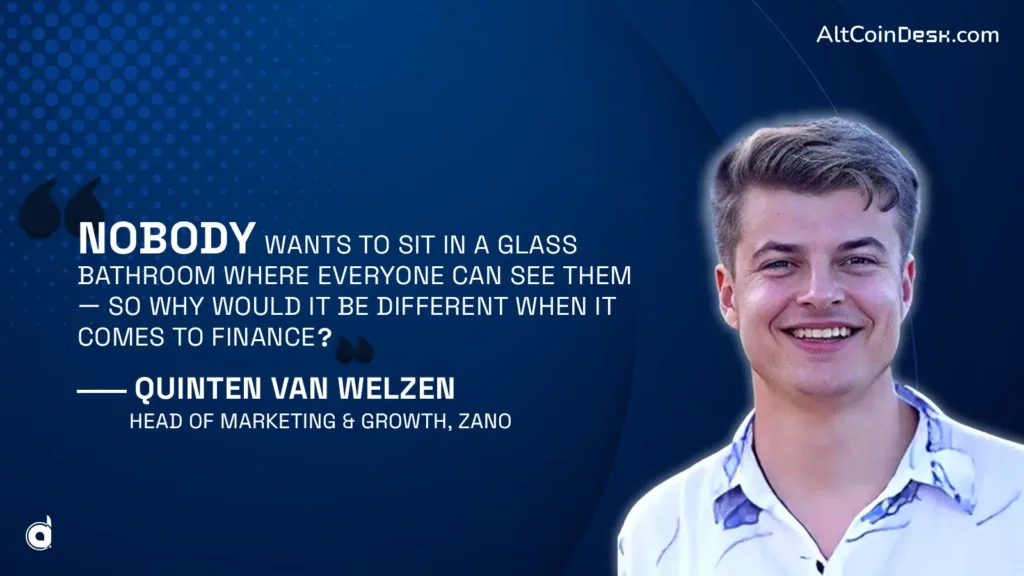
It’s a simple analogy, but it lands. Traditional banks, for all their flaws, don’t broadcast your transactions to the world. Public blockchains, on the other hand, do exactly that. Networks like Bitcoin and Ethereum make it possible to trace balances and activity – sometimes all the way back to a real-world identity.
That visibility isn’t just theoretical. Quentin points to a growing number of real-world incidents where individuals have been targeted because their holdings were publicly exposed. Even outside of extreme cases, transparency opens the door to things like front-running and MEV, where others can profit simply by seeing what you’re about to do.
For businesses, the problem is just as obvious. “No company wants its treasury or strategy visible to competitors,” he says. Privacy, in that sense, starts to look less like a luxury and more like a requirement.
Fixing the old trade-offs
One of the long-standing issues with privacy tech is that it tends to slow things down. More privacy usually means more complexity, and more complexity often means worse performance.
Zano is trying to get around that. The network currently runs on a hybrid model but is moving toward full Proof-of-Stake, which Quentin says will make a noticeable difference. The goal is faster blocks, fewer confirmations, and near-instant finality – closer to what users expect from modern Layer 1s.
There’s also a more unusual feature already live: Proof-of-Stake with hidden amounts. In simple terms, it lets users stake without revealing how much they hold. It’s the kind of detail that doesn’t grab headlines, but it fits the broader philosophy – privacy shouldn’t stop at transactions.
Drawing a hard line on backdoors
If there’s one area where Quentin doesn’t hedge, it’s backdoors. The question comes up often in discussions around regulation: should there be some form of access for authorities?
His answer is immediate. “No. That defeats the entire purpose.”
Instead, Zano leans on selective transparency. Users can choose to share specific information if they need to – say, for compliance or auditing – but the default remains private. It’s a reversal of how most blockchains work today, where everything is public unless you go out of your way to hide it.
At the same time, the team is trying to make the system easier to plug into. A feature called gateway addresses is designed to help exchanges and services integrate with Zano without dealing with the full complexity of a privacy chain. These addresses are transparent and account-based, which brings down the barrier for adoption while keeping user-level privacy intact.
Coming full circle
Quentin says he sees all of this as part of a broader shift in crypto. Privacy, he argues, was always part of the original vision. He points to Satoshi Nakamoto, who discussed privacy concepts in the early days – even if they weren’t fully implemented in Bitcoin itself.
Somewhere along the way, the focus changed. The industry leaned into speculation, rapid token launches, and short-term trends. Now, Quentin thinks it’s starting to recalibrate.
There are a few reasons for that. Regulation is tightening. Digital identity systems are becoming more common. Centralized digital currencies are on the horizon. And at the same time, the risks of fully transparent systems are becoming harder to ignore.
Zano is betting that this shift will bring privacy back into focus – not as a niche, but as a baseline expectation. The roadmap reflects that: better integrations through gateway addresses, faster performance through full Proof-of-Stake, and incentives for developers to build within the ecosystem.
For Quentin, the end goal is straightforward. If Zano can combine speed, flexibility, and strong privacy in one place, it becomes much harder to argue against building on it.
“If we get it right,” he says, “you won’t have to choose anymore.”