



In an exclusive chat with AltCoinDesk, Ram Kumar, core contributor at AI blockchain OpenLedger, spoke about the rising convergence between distributed ledger technology and artificial intelligence.
During the conversation, Ram talked about the numerous factors that make OpenLedger different from other AI-focused blockchains, the risks of centralized AI platforms, and more. The interview follows below.
Interview with Ram Kumar, core contributor, OpenLedger
1. OpenLedger calls itself an ‘AI blockchain.’ Can you explain what you mean by that?
Ram: When we say “AI blockchain,” we mean that OpenLedger was built from the ground up to support the lifecycle of artificial intelligence as a native economic layer, not just store transactions. In contrast to traditional blockchains that focus only on value transfer or smart contracts, OpenLedger embeds identity, attribution, and economic incentives directly into the execution paths of AI models, data, and autonomous agents. In other words, AI systems on OpenLedger can be verified, compensated, and trusted at the protocol level.
2. Why does a blockchain network need AI?
Ram: AI is slowly becoming the cornerstone of numerous on-chain processes—ranging from autonomous trading and prediction markets to decentralized governance and data analytics. However, these systems need provable provenance.
They also require auditability, and economic alignment to be completely reliable at scale. In that regard, blockchain offers the trust layer—comprising immutability, clear ownership, and verifiable logs—while AI provides decision-making and automation. They enable machines to act with accountability in financial and real-world workflows.
3. What specific problems is OpenLedger targeting that current blockchains or AI platforms cannot?
Ram: The fundamental gap today is attribution and aligned economic incentives. Models are trained on massive datasets that were often scraped without consent; contributors are never paid, and once AI makes a decision, there’s no reliable way to trace why it arrived there. Traditional blockchains don’t have the primitives to track the influence of specific data on AI behavior, and most AI platforms treat training and inference as opaque processes. OpenLedger introduces a protocol-level framework where data provenance, contribution tracking, and micropayments are first-class features. As a result, it makes intelligence economically fair and verifiable.
4. What makes OpenLedger different from other AI-focused chains?
Ram: Many so-called “AI chains” are really general blockchains with AI buzzwords. OpenLedger’s architecture integrates three pillars that others lack:
Attribution and provenance: it can prove which data shaped a model and how it influenced outcomes.
Economic primitives: pay-per-use, micropayments, and automatic royalty distribution at inference time.
Agent identity and accountability: Autonomous agents possess verifiable identities, and can be audited in real time.
This combo changes AI systems into accountable economic actors, rather than mere computational services.
5. What risks do centralized AI platforms pose to developers and users?
Ram: Centralized AI platforms create multiple risks, which include opaque data usage. In such cases, developers don’t know what data was used or whether it’s licensed.
Lack of compensation for contributors: people who produce high-value data don’t receive economic benefits.
A single point of control is another major risk factor. Here, models, APIs, and governance are controlled by a handful of corporations.
Finally – unverifiable outputs – where users can’t prove how or why a model arrived at an answer, is another bottleneck.
These risks are systemic and get worse as AI agents take on more autonomous roles in finance, governance, and infrastructure.
6. How does OpenLedger handle scalability for AI workloads?
Ram: Notably, OpenLedger clearly separates the on-chain settlement layer from the off-chain execution process. Excessive AI computation like training and inference happens off-chain using specialized compute resources. Meanwhile, the blockchain logs attribution, payments, and identity events.
This hybrid model upholds decentralization and transparency without adversely impacting performance. We’re also integrating modular infrastructure that allows batching, sharding, and cross-chain interaction so that both high-frequency agents and long-running models scale efficiently.
7. Where do you think most of the AI and crypto projects are getting it wrong?
Ram: Several projects are treating AI as a new feature, instead of an infrastructure layer. They focus on embedding models into their apps without giving any thought to incentives, auditability, or accountability. Without attribution, knowing which data shaped a model and rewarding those contributors, you wind up with extractive systems that look a lot like the models built by Big Tech. True decentralization means everyone who contributes should be able to benefit and be able to prove how their work influences outcomes.
8. According to you, what is the biggest misconception people have about decentralized AI?
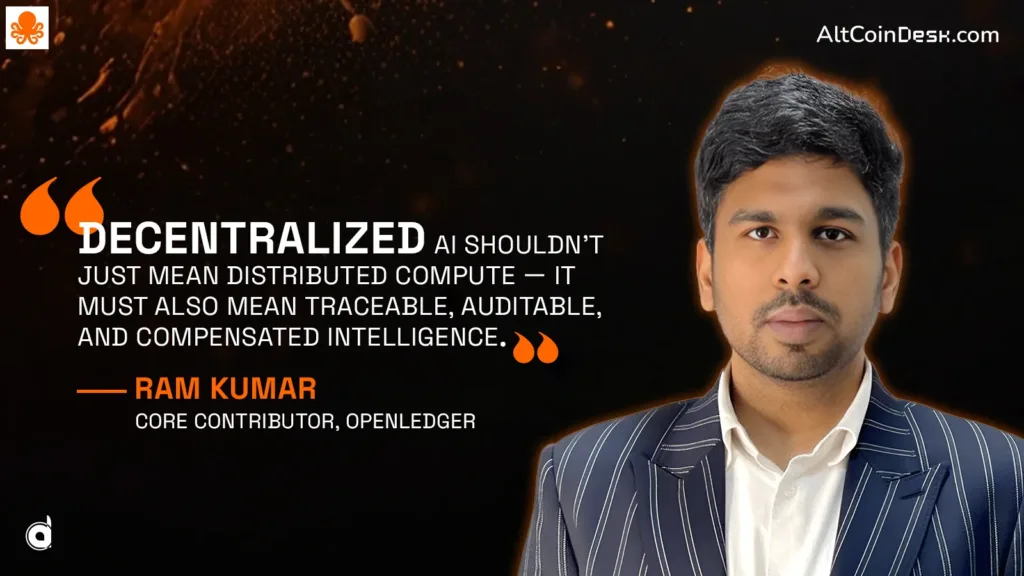
Ram: A common misconception is that decentralization just means running models on distributed nodes. That’s only half the story. Decentralization must also include economic rights, provenance, and dispute resolution. You can run a model on many computers, but if you can’t prove licensing, ownership, or contribution impact, you still have a black box. Decentralized AI should mean traceable, auditable, and compensated intelligence, not just distributed compute.
9. In your opinion, what are the most exciting OpenLedger milestones ahead?
Ram: The next important milestone is seeing AI agents operate in real decentralized finance environments, with verifiable audit trails, not simulations but actual financial workflows where every decision is provable and accountable. In the same vein, we are rolling out attribution-based data markets and model marketplaces, where contributors are compensated automatically every time their data or model component influences an outcome. That’s when the promise of a fair AI economy starts becoming reality.