


In an industry where most projects’ longevity spans a couple of years, there are only a handful of projects that last more than a decade. Besides the obvious ones like Bitcoin and Ethereum, there is DMD Diamond.
Often called the “Phoenix of Crypto,” DMD Diamond’s Chairman, Helmut Siedl, spoke with AltCoinDesk to share his thoughts on Layer-1 blockchains, the importance of continual innovation in the crypto industry, the role of privacy-focused blockchains, and more.
In pursuit of “True Decentralization”
Siedl stated that he had observed that most of the projects in the cryptocurrency industry that fizzled out were primarily driven by short-term interests or VC-funding cycles. In contrast, DMD Diamond was launched with the goal of achieving “True Decentralization.”
He added that DMD Diamond stands as a sovereign alternative in a world full of centralized finance and “decentralized in name only” (DINO) projects. The project has earned the nickname “Phoenix of Crypto” due to its ability to survive every major crypto market crash since 2013.
Siedl noted that this kind of resilience doesn’t just come from a marketing budget. Rather, it stems from a community that understands the value of a scarce, digital gold-like asset.
Cornerstones of DMDv4
In his conversation with AltCoinDesk, Siedl emphasized that innovations like dynamic block times, instant finality, and front-running protection form the cornerstones of DMDv4. Instant finality means that the “waiting game” for the end-user is now over.
When a transaction is confirmed, it is immutable—there are no chain re-organizations or “forking” risks. Dynamic block times ensure the network is efficient; it breathes with the demand, saving energy and optimizing speed.
Helmut Siedl, Chairman, DMD Diamond
When it comes to developers, front-running protection is often dubbed as a game-changer. In simple words, front-running protection prevents bots or validators from seeing a pending transaction and inserting their trades ahead of it to profit at the user’s expense. This problem is especially prevalent in many legacy networks.
DMD Diamond circumvents this issue by implementing HoneyBadger BFT (HBBFT) and specific transaction ordering. This allows developers to build DeFi applications on DMD, knowing their users won’t fall victim to predatory MEV tactics.
Privacy blockchains will be the ‘foundation’ of crypto ecosystem
Over the past two years, the crypto market has seen an unprecedented rise in the popularity of privacy-oriented blockchains such as Monero and Zcash. The positive traction experienced by privacy blockchains is reflected in the price action of their respective native coins, which have outperformed large-cap coins like Bitcoin and Ether over the past year.
In the interview, Siedl said that while DMD Diamond is primarily focused on being a secure, scarce store of value and a smart contract platform, he foresees that as global crypto regulations mature, the demand for privacy blockchains is likely to skyrocket.
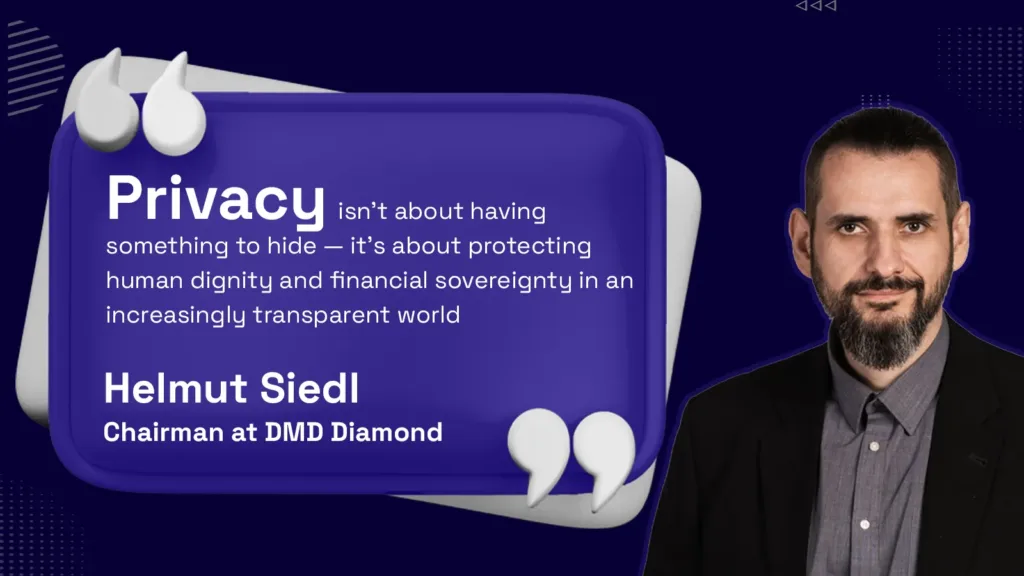
He made the bold prediction that privacy tech will steadily move from “fringe” to the “foundation.” Siedl added that users will slowly realize that a public ledger should not mean a broadcast of their entire financial history.
The DMD Diamond Chairman added that the crypto industry will likely see more integration of privacy-preserving layers that facilitate compliant but private transactions. This way, they can ensure that blockchains remain a tool for freedom rather than surveillance.
How does DMD Diamond treat privacy?
Going on, Siedl noted that DMD Diamond has made a deliberate strategic choice at the Layer-1 level. The blockchain does not implement privacy features directly into its base layer.
We want to ensure the chain remains universally available and compliant across the globe without facing the ‘privacy coin’ de-listing risks that plague other projects. Instead, we have built what is arguably the best Layer-1 platform to host privacy-enhancing technologies (PETs) on top. Because of our improved censorship resistance and the unique threshold encryption of block content (where block contributions stay encrypted until the block is finalized), we offer a uniquely safe harbor for privacy projects.
Helmut Siedl, Chairman, DMD Diamond
DMD Diamond’s architecture protects developers from having their protocols censored. More importantly, the blockchain’s architecture protects its validators from legal risks.
Siedl substantiated, saying that in DMDv4 HBBFT engine, a specific validator is not treated as a ‘block creator’ in the traditional sense of the word. Even if a node is part of the active validator set, doesn’t automatically imply that it was a part of the specific ⅔ +1 majority of active validator set required to finalize a particular block.
Since which nodes formed that majority is not tracked on-chain—and threshold encryption ensures they couldn’t see the transaction content before agreeing on it anyway – our validators are technically and legally insulated from the nature of the data they process.
Helmut Siedl, Chairman, DMD Diamond
“Layer-1 killer” is a narrative of the past
When asked about his thoughts on the current state of Layer-1 blockchains in the crypto industry, Siedl noted that he thinks that the “Layer-1 killer narrative is a relic of the past.” He added that the future is a web of specialized blockchains.
I see a multi-blockchain future as an ecosystem of digital cities. Some cities are built for high-frequency micro-transactions, while others – like DMD – are built as high-security, ultra-scarce financial hubs (the “Digital Gold” vaults).
Helmut Siedl, Chairman, DMD Diamond
He remarked that blockchains will leverage Ethereum virtual machine compatibility and advanced bridging and share both liquidity and utility. In 2026, Siedl expects the narrative to shift toward sustainable consensus and true interoperability – indicating the industry’s shift from the ‘casino’ phase to the ‘infrastructure’ phase.
Siedl also stated that as the world moves and demands carbon-neutral solutions, DMD Diamond’s transition to a pure PoS/HBBFT will give it a natural advantage over the competition. He added that he’s also closely watching the rise of “Protocol-Owned-Liquidity” and decentralized autonomous organizations (DAOs) that can manage physical-world assets.
DGEI is being underestimated
Toward the end of the interview, Siedl stated that the most underestimated use case of blockchain technology currently is Decentralized Governance of Essential Infrastructure (DGEI).
In simple terms, DGEI means communities use blockchain systems to collectively manage services like energy or data networks instead of centralized operators. Decisions are made transparently by stakeholders, reducing single points of control.
Siedl concluded that most people see DAOs for simple voting or treasury management. However, he sees DAOs – powered by DMD Diamond’s governance model – managing things like local energy grids, data storage, or even community-owned telecommunications.
When you combine a truly scarce asset with a fair, decentralized governance mechanism, you create a tool that can outlast any corporation. We are just scratching the surface of what a 100% community-owned network can achieve when it stops trying to be a “get rich quick” scheme and starts being a “build forever” foundation.
Helmut Siedl, Chairman, DMD Diamond