


The global payments landscape is seeing a quiet but meaningful transformation, and only a few areas highlight this change more clearly than cross-border transactions.
In a recent interview with AltCoinDesk, Raj Kamal – CEO and Founder of TransFi – shared his thoughts on how stablecoins and new infrastructure models are transforming the way money moves across borders – particularly in emerging markets.
Kamal’s journey into this space spans decades. “My background is nearly 20 years payments,” he explained, pointing to his time at McKinsey & Company and later at Naspers, where he began investing in blockchain and crypto as early as 2015. That combination of traditional payments expertise and early exposure to crypto laid the foundation for TransFi.
“At its core, TransFi essentially is a cross-border payments infrastructure platform which makes transactions happen on stablecoin rails with a focus on emerging markets,” Kamal said, outlining the company’s mission to tackle long-standing inefficiencies in global finance.
Why emerging markets are still broken for payments
While domestic payment systems in many countries have become fast and efficient, cross-border transactions remain a different story altogether. “You can really transfer money locally in any country almost instantaneously at zero cost. That’s not the issue,” Kamal noted.
The real friction begins when money crosses borders – especially into emerging economies. Costs can quickly increase, reaching levels that feel unreasonable for everyday users.
“If you were to look at World Bank reports, the costs of doing transfers to a country like India would be 2%, the Philippines would be like 3%, and if you went from Europe into Africa, it could be 8 to 10%,” he explained.
These costs aren’t just abstract figures – they directly impact real people. “If you’re transferring money to your mother, and if you’re being charged 3% for it, that is very, very rich,” Kamal added.
Speed is another major pain point. While transfers between developed markets often settle the same day, emerging market corridors can take significantly longer. “It will take you T+2, T+3 up to T+5,” he said, describing delays that can disrupt both personal remittances and business payments.
Perhaps the most frustrating issue, however, is unpredictability. “You could be sending money and realize that 5 days later your bank says the correspondent rejected the transaction, and there is no explanation given ever.” That lack of clarity and reliability continues to undermine trust in traditional systems.
Stablecoins as an alternative to legacy rails
TransFi’s solution involves stepping away from legacy infrastructure like SWIFT altogether. “We are trying to avoid the SWIFT network because that is where a lot of issues emerge from,” Kamal explained. Instead, the company uses stablecoins to bridge local payment systems across countries.
But he was quick to point out that speed alone isn’t enough. “Faster payments is a necessary condition, but it is not a sufficient condition,” he said. In emerging markets, success depends on much more, particularly the ability to support a wide range of local payment methods.
Card-based systems, for example, are far less relevant than many assume. “Penetration of cards in Indonesia is not even 15%, in Vietnam it is not even 5%,” Kamal pointed out. Instead, users rely heavily on bank transfers, QR-based systems, and digital wallets like GCash and others.
This fragmented landscape means that any viable payment infrastructure must be deeply integrated at the local level. At the same time, it must address the challenge of liquidity – especially when scaling operations.
“It’s one thing to move $100,000, another thing to move $10 million, absolutely a different thing to move a billion dollars,” Kamal said, underscoring the importance of corridor-level liquidity.
The role of regulation and market trust
As stablecoins gain more adoption, regulation is becoming a central theme in their adoption. For Kamal, clarity from regulators is not a barrier – it’s a necessity. “We welcome regulations. We are compliance first in our approach,” he said.
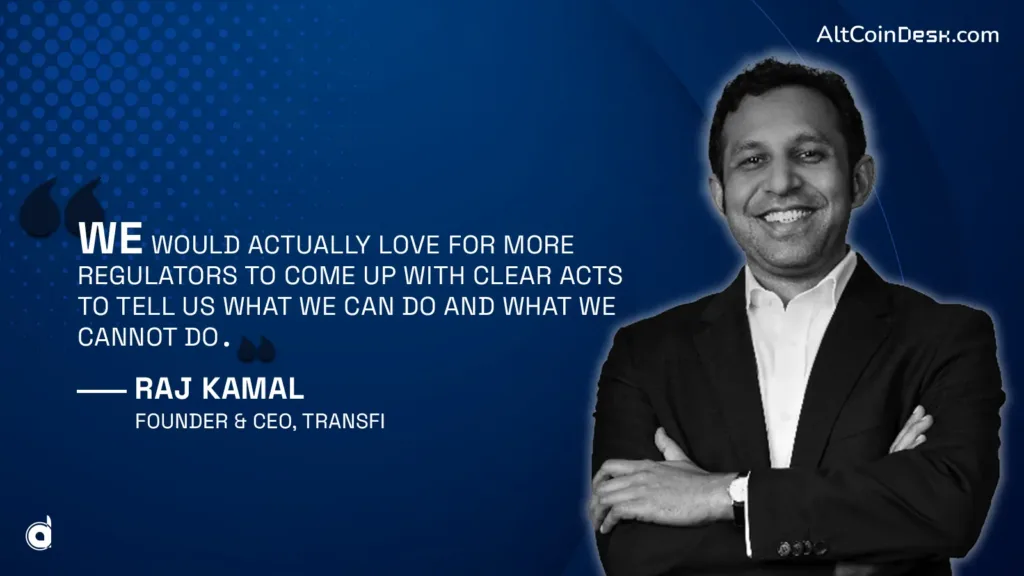
In fact, he believes clearer frameworks will accelerate growth rather than hinder it. “We would actually love for more regulators to come up with clear acts to tell us what we can do and what we cannot do,” he added, emphasizing that uncertainty is far more damaging than strict rules.
The company is already leaning heavily into compliance, with licensing efforts underway in multiple countries and advanced monitoring systems in place. This also suggests an industry-wide belief, that stablecoin-based payments must operate within the same or higher standards, compared to traditional finance (TradFi).
Building for scale with modular infrastructure
Another major key aspect of TransFi’s approach is its modular design. Rather than offering a single, rigid solution, the platform allows users to tailor how they interact with payment systems. “A customer should be able to plug and play,” Kamal explained.
This flexibility is critical because different use cases demand very different setups. A small remittance transaction is different from a large-scale trade payment, both in terms of compliance requirements and operational complexity. By fostering a modular infrastructure, TransFi is burning the midnight oil to serve a wide range of customers – from individuals to large enterprises.
Geographically, the company is seeing the most traction in Asia and Latin America. “We see Asia and LATAM both as rapidly growing corridors,” Kamal said, pointing to strong remittance flows and increasing demand for digital payment solutions.
Africa, although promising, comes with extra regulatory and counterparty risks that require a more cautious approach.
From niche to mainstream adoption
Despite the rapid speed of progress, stablecoins are seen as a niche segment within the wider digital assets ecosystem. Kamal believes that perception is already starting to change, and will continue to evolve with greater institutional involvement.
“I think regulatory clarity is very very important,” he reiterated, adding that participation from banks and large corporations will be a major catalyst. When well-established financial players begin adopting stablecoin rails, it sends a strong signal to the rest of the market.
Kamal shared a personal anecdote to show this shift, even traditional banks are beginning to acknowledge stablecoins in their communications. That kind of mainstream recognition marks an important step forward.
Ultimately, the transition from niche to mainstream won’t happen quickly. In fact, it will happen with improving infrastructure, growing adoption, and clearer regulations.