



Crypto has moved firmly into the mainstream. More people are entering the market, tools have improved, and regulatory clarity has increased over the past two years. But the most common reason people lose money hasn’t changed: decisions made on emotion, hype, and incomplete information.
It’s not insider access or luck that helps people do well here. It’s consistency. Once you build a small set of repeatable habits, crypto stops feeling overwhelming and starts feeling manageable. Here are 10 daily habits that genuinely make a difference.
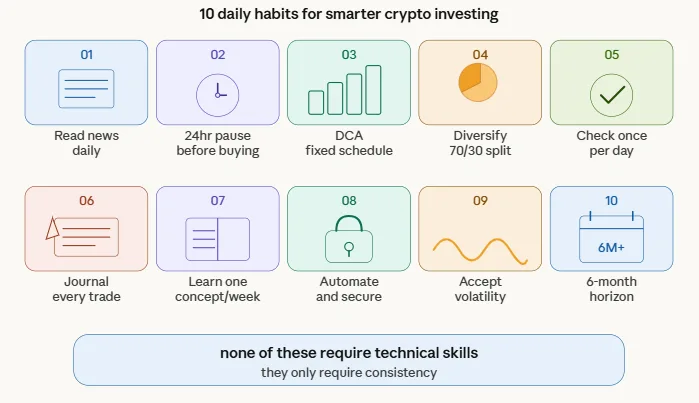
Read credible news every morning
Spend 5 to 10 minutes each morning reading actual reporting from sources like CoinDesk or The Block. Not influencer takes or X posts. Verified journalism with real sources. This is the foundation of crypto investing for beginners, because good decisions always come from good information.
Do this consistently for 90 days, and you’ll develop a feel for market cycles, project narratives, and token fundamentals that no single article or YouTube video can teach you. It costs nothing and takes less time than scrolling social media.
Never buy on the day you discover something
When a coin trends on social media, the price already reflects the excitement. The people who profited from that move entered before the noise started, and by the time it reaches your feed, the opportunity has usually passed.
A 24-hour pause before any purchase is one of the simplest ways to learn how to invest in crypto smartly. It gives you time to check a project’s fundamentals, look at wallet concentration data, and ask honestly whether there’s a real reason behind the price movement or just manufactured hype.
Dollar-cost average into positions
Dollar-cost averaging is one of the most reliable crypto investment strategies. Instead of trying to time the market, you invest a fixed amount on a regular schedule. $50 a week into Bitcoin or Ethereum, regardless of price, averages out your entry point over time.
The reason it works so well is that it removes the psychological pressure of trying to buy at exactly the right moment. You stop agonizing over whether today is a good day to buy, because the decision is already made for you.
Diversify across asset categories
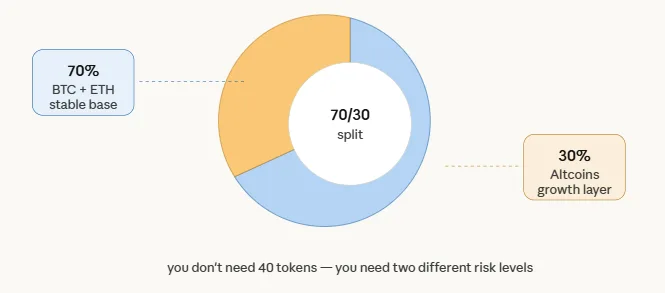
Diversification is the second pillar of solid crypto investment strategies. A rough split of 70% in established assets like Bitcoin and Ethereum and 30% in higher-growth sectors gives you a balance between stability and upside without requiring constant attention.
You don’t need to own 40 different tokens to be diversified. You just need exposure across different risk levels, so that one bad project doesn’t wipe out everything you’ve built.
Check your portfolio once a day, at a set time
Pick a time, check your holdings once, then close the app. Measuring performance against your investment thesis rather than against yesterday’s price is one of the daily habits crypto investing consistently rewards, and it keeps you from reacting to every small move the market makes.
Checking too often is where things go wrong for most people. The more you look, the more you feel like you need to do something, and that urge to act is usually what causes unnecessary losses.
Write down why you’re buying before you buy
Before you execute any purchase, write down the reason. Not after, before. It forces you to articulate your thinking, which tends to expose weak reasoning before it costs you money. Among easy crypto routines beginners can start today, this one has the highest return for the least effort.
Over time, this journal becomes genuinely useful. You can look back and see which decisions were based on solid thinking and which ones were based on a feeling you had at 11 pm after reading three Reddit threads.
Learn one new concept per week
To actually become smarter about crypto in 2026, you don’t need to master everything at once. The market has added real complexity in recent years, with staking, tokenized real-world assets, decentralized finance, and spot Bitcoin ETFs all now accessible to everyday investors. Trying to absorb it all simultaneously just leads to paralysis.
One concept per week is a pace that actually sticks. Staking one week, on-chain analysis the next, then wallet security, then how to read a whitepaper. By the end of a year, you’ll have a working understanding of the entire ecosystem without ever feeling like you’re cramming for an exam.
Automate your buys and lock down your accounts
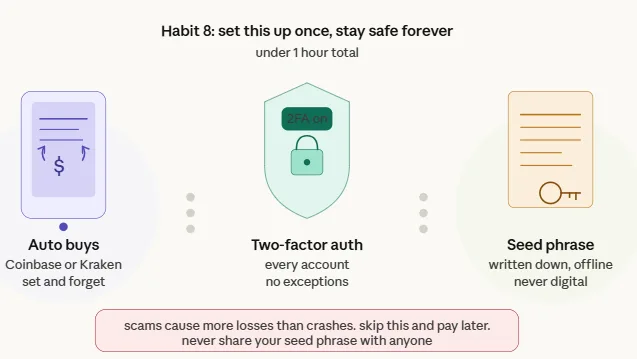
Set up automatic recurring buys through a regulated platform like Coinbase or Kraken, enable two-factor authentication on every account, and store your seed phrase offline somewhere you’ll actually remember. These are the easy crypto routines beginners most often skip, and they’re also the ones that prevent the most common and painful losses.
Phishing scams, fake exchange websites, and compromised accounts cause far more damage to new investors than market crashes do. Getting the security basics right early means you’re not learning that lesson the hard way later.
Accept volatility instead of fighting it
This is where crypto investing for beginners most often falls apart. A 20% drop in Bitcoin feels catastrophic if you’re not expecting it, but it has happened dozens of times throughout the asset’s history, and the market recovered every time. Knowing that going in changes how you respond when it happens.
Set a clear investment thesis before you buy anything and stick to it unless the project’s actual fundamentals change. Price dropping is not a reason to sell. Price dropping because the team abandoned the project is a reason to sell. Learning the difference is one of the most valuable things you can do.
Think in months, not days
Short-term thinking is where most losses happen. Every position you take should have a thesis that extends at least six months out, ideally longer. If you can’t explain why you’d still want to hold something six months from now, that’s a sign the purchase is driven more by price action than by conviction.
Crypto rewards patience far more reliably than it rewards urgency. The investors who build real wealth in this market are almost never the ones moving fastest. They’re the ones who made a plan, stuck to it, and didn’t let short-term noise talk them out of long-term positions.
The bigger picture
None of these habits require hours of screen time or technical expertise. They’re behavioral, not technical, and that’s exactly what makes them sustainable. The best crypto investing tips for beginners aren’t about finding the next hot coin. They’re about building a process you can repeat consistently, one that keeps emotion out of your decisions and gives you something solid to lean on when the market gets chaotic.
Building these habits one at a time is genuinely enough. You don’t need to implement all 10 tomorrow. Start with the news habit and the 24-hour rule, and layer in the rest as they become natural. That’s how real investing competence develops, not through a single breakthrough moment, but through small decisions made consistently over a long period of time.