



Crypto, stock, and ETF markets are very volatile, and the movement of information is often rapid. When applying instincts alone, you can lag behind other traders who use more organized trading tools for decision-making and implementation.
Today, investors have some powerful investment trading tools at their disposal. These tools make the process of analysis easier and automated, while ensuring risk control across portfolios.
But the most important aspect is to understand the most important tools and how to incorporate them to form an effective investment strategy.
12 best trading tools for crypto, stocks, and ETFs
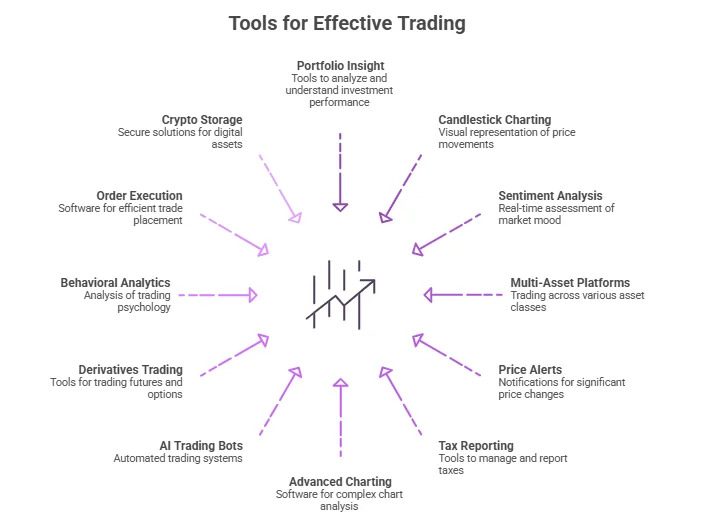
The following are 12 key tools that come in handy for crypto, stocks, and ETF investors:
1. Portfolio insight and analytics tools
Successful investing calls for a proper understanding of assets as well as general portfolio structure. The basic analysis tools measure the value based on earnings data, macro trends, and performance in the sector.
By using technical indicators such as RSI, MACD and Bollinger Bands, you can identify the the direction of momentum as well as possible entry points of entry can be identified. Such features are included in applications that enable traders to study the markets without any external applications.
Portfolio insight dashboards also help in tracking allocation, exposure, and performance of the holdings, therefore constituting key investment trading tools.
2. Candlestick charting tools
Candlestick charts are representations of raw price data that are converted into a structured, visual representation that can be interpreted at a glance. Every candle records open, close, high, and low prices over a specific time period.
Normally, the shape of the candle and positioning highlight trend strength, reversals, and market sentiment changes. These charts have continued to be fundamental trading tools as they represent complex data in easy-to-read signals without losing the details.
3. Real-time sentiment analysis
Cryptocurrency markets are more data-driven than emotion-driven ones. Sentiment tools quantify the behavior of a group of people by examining the social trends, news volume, and trading indicators.
The Fear & Greed Index is a metric that summarizes several data points into one index that shows market mood. A high reading shows risk appetite, and a low reading highlights caution and fear. You can use sentiment tools in conjunction with technical and fundamental analysis to have a contextual view that helps in predicting crowd emotions.
4. Multi-asset trading platforms
Having many accounts on various sites is cumbersome, time-wasting, and risk-prone. All-in-one solutions eliminate that issue by offering crypto, stocks, and ETFs in a single interface.
Multi-asset trading platforms enable you to track assets’ performance, trade, and handle capital all without having to change tools. This cohesive framework enhances the response time and mind workload of disrupted work processes.
These platforms are among the most feasible trading tools that you can use to invest in exchange-traded funds (ETFs), stocks, and digital assets.
5. Price alert systems
It is very difficult to track various assets in real time, particularly across crypto and derivatives markets that are very volatile and operate 24/7. However, using price alert tools can help resolve this issue by alerting you whenever the price of assets hits a certain level.
These alerts assist in noticing the breakouts, reversals, or important support and resistance areas without having to be at the screen all the time. Additionally, price alert systems help to make quick responses without disorganized decision-making.
This is one of the easiest but most efficient stock trading tools, as it contains built-in alerts in most of the platforms that help investors to monitor their stocks.
6. Tax reporting tools
It is easy to lose track of taxable events in more than one trade, in more than one place. This can be automated with the help of tax reporting tools, which compute gains, losses,s and cost basis in real time.
Exchange integrators, such as CoinTracker, use exchanges to produce reports and aid in various accounting processes. This minimizes the amount of manual work and enhances the accuracy of compliance. These tools provide you with clarity to help avoid expensive tax reporting mistakes.
7. Advanced charting and pattern recognition software
Besides simple charts, there are more sophisticated tools that can help you plot multiple assets, use various indicators, and draw trendlines. This deeper analysis helps you to identify correlations and underlying patterns.
Technical analysis platforms such as TradingView have custom indicators, community scripts, and back-testing environments, which you can use to optimize trade strategies before applying them. If you are a technical trader, you can depend on such tools as they enforce precision and pattern recognition.
8. AI-powered trading bots
Automation removes human emotions and allows strategies to be run in a continuous manner without human intervention. The AI trading bots analyze large volumes of data and adjust their strategies to the prevailing circumstances.
These bots can adjust to volatility, detect patterns, and advance execution logic with time compared to a fixed system. Several crypto, stocks, and ETFs investing platforms can be integrated with other platforms (via APIs) to enable users to run their own strategies.
If you are actively trading, these bots can be considered among the state-of-the-art best trading tools for crypto trading and algorithmic trading.
9. Derivatives trading tools
The derivatives markets allow you to trade price changes without necessarily having the underlying asset. An example of such is futures contracts, which allow you to hedge on upward or downward price movements.
Derivatives trading tools are flexible and can accommodate sophisticated techniques like hedging, leverage management, and directional speculation. Some platforms feature tools that offer exposure to crypto futures to enable traders to refine exposure in volatile environments.
When utilized properly, derivatives can be one of the strongest trading tools to use when investing in both crypto and traditional markets.
10. Behavioral analytics and trade journaling tools
Trade tracking gives you insight into the trends in decision-making that would otherwise be difficult to notice. These tools allow each trade to have a detailed journal entry, including entries, exits, line of thinking, and results.
With time, this information shows areas of strength, weaknesses, as well as mistakes that occur frequently,y affecting performance. This is further extended by behavioral analytics tools, which visualise win rates and emotional triggers. However, journaling is one of the least utilized yet mighty investment trading tools at hand.
11. Trade order execution software
How your trades are implemented is very crucial, particularly when dealing with volatile markets like crypto, ETFs, and equities. Trade order tools enable you to stipulate how and when your orders should be executed.
Market orders aim at speed while limit orders focus on price changes. Stop-loss orders ensure the protection of capital by exiting on breach of price levels.
By integrating these tools, you can enforce structured risk management. This makes trade order execution tools indispensable trading tools for both beginners and experienced investors.
12. Secure crypto storage solutions
In crypto markets, security is a vital aspect of any investment strategy. Hardware wallets are offline storage tools for private keys, and it minimizes hacking and phishing risks.
Ledger devices provide encrypted storage of thousands of assets and give control to users. On the other hand, cold storage divides long-term investments from active investments. As a result, safe storage is among the most critical trading instruments for crypto-oriented investors.
Conclusion
Successful investment across stocks, ETFs, and crypto markets requires more than just picking the right assets. These markets need effective trading tools that facilitate the analysis, execution, and control of risk across various assets.
All the stock, crypto, and ETF trading tools analyzed above provide you with the framework required to trade effectively across highly unpredictable investment environments. Despite being very useful, however, you must use several tools to form a successful trading strategy.