
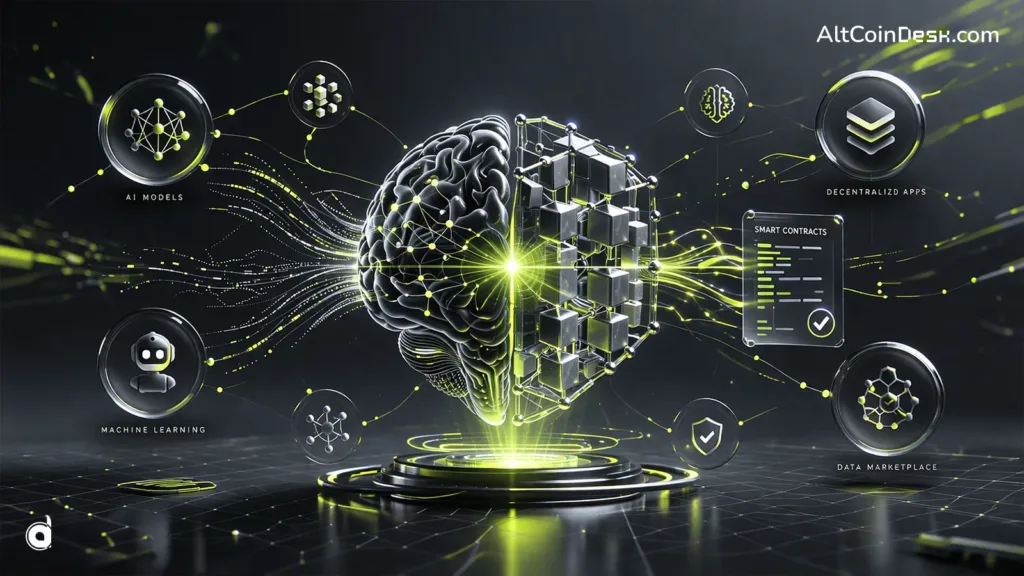

The intersection between crypto and artificial intelligence is shaping more adaptive and responsive networks. This combination improves how blockchain systems operate, helping transactions run more securely and with greater efficiency.
Machine learning sits at the core of this shift. It accelerates data processing, identifies trends in network activity, and allows systems to execute tasks automatically on the blockchain.
The synergy between the two technologies has resulted in AI crypto tokens that advance innovation in decentralized finance (DeFi) and digital ecosystems. This guide will look at the 6 most interesting AI crypto projects combining machine learning and blockchain.
Why is the intersection between machine and blockchain growing rapidly?
Machine learning (ML) is an artificial intelligence subset that enables computer systems to learn and make predictions without requiring human input to do so. This predictive ability enhances operational efficiency in decentralized finance and decentralized applications (dApps).
Blockchain machine learning also helps to enhance smart contracts by making them dynamic to respond to real-world inputs. This improves the security of blockchain systems since anomalies can be identified early to avert possible risks.
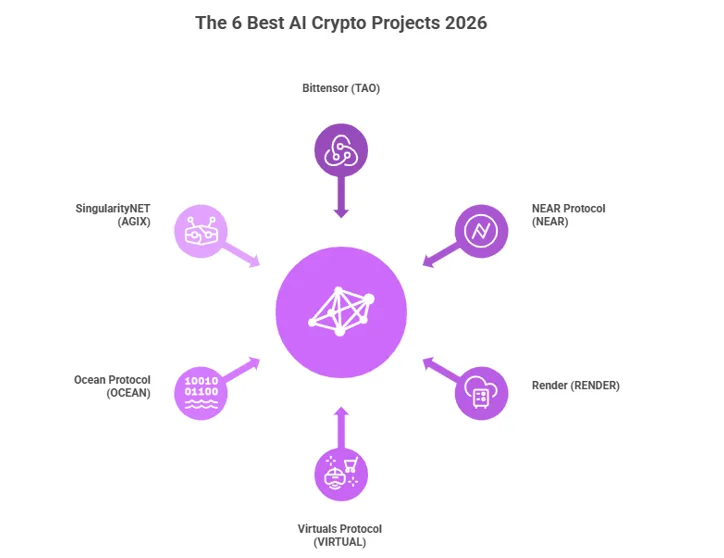
Top 6 AI crypto projects blending machine learning with blockchain
The fusion between machine learning and blockchain has led to the creation of several AI crypto projects that aim to provide innovative solutions to crypto enthusiasts. Some of the top ones include:
1. Bittensor (TAO)
Bittensor is a decentralized AI crypto network that allows participants to create and serve AI models across domain subnets. Rather than competing on brute computing power, contributors compete on the basis of utility and accuracy of their products. Rewards are assigned in TAO tokens that align with incentives among developers and users who demand high-quality AI services.
In 2026, TAO is among the biggest AI cryptocurrencies with a robust market presence and a growing number of expert subnets. The Bittensor ecosystem is also dynamic, implying developers can experiment with some blockchain machine learning tasks as they scale to a larger decentralized intelligence network.
Bittensor introduces a superior AI economic model due to its non-centralized nature. This design is expanded to scale as the need for decentralized AI platforms grows.
2. NEAR Protocol (NEAR)
NEAR Protocol is a layer 1 (L1) high-performance blockchain that is swiftly establishing itself as an AI blockchain integration hub. Its agentic commerce concept enables autonomous AI agents to transact and interact in decentralized ecosystems. The architecture of the network allows a high throughput and rapid finality, and will be suitable for real-time applications of AI-based programs.
This project is actively building its ecosystem by adding AI-oriented developer tools such as auto-generated smart contracts and auto-intelligent debugging. It is also focused on data marketplaces and grant programs to attract machine learning builders to the platform.
NEAR is creating infrastructure that AI agents can take an active role in economic activity, as opposed to merely assisting in applications behind the scenes. This makes it a layer on which subsequent decentralized systems that run autonomous intelligences will be built.
3. Render Network (RENDER)
Render Network is an example of a decentralized GPU-based computer that offers computing power to tasks like 3D rendering or machine learning. The network enables a distributed infrastructure of high-performance computing by matching users to unused resources of GPUs with those in need. This model is cheaper and also more accessible to developers and creators.
The Render Network is growing as the demand for GPU resources increases due to the development of generative AI and the onboarding of more complex models. This AI crypto project has been gaining traction in several areas, such as media production, video games, and AI studies.
Due to the increased demand for more powerful computational abilities, there is a growing need for decentralized applications, which the Render Network is designed to offer. This network also powers scalable AI development across the blockchain ecosystem.
4. Virtuals Protocol (VIRTUAL)
Virtuals Protocol is a protocol that concentrates on empowering the development and monetization of autonomous agents of AI in decentralized ecologies. Examples of tasks that can be performed by these agents include trading, content generation, interaction with applications, and generating revenue. The platform provides easy deployment by use of easy-to-use tools that make it easy to deploy.
The adoption of no-code solutions has opened the doors to more people to create AI applications and to allow a wider audience to join in. It is also enhancing interoperability within the protocol, enabling agents to be utilized with a wide range of blockchain networks.
Virtuals Protocol is paving the way for agent-based economies where AI systems are proactively creating value. This can make the user experience in the decentralized finance and web-based systems groundbreaking.
5. Ocean Protocol (OCEAN)
Ocean Protocol facilitates decentralized marketplace-based machine learning sharing of secure data. Its compute-to-data model enables algorithms to be performed on data without exposing data, so that it maintains its privacy and at the same time performs analysis. This is of great use in the business sectors involving sensitive information.
The platform comes in handy for data providers and developers interested in reliable datasets to train AI. Its focus on privacy complies with the growing global requirements for safe data use.
Ocean Protocol provides access to the commercialization of data to train AI in a secure way. This makes it play a decisive role across emerging AI crypto projects.
6. SingularityNET (AGIX)
SingularityNET is a decentralized marketplace that allows developers to create, share, and sell AI services. The platform facilitates interoperability among various machine learning models, enabling them to collaborate and create higher-order applications. Its mission is to decentralize access to artificial intelligence and no longer be dependent on centralized providers.
This network is expanding with new AI services to sectors like healthcare, robotics, and natural language processing. The token utility sustains the transactions, governance, and engagement in the ecosystem.
The platform mitigates risks at the intersection of AI models and enhances access and collaboration. It turns the environment more competitive with innovation not being confined to big technology companies only.
What does the future of AI blockchain integration hold?
AI blockchain integration is likely to increase in the future as the two technologies continue to evolve and solve issues. As decentralized data economies emerge, individuals will be able to share and monetize their data securely to machine learning without losing control. This change could open the door to additional datasets previously unavailable because of privacy issues or regulatory barriers.
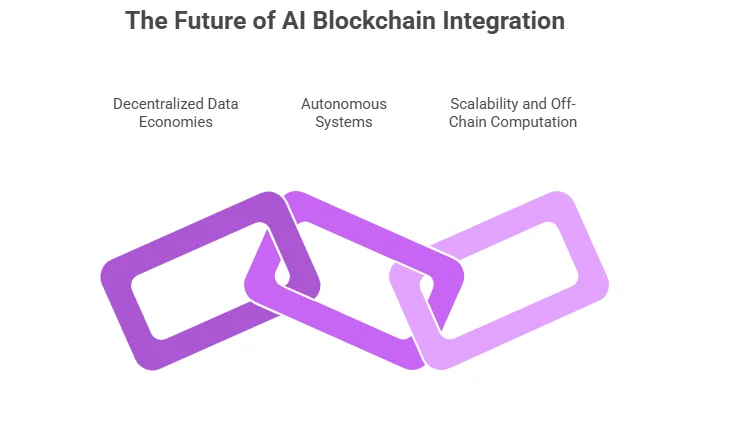
The advent of autonomous systems is another key development. These systems facilitate simple functions between blockchain networks. They control assets, transact, and automate ecosystems without the input of a human being.
Moreover, AI x blockchain scalability and off-chain computation innovations will significantly contribute to improving AI blockchain integration innovations.