

The choice of the NFT marketplace has a direct impact on pricing power, discovery, and long-term returns to both the creator and the collector. Platform differences now go beyond simple listings, including liquidity depth, fee structures, supported chains, and the extent to which royalties are fully implemented across secondary markets, serving as key metrics to consider.
As the market matures, creators and collectors are looking for NFT marketplaces that fit their workflow, the types of NFTs they support, and the blockchains they support. This guideline will explore the platforms with actual traction to help you understand some of the best NFT marketplaces.
What is a non-fungible token (NFT)?
A non-fungible token is a unique identifier stored on a specific blockchain. These digital assets certify ownership and authenticity of specific assets, such as digital art, music, videos, or in-game items.
Unlike fungible cryptocurrencies like Bitcoin, where each unit is identical and interchangeable, each NFT has a distinct value and cannot be exchanged on a like-for-like basis because it contains unique metadata and attributes. Instead, their value comes from a combination of provenance, creator reputation, utility, and market demand.
Understanding what an NFT marketplace is
An NFT marketplace is a website that helps to create, list, buy, and sell NFTs using smart contracts. Such marketplaces offer the infrastructure between wallets and blockchains, and facilitate transactions without the central ownership of the assets themselves.
Most NFT marketplaces accept wallets, auction, and fixed-price listings, and royalty structures. Other features of the largest NFT marketplace platforms are analytics, aggregation tools, and cross-chain compatibility that determine the efficiency of the trading and access to liquidity to a great extent.
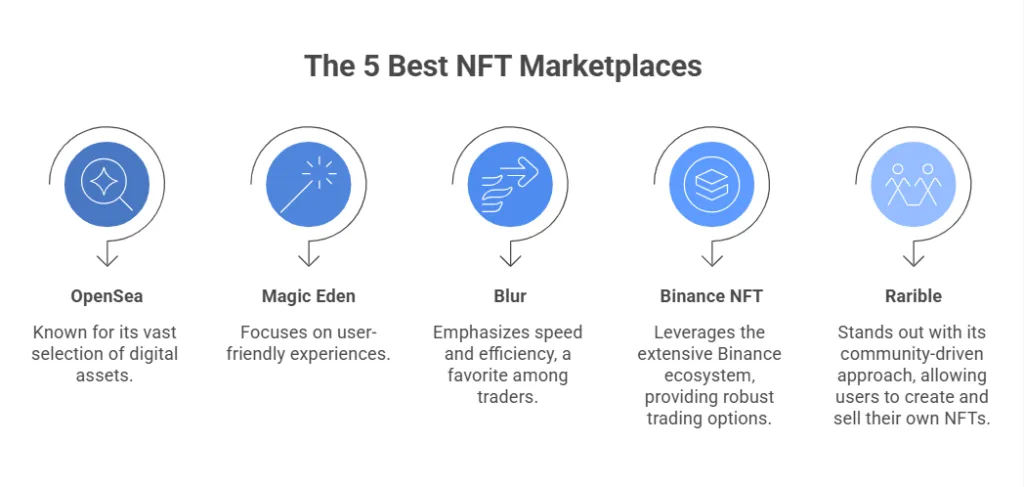
The 5 best NFT marketplaces for creators and collectors
The following are some of the largest NFT marketplaces in 2026:
1. OpenSea
OpenSea is one of the largest NFT marketplaces available in 2026. This marketplace supports large volume listings, a wide array of supported assets, and cross-chain activities. It is compatible with Ethereum, Polygon, and various Layer 2 (L2) networks, including Arbitrum NFT marketplaces.
Its size gives it a good liquidity environment that enhances the speed of execution for buyers and sellers of various types of assets. This NFT marketplace has a user-friendly interface, making it perfect for new NFT collectors.
2. Magic Eden
Magic Eden NFT platform offers multi-chain support with a focus on Solana, Ethereum, Polygon, and Bitcoin-based assets. Magic Eden is now a marketplace for gaming NFTs and Ordinals, which drives demand for its new asset classes that are more recent than the usual collections.
Its fees are also very competitive, and its emphasis on low transaction costs is in tandem with customers who are more concerned with low latency and low costs. Its community-driven launches make it a top marketplace due to strong user interaction.
3. Blur
Blur is designed for users who handle multiple positions and collections at the same time. Blur focuses on providing creators and collectors with speed, batch processing, and real-time data, which impacts the way users deal with pricing and liquidity.
The platform also has zero platform fees, making frequent trading less frictional. Its aggregation feature also enables users to find listings on different platforms via a single dashboard. This NFT marketplace experiences strong traction amongst collectors seeking efficiency.
4. Binance NFT
Binance NFT is built into the wider Binance ecosystem, giving users access to trading, minting, and collecting in one place. This integration makes it convenient for those already active on the exchange. The Binance NFT platform focuses on simplicity and low costs.
Because of this, the Binance NFT marketplace is one of the best NFT marketplaces for individuals looking to trade NFTs as well as other digital assets on the same platform. The fee charged to sellers remains constant at 1%, while creators are not charged any listing fees.
5. Rarible
Rarible is a one-of-a-kind NFT marketplace that gives creators and communities the oppotunity to build and run their marketplaces. This strategy aligns with the projects where creators and collectors want to have control over branding and fees, as well as user experience.
It has a multi-chain support that also covers networks frequently classified in abstract NFT marketplaces. This platform is great for experimentation and custom non-fungible token implementations. Its governance model also brings the element of community influence, which is not common among centralized platforms.
How to select the right NFT marketplace in 2026
When choosing the best NFT marketplace, the following are some of the key features to consider:
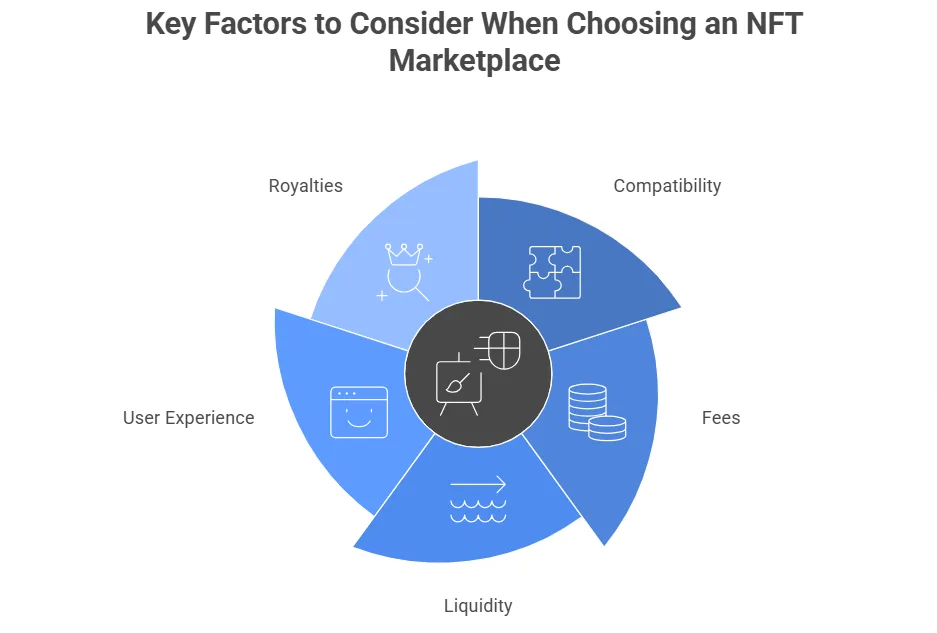
- Compatibility: The perfect NFT marketplace must fit your specific needs and use case. This factor helps you determine whether you will opt for experimental platforms such as Arbitrum NFT marketplaces or new ones like the best Aurora NFT marketplaces.
- Fees: The profitability of an NFT is directly tied to the fees charged. No-fee or low-fee platforms minimize trading costs, leaving buyers and sellers with greater profits per trade.
- Liquidity: The speed at which an NFT can be purchased or sold without causing a significant price change influences the overall market value. This means that marketplaces with greater liquidity have a higher likelihood of price stability.
- Royalty management: Royalties are handled differently by various NFT marketplaces. Creators and collectors must determine if royalties are implemented on secondary sales.
- User experience: An intuitive NFT marketplace interface simplifies the process of creation and collection of NFTs, particularly when managing more than one asset. Features such as analytics, batch processing, and portfolio trackers also come in handy for established creators and collectors.
Conclusion
NFT marketplaces have become a vital infrastructure in the larger digital asset ecosystem, uniting NFT creators and collectors on various blockchains and asset classes. The best NFT marketplaces are the ones that integrate liquidity, technical performance, and features that are user-oriented.
OpenSea remains the biggest NFT trading platform, Magic Eden focuses on gaming NFTs and Ordinals, Blur leads in high-frequency trading, Binance NFT has a low-cost and simple alternative, and Rarible is for customizable ecosystems.
Every platform serves a clear purpose, and thus your ultimate choice should be based on various factors such as compatibility, fees, liquidity, user experience, and royalties.