

Let’s introduce you to the most predictable “shock” in finance. Here’s how the crypto halving event quietly rewrites crypto’s rules while everyone argues about prices.
A crypto halving event is the only “surprise” in finance that comes with a calendar reminder years in advance. And yet, every single time it happens, the market reacts like it just found out five minutes ago.
Let’s keep it simple. A crypto halving event cuts the number of new coins entering circulation by half. Not a little trim. Not a polite adjustment. A clean, unapologetic 50 percent cut.
And somehow, this tiny piece of code has become one of the biggest talking points in crypto. Traders build entire timelines around it. Analysts write long essays about it. Influencers suddenly become economists.
But here is the real question no one wants to answer honestly. Does a crypto halving event actually matter, or are we all just enjoying the drama?
What a crypto halving event really is
Forget the complicated explanations for a second. Imagine you run a bakery. Every day, you produce 100 loaves of bread. Then one day, you decide to produce only 50. Same demand. Half the supply. That is a crypto halving event in its purest form.
In Bitcoin’s case, this is not a decision someone makes on a Monday morning. It is written into the system itself. Every 210,000 blocks, which is roughly every four years, the reward miners get for adding new blocks is cut in half.
When Bitcoin launched, miners earned 50 BTC per block. Then it dropped to 25. Then 12.5. Then 6.25. And as of April 19, 2024, it is now 3.125 BTC. So instead of about 900 new Bitcoins entering the market daily, it is now closer to 450. No drama. No committee meeting. Just code doing its job. That is why the crypto halving event is often described as monetary policy without human interference.
A quick timeline that explains everything
Let’s zoom out for a second, because this part matters more than people think. Bitcoin has gone through four major crypto halving events so far:
- 2012: Reward drops from 50 to 25 BTC
- 2016: 25 to 12.5 BTC
- 2020: 12.5 to 6.25 BTC
- 2024: 6.25 to 3.125 BTC
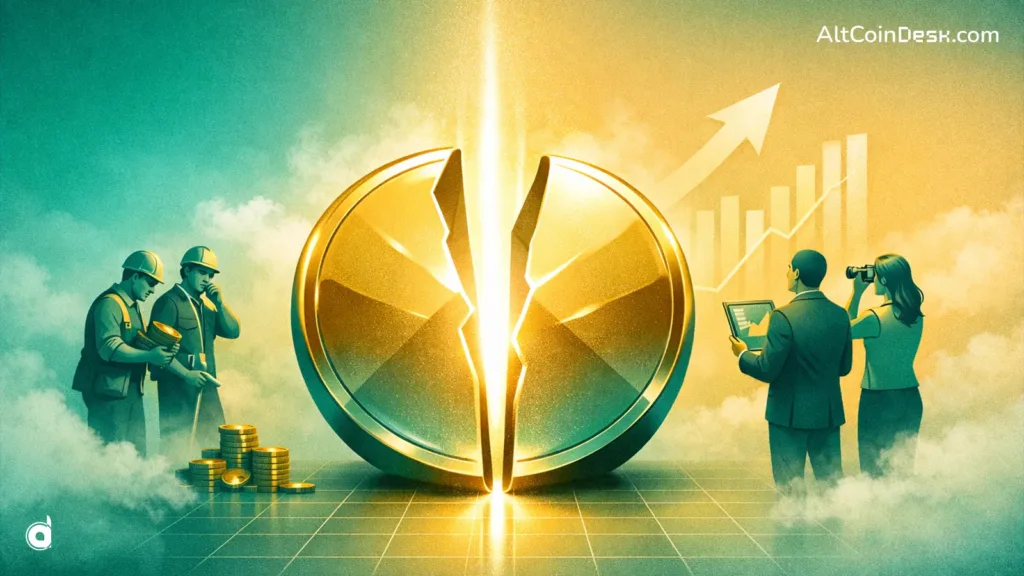
The next crypto halving event is expected around 2028, where rewards will fall again to 1.5625 BTC. Notice something interesting here. Every time the reward drops, Bitcoin becomes harder to produce. It is like mining gold, except the universe itself decides that digging just got twice as difficult overnight.
Why does everyone suddenly become an expert?
The crypto halving event has a special effect on people. Six months before it happens, everyone starts talking about scarcity. Three months before, charts appeared everywhere. One month before, price predictions became strangely confident.
And right after it happens, two groups emerge: Group one says, “This is bullish. Supply is down.” Group two says, “It was already priced in.” Both groups are partially right, which is exactly why this topic refuses to die.
Supply, demand, and the simplest truth
At its core, a crypto halving event is about supply. Before the 2024 halving, around 328,500 BTC were entering circulation each year. After it, that number dropped to roughly 164,250 BTC. That is not a small adjustment. That is a serious shift.
But here is the part that often gets ignored. Supply going down does not automatically mean the price goes up. If demand stays flat, nothing dramatic happens. If demand rises, then things get interesting. If demand drops, even a crypto halving event cannot save the price. This is where reality interrupts the hype.
The price myth nobody wants to challenge
Let’s address the elephant in the room. Does a crypto halving event guarantee a price rally? No. Historically, Bitcoin has often gone up after halvings. But that does not mean the halving caused it. Markets are messy. They respond to interest rates, regulations, liquidity, hype cycles, and sometimes pure chaos.
In 2024 and 2025, Bitcoin behaved differently compared to earlier cycles. Yes, it rose after the halving, but not in the explosive way people expected. Why? Because Bitcoin is no longer a niche experiment. It is now part of a bigger financial system. There are ETFs, institutional investors, and macroeconomic forces all pulling on the same rope. So the crypto halving event still matters, but it is no longer the only story in the room.
The part everyone ignores: Miners
Let’s talk about miners, because this is where things get uncomfortable. A crypto halving event cuts their rewards in half overnight. Imagine waking up to find your salary just reduced by 50%, but your electricity bill stayed the same. That is mining after a halving.
Unless the price of Bitcoin increases, miners feel the pressure immediately. Some shut down. Some upgrade their equipment. Some hope transaction fees will make up the difference.
But here is the catch. Transaction fees still make up a relatively small part of miner income most of the time. So every crypto halving event quietly asks a serious question: Can the network remain secure if miners earn less? It is not a glamorous question, but it is one of the most important ones.
Not every crypto has this feature
Another misconception is that every cryptocurrency has a crypto halving event. That is not true. Bitcoin and Litecoin follow this model. They reduce issuance over time.
But Ethereum does not do halvings. After switching to proof of stake, its supply dynamics changed completely. Instead of planned cuts, its release depends on how busy the network is and how much staking there is. When people talk about a crypto halving event, they usually mean Bitcoin or another proof-of-work system.
Why the 2024 halving felt different
The 2024 crypto halving event did not feel like the earlier ones. And that is actually a good thing. In 2012, Bitcoin was barely known. In 2016, it was gaining attention. In 2020, it was entering mainstream awareness.
By 2024, it had already arrived. That changes everything. Instead of being driven mostly by retail excitement, the market now includes institutional flows, ETF demand, and global macro factors. So when the halving happened, it was not the only driver of price. It was just one piece of a much larger puzzle.
The psychology of scarcity
Here is where things get interesting. A crypto halving event does not just change numbers. It changes perception. People like scarcity. It makes things feel valuable. Gold is valuable partly because it is hard to find. Bitcoin leans into the same idea, but with a twist. Its scarcity is not based on nature. It is based on code.
Every crypto halving event reinforces that story. It reminds the market that Bitcoin is not supposed to be abundant. It is designed to become harder to get over time. And that narrative is powerful, whether you believe in it or not.
The long game no one talks about
Eventually, Bitcoin will reach a point where no new coins are created. Not tomorrow. Not next year. But one day. At that stage, miners will rely almost entirely on transaction fees. And every crypto halving event is a step toward that future.
This raises a big question. Will transaction fees alone be enough to keep the network secure? No one has a perfect answer yet. But each halving brings us closer to finding out.
So, why does the crypto halving event matter?
Let’s bring it all together. A crypto halving event matters because it changes three things at once:
- It reduces supply in a predictable way
- It pressures miners and reshapes network economics
- It reinforces the narrative of scarcity
But it does not control the market on its own. It is not a magic switch. It is more like a slow, steady force that shapes the system over time.
The key takeaway most people miss
Here is the honest truth. The crypto halving event is important, but not in the way most people think. It does not guarantee price increases. It does not create instant wealth. It does not operate in isolation. What it does is far more subtle. It builds trust in the system.
Every time a crypto halving event happens exactly as expected, it proves that the rules are still being followed. No shortcuts. No sudden changes. In a world where financial systems can change overnight, that kind of predictability is rare. And maybe that is the real value.