

Crypto is packed with data. Charts, percentages, ratios, scores. There’s no shortage of signals trying to tell investors what the market might do next. The issue isn’t access to crypto market indicators. It’s that most beginners pick up a few numbers, misread what they mean, and make decisions based on incomplete information.
These five indicators are the ones serious traders actually use to read the market. Here’s what they’re really measuring, and where they keep getting misunderstood.
Bitcoin dominance is not just about Bitcoin
Bitcoin dominance tracks what percentage of the total crypto market’s value belongs to Bitcoin. It shifts constantly as capital flows between Bitcoin and altcoins.
The common mistake is assuming high Bitcoin dominance means Bitcoin is performing well. That’s not always the case. When dominance is rising, it often signals that investors are retreating toward the relative safety of Bitcoin and pulling away from riskier, smaller coins. It’s less “Bitcoin is thriving,” and more “caution is creeping in.”
When dominance falls, capital is rotating into altcoins. That can kick off what traders call “altcoin season,” a stretch where smaller coins significantly outperform Bitcoin. But falling dominance can also mean risk appetite is reaching dangerous levels, where euphoria is pushing money into anything with a low price tag.
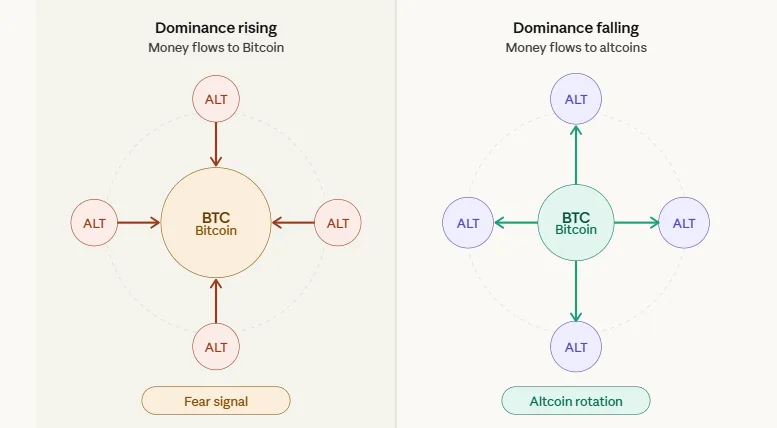
Same chart movement, completely different meanings. That’s why context around Bitcoin dominance matters far more than the number itself.
Crypto market sentiment and the fear and greed index
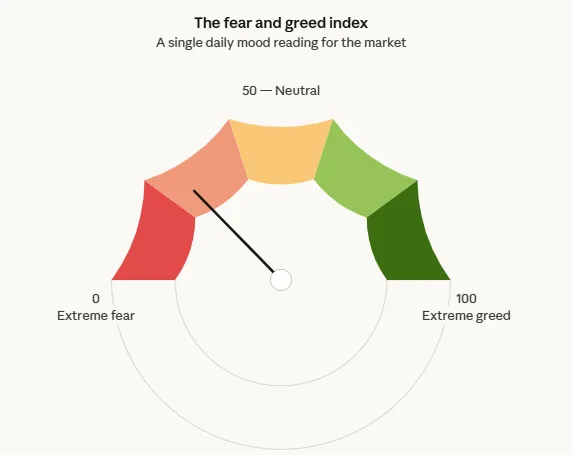
The Crypto Fear and Greed Index is one of the most referenced tools for measuring crypto market sentiment. It runs on a scale from 0 to 100, pulling from data like price volatility, trading volume, Bitcoin dominance, and social media activity to produce a single daily mood reading.
The logic seems clean: extreme fear tends to appear near market bottoms, extreme greed tends to appear near tops. Buy when everyone is scared, be cautious when everyone is euphoric.
The catch is that the index can stay in extreme territory for weeks or even months. Extreme fear doesn’t mean a bounce is coming tomorrow. Extreme greed doesn’t mean a crash is a week away. Using it as a precise trigger, rather than a broad temperature check, is one of the most common errors made with crypto trading indicators.
Think of it less like a traffic light and more like checking the weather before a long drive. Useful for setting expectations, not reliable enough to time specific moves to the day.
Open interest and funding rate: The leverage signals
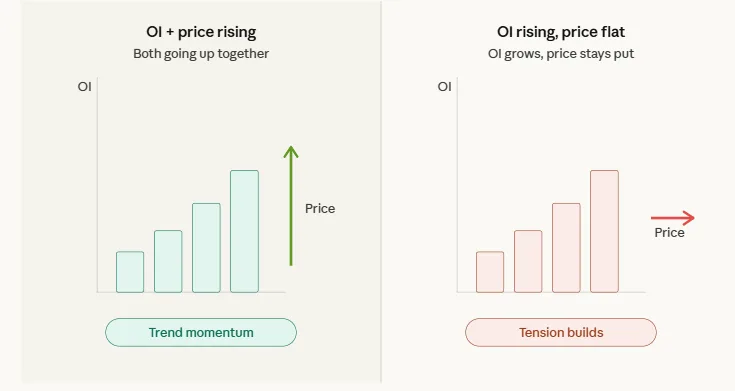
Futures markets run on borrowed conviction. Open interest is just the scoreboard. It shows the total value of all active futures contracts sitting open at any moment. More open interest means more leveraged money is in the game.
Here’s where it gets interesting. Open interest climbing alongside price? That’s momentum with fuel behind it. But open interest climbing while price just… sits there? That’s a coiled spring. Nobody’s winning yet, and when it finally moves, it tends to move hard.
The funding rate is the other half of this. Perpetual futures don’t have an expiry date, so to keep the contract price tethered to the actual spot price, one side pays the other periodically:
- Longs pay shorts when demand to go long is heavy – bullish pressure is stacking up, and traders are literally paying a fee to hold that bet
- Shorts pay longs when bearish pressure takes over – the market is leaning the other way and funding flips negative
Now here’s the part that catches people off guard. When funding has been positive for a long time and sitting high, that’s not a bullish signal. It’s a warning. The trade is too crowded. Too many leveraged longs propped up on optimism, and the whole thing becomes shaky. A single bad headline, a whale unloading, a rumor. Any of it can set off a liquidation cascade that sends price down faster than most people can react.
On-chain metrics: Reading the blockchain directly
Here’s where crypto genuinely differs from traditional markets. Because blockchains are publicly accessible, it’s possible to see what real holders are actually doing with their coins, not just what traders are doing on exchanges.
On-chain metrics offer behavioral context that no price chart can replicate. A few key things they reveal:
- Exchange inflows and outflows: Large amounts of coins moving onto exchanges often signals that holders are preparing to sell. Coins moving off exchanges into private wallets typically suggests accumulation and longer holding intent.
- Long-term holder behavior: When wallets that haven’t moved coins in years suddenly start selling, that’s historically been a late-cycle signal. Experienced holders quietly distributing into strength has often shown up before major tops.
- Realized price: This is the average price at which all circulating coins last changed hands. When the market price drops below the realized price, a large portion of holders are sitting on unrealized losses. That condition has historically been associated with market bottoms, though it’s never a guarantee.
Combining on-chain metrics with exchange data gives a much fuller picture of where the market actually is versus where the price line is sitting.
Using crypto market indicators together
The biggest mistake with any of these market indicators crypto investors encounter is treating them in isolation. A single data point tells a fragment of the story at best.
Bitcoin dominance falling while funding rates spike and coins flood onto exchanges tells a completely different story than dominance falling with stable funding and coins moving off exchanges into cold storage. Same surface signal, completely different conditions underneath.
A useful starting point before making any decision:
- What is the current crypto market sentiment showing?
- Is open interest building, stable, or contracting?
- What are long-term holders actually doing on-chain right now?
That framework doesn’t eliminate risk, but it replaces gut-feeling decisions with something a lot more grounded, and that alone puts an investor ahead of a large chunk of the market.
Understanding these signals changes the game
Crypto market indicators are genuinely powerful tools, but only when understood for what they’re actually measuring. Misreading Bitcoin dominance, using the Fear and Greed Index as a timer, overlooking funding rate warnings, or skipping on-chain data entirely are all ways to find yourself on the wrong side of a move.
The market doesn’t care about intentions. Investors who take the time to understand what these signals actually say, rather than what they appear to say on the surface, are working with significantly better information than those who don’t.