


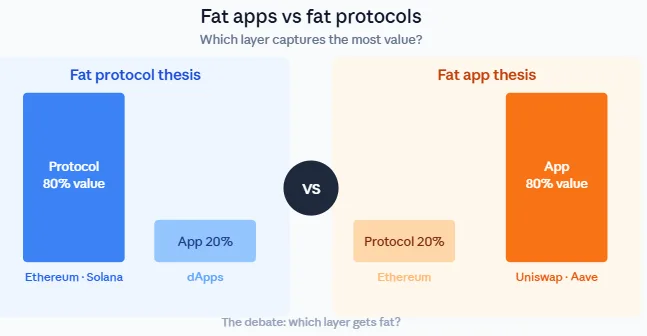
For years, the biggest question in crypto was simple: where does the value actually go? Does it sit in the blockchains themselves, or in the applications people use every day? Two competing ideas have shaped how investors, builders, and users think about this. The fat protocol thesis says the base layer wins. The fat app thesis says the apps do. In 2026, both arguments are very much alive.
The answer matters because it determines where money flows, where developers build, and which tokens hold long-term value. Understanding the difference between fat protocols and fat apps is one of the most important things a beginner can learn before going deeper into crypto and blockchain.
What the internet can teach us about blockchain
To understand blockchain fat protocols and fat apps, it helps to look at the regular internet first.
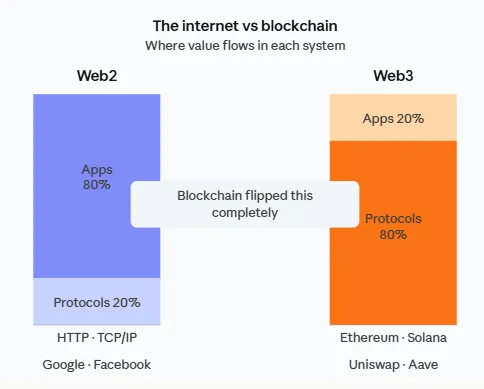
The internet runs on invisible infrastructure called protocols. Things like HTTP (how web pages load) and TCP/IP (how data travels) make everything possible. But who made the money from the internet? Not the protocols. Google, Facebook, and Amazon did. The apps captured all the value. The protocols were free and open for anyone to use.
This is what researchers call “thin protocols, fat applications.” The pipes were free. The businesses sitting on top of them became the most valuable companies in history.
Blockchain was supposed to flip this completely.
What are blockchain fat protocols?
In 2016, investor Joel Monegro published an essay called “Fat Protocols” that changed how the crypto industry thought about value. He argued that blockchain would behave differently from the internet. Value would not be concentrated at the application layer. It would stay at the bottom, in the blockchains themselves.
Ethereum, Solana, and Bitcoin are the clearest examples. These are base layer protocols, the foundations that everything else runs on. When someone uses a DeFi app built on Ethereum, they pay gas fees to the Ethereum network. When transaction volume goes up across any app in the ecosystem, Ethereum captures a cut. The apps come and go. The protocol sits underneath all of them.
Why value sticks at the base layer
Two things make this possible.
- Open data: Facebook and Google built their businesses on owning user data. Blockchain protocols work the opposite way. Everything is stored on the chain and is readable by any app built on top of it. No single application gets to lock that data away, which means no single application can dominate by controlling it.
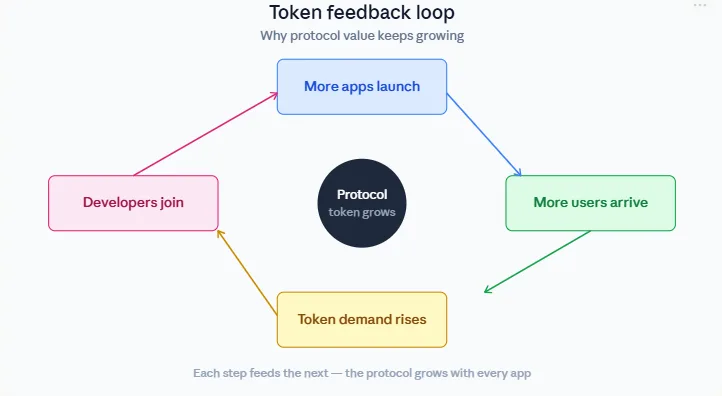
- Token demand: Using apps on Ethereum requires ETH. As more apps launch and more users arrive, demand for ETH grows. A higher token price draws in developers looking to build on a valuable network, which produces more apps, which brings more users. Each part of the cycle feeds the next.
Ethereum reached a multi-billion dollar valuation before any single breakout application existed on it. That was not irrational. It reflected a bet on the base layer itself, not on any one thing built on top of it.
Fat apps definition: What changed?
Fast forward to today. The apps got very good, very fast.
The fat apps definition is straightforward: a fat app is a decentralized application that captures significant value for itself, rather than passing most of it to the protocol underneath. This includes fees, user retention, and liquidity, all held at the application layer.
Decentralized fat apps like Uniswap, Aave, and Curve now generate real revenue, attract millions of users, and in some cases rival entire blockchains in fee income. The Fat App Thesis argues that applications, not protocols, are where the real value accumulates next.
Fat apps vs thin apps
Understanding fat apps vs thin apps is key to seeing why this shift matters.
A thin app is easily replaced. It has no real competitive advantage, no sticky users, and adds no independent value. Swap it out and nothing changes. Early crypto apps fit this description well.
A fat app is different. It builds its own network effects. Users stay because the liquidity is deeper, the interface is better, or the community is stronger. Uniswap processes billions in daily trading volume that would not simply move if a competitor launched a copycat. That stickiness is what makes an app fat.
Fat apps architecture
The fat apps architecture describes how these applications are built to retain value rather than pass it all upward to the base layer.
Instead of simply routing users through a protocol and collecting nothing, fat apps:
- Charge their own fees on top of protocol costs
- Build proprietary liquidity pools that lock capital inside the app
- Issue their own governance tokens, creating an independent stakeholder base
- Deploy across multiple blockchains, reducing dependence on any single protocol
Some fat apps are now taking this further. Uniswap has launched its own blockchain called Unichain, specifically to internalize the fees it currently pays to Ethereum. This is the fat apps architecture at its most advanced: an app becoming its own protocol.
Weighing up the options: Fat protocols vs fat apps
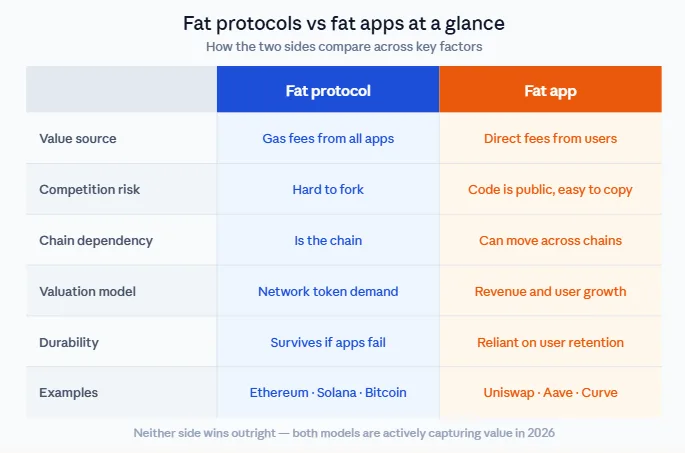
Both sides of this debate have real merit. Here is how they stack up.
Advantages of fat protocols
Investing in a base layer protocol is essentially a bet on an entire ecosystem at once. If anything built on top succeeds, the protocol benefits.
- Acts as an index bet on an entire ecosystem, not just one app
- Value is durable – even if individual apps fail, the protocol survives
- Every transaction on every app pays fees to the base layer
- Much harder to fork than a single application
- Token holders benefit directly from all growth across the ecosystem
Disadvantages of fat protocols
The protocol model is not bulletproof. As the blockchain space matures, some of its core advantages are being tested.
- More blockchains competing means fees are being driven down across the board
- Infrastructure is becoming a commodity, with most chains now offering similar features at similar costs
- Token valuations have historically run far ahead of actual network usage
- A protocol with no successful apps built on top of it generates no fee revenue
Advantages of fat apps
Fat apps behave more like traditional businesses, and that is increasingly being seen as a strength rather than a weakness.
- Revenue is direct and traceable, fees come in when users do something, not as a byproduct of network activity
- User bases and liquidity belong to the app, not whatever chain it happens to run on
- If a faster or cheaper chain launches, apps can move to it
- Apps can be valued the same way a tech stock is, on actual revenue and user growth, not on speculation about future network demand
Disadvantages of fat apps
Fat apps have real vulnerabilities too, particularly when it comes to competition and capital.
- The code is open source, which means a well-funded team can copy the whole thing and launch a competitor with better token rewards
- Security and uptime still depend on the protocol underneath, which is outside the app’s control
- Crypto venture capital has spent years backing base layer chains over applications, so raising has been harder at the app layer
- Pull the token incentives and users often leave just as fast as they came
Where things stand in 2026
The line between fat apps and fat protocols is blurring. The strongest apps are not choosing one side. They are becoming both.
Protocols are still dominant in total market cap. But real revenue, real users, and real business metrics are increasingly found at the application layer.
Builders and investors in 2026 are watching both sides carefully. The next cycle will likely be shaped by whoever locks in the most users and the most liquidity, whether that happens at the base layer or on top of it.