

Although the crypto market came into existence with Bitcoin’s launch in 2009, things are vastly different in 2026. There are not only millions of other coins and tokens in circulation today, but there are also different verticals such as decentralized finance (DeFi), non-fungible tokens (NFTs), real-world assets (RWAs), and memecoins, among others.
As a result, investors often get confused about where to deploy their capital. While there’s no lack of options, separating signal from noise has become a herculean task in the sea of millions of coins being traded in the crypto market.
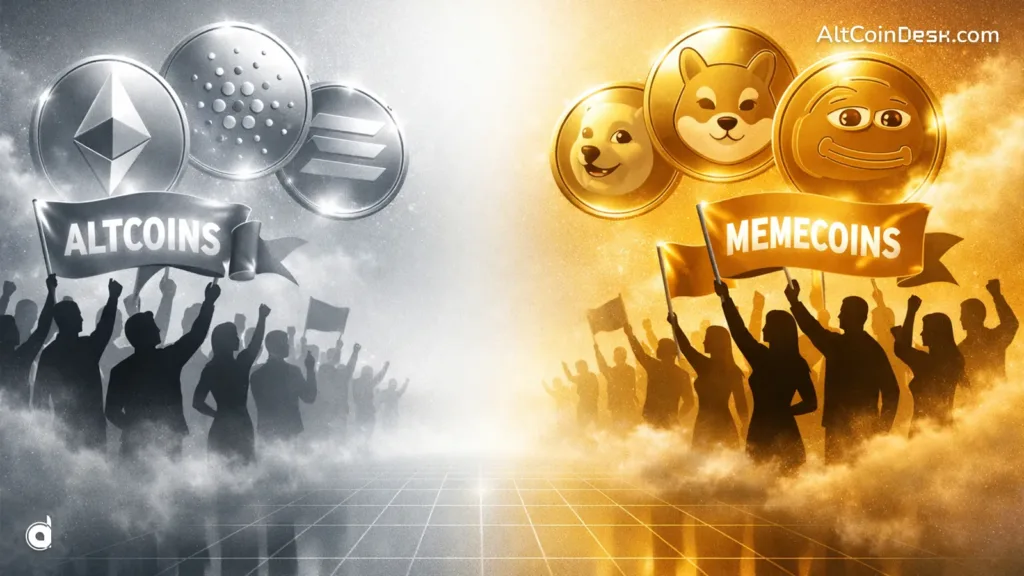
One of the newest additions to the swarm of different types of digital assets is memecoins, a class of tokens borne out of social trends and internet-age virality. Before we deep dive into memecoins, let’s first make one thing very clear – memecoins are not separate from altcoins. Rather, memecoins are a subset of altcoins.
What are altcoins?
From a strictly definition perspective, altcoins are all cryptocurrencies besides BTC. However, unlike the top cryptocurrency, most altcoins promise multiple utilities. For example, Ethereum’s native token ETH functions as ‘gas’ on the smart contract platform, making it possible for users to send and receive tokens, interact with smart contracts, decentralized applications, and do a lot more.
In addition, altcoins can be used to participate in the network’s security mechanism by staking tokens, participating in on-chain governance, or to incentivize developers and users to enhance network activity and adoption.
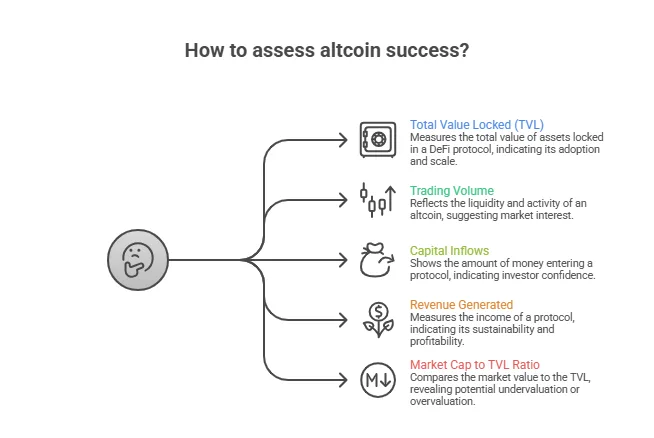
Due to altcoins’ multiple utilities, there are different metrics to determine their success, or lack thereof. For example, the success of DeFi protocols is often judged by parameters such as total value locked (TVL), trading volume, capital inflows, revenue generated, market cap to TVL ratio, and others.
That said, utility doesn’t always necessarily translate into success or greater adoption for the underlying token. In fact, the majority of altcoins experience a gradual decline in popularity due to a lack of adoption. Only a handful of altcoins, such as ETH, Tron, Solana, and Cardano, have survived multiple bear markets.
How are memecoins different?
As mentioned earlier, memecoins are a subset of altcoins. However, they occupy a very different space in the overall crypto ecosystem. Unlike utility-based altcoins, memecoins are typically launched without a clear roadmap. Instead, memecoins mostly rely on branding, humor, and social trends.
Usually, memecoin communities are formed around viral jokes, a trending meme, or even something as unserious as a plank of wood. As a result, they tend to not take themselves too seriously, unlike other altcoins, which are always staring at adoption metrics. In a way, this casual attitude toward the token’s price may sometimes even help the memecoin.
However, price movements in memecoins are often abrupt and extreme. Unlike large-cap cryptocurrencies such as ETH, SOL, or ADA, memecoins usually have small market caps. As a result, they suffer from low liquidity and, consequently, sharp price actions.
An X post by a prominent influencer promoting the said memecoin can lead to quick price appreciation for the digital currency. Conversely, any rumor of a hack or security compromise or token supply inflation can result in a price crash for the memecoin.
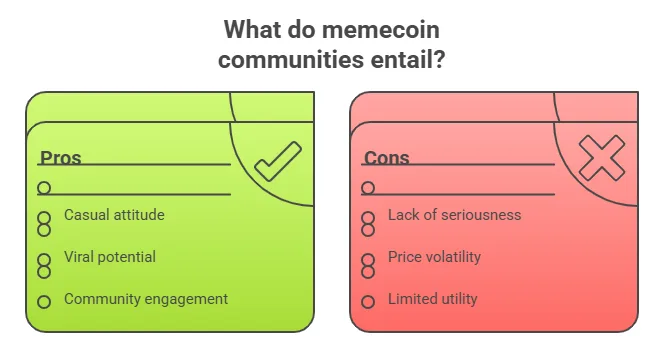
Unlike altcoins, it is extremely rare for a memecoin to have sustained organic demand once the public’s interest in it fades. Only a handful of memecoins, such as Dogecoin, Shiba Inu, and Bonk, have made it past the initial speculation phase.
Same market but different risks
To say that utility-based altcoins are less risky than memecoins would be dishonest. Both cryptocurrencies carry risks, but of different types. Utility-based altcoins’ risks stem from the project failing to achieve its objectives according to the decided timeline.
Further, regulatory changes play a vital role. For example, consider privacy coins. Leading cryptocurrencies like Monero (XMR) and Zcash (ZEC), despite having market caps in billions of dollars, periodically face regulatory challenges, and financial watchdogs the world over crack down due to their privacy features.
However, the risks associated with memecoins are more concentrated in public sentiment. If the hype fades, the memecoin can risk crashing abruptly. Therefore, it is important to understand the dynamics of memecoins and how they function in the wider crypto market.
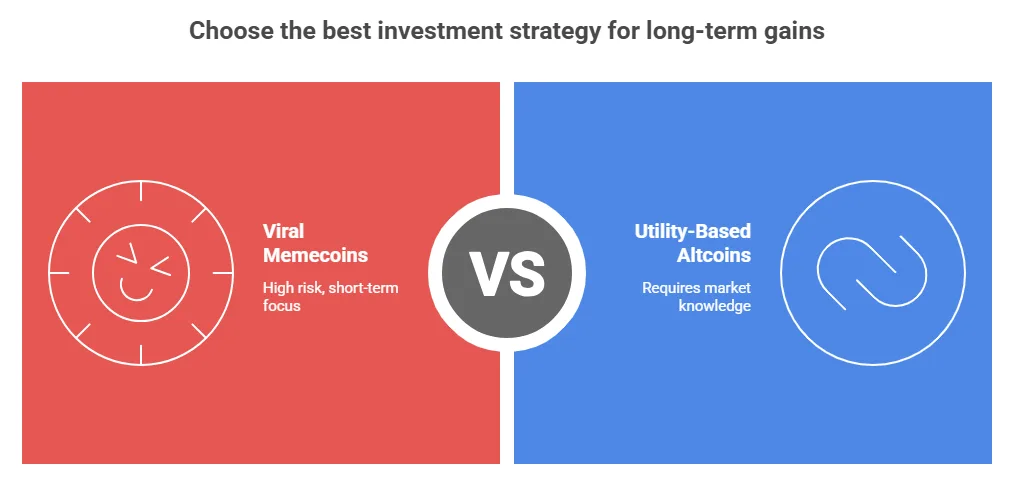
Treating a viral memecoin as a long-term hold may not be the best decision when it comes to making beneficial investments. Similarly, accumulating a utility-based altcoin (DeFi, NFT, RWA) with no strong knowledge of market hype cycles or regulatory outcomes can hurt the investor in the long term.
Investor psychology and market behavior
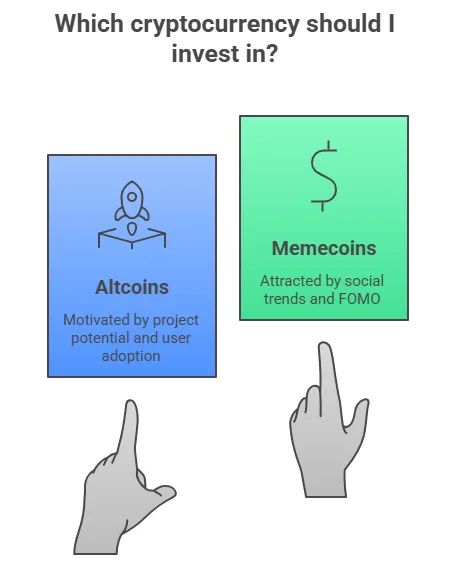
While investors invest in both altcoins and memecoins in hopes of future profits, there is a slight difference in the psychology behind putting money in either of them. For instance, the project’s potential to attract new users and increase adoption motivates utility-based altcoin investors.
On the other end of the spectrum, the longevity of social sentiments attracts memecoin investors. It’s the fear of missing out and joining an online trend that has gone viral in this instance. If the trend continues for some time, it can be enough to generate strong gains for investors.
Performance across market cycles
The performance of altcoins and memecoins differs, depending on the phase of the market cycle. For instance, utility-based altcoins are typically the ones that gather liquidity earlier. When the crypto market enters a bullish phase, BTC is the first one to show any bullish momentum.
Slowly, liquidity flows into large-cap altcoins such as ETH, SOL, ADA, TRX, and others. It is toward the end of the bull market that small-cap tokens like memecoins start attracting liquidity.
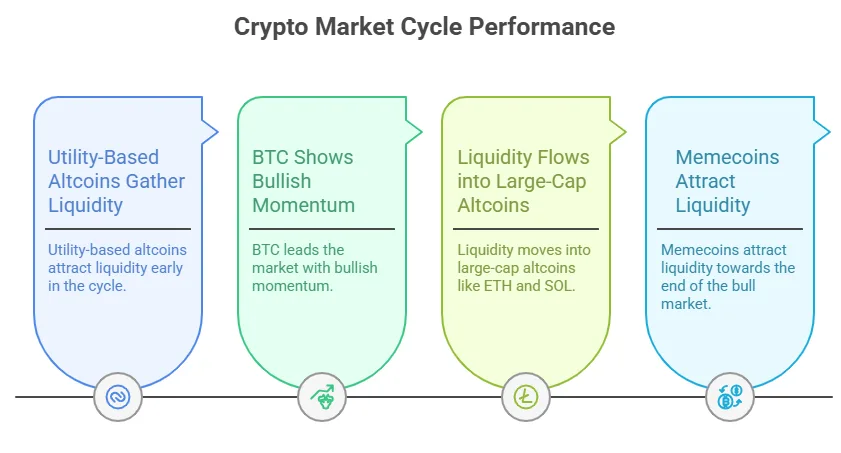
Things essentially reverse in a bear market. At the beginning of a bear market, it is the memecoins that first start showing signs of thin liquidity. As their market caps are usually lower, the exodus of liquidity impacts memecoins severely, resulting in sharp and abrupt price drawdowns.
Final thoughts on utility vs memecoin debate
To sum it up, utility-based altcoins and memecoins – also called sentiment-based altcoins – are the two sides of the same market. While the former class of altcoins is primarily focused on utility, scaling crypto infrastructure, enabling payments via stablecoins, and powering DeFi, the latter is for the less serious investors.
It’s pointless to say one is better than the other since their creation intentions differ greatly. It’s like comparing apples to oranges, or, in this case, ETH to BONK. There simply is no scale of comparison between the two.
The most likely outcome is that both will continue to coexist. From an investor’s standpoint, it is not important to try to predict which category of altcoins will perform better. Rather, what’s more important is to have the necessary knowledge about the tokens, their utility, or lack thereof, and most importantly, to always be cognizant of the fact that in crypto, volatility is the norm.