


Have you ever looked at your cryptocurrency and thought, “I wish I could use this money without having to sell my coins?” You are definitely not alone. This is exactly why the crypto loan was created. It’s a popular yet often confusing part of the digital money world.
Many trading platforms advertise them with flashy promises of low rates and instant cash. But behind that shiny surface is a powerful tool that can help you or, if you’re not careful, hurt your finances. Let’s simplify how a crypto loan really works.
What exactly is a crypto loan?
In simple terms, a crypto loan allows you to use your digital coins, like Bitcoin or Ethereum, as a security deposit to borrow money. The money you borrow is usually a digital dollar, known as a stablecoin, or sometimes actual cash.
Think of it like using your bike as collateral to borrow money from a friend. You still own the bike, but your friend holds onto it until you pay them back. Companies like Coinbase, Nexo, and Binance act like that friend, but instead of a bike, they hold your digital assets.
The big benefit is access to cash without selling your crypto. This means you don’t have to worry about tax bills from selling, and you don’t miss out if your crypto’s value goes up later. That’s the good part. But there’s more to the story.
The parts they don’t highlight in ads
The loan-to-value trap (LTV)
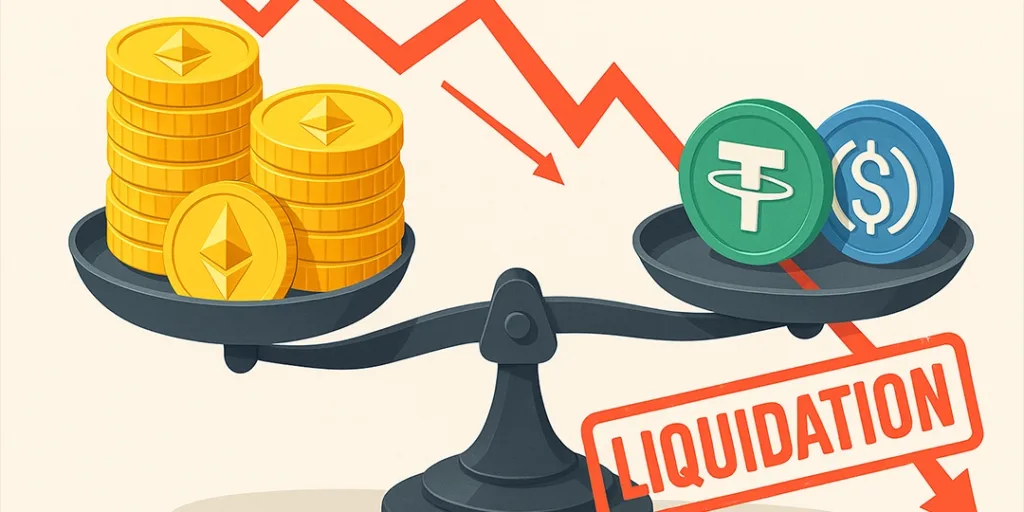
This is the biggest risk. The platform will only lend you a percentage of your crypto’s value, usually between 30% and 70%. This is called your Loan-to-Value ratio (LTV). So, if you put down $10,000 in Bitcoin, you might borrow $5,000 (a 50% LTV).
The problem? Crypto prices change fast. If the value of your Bitcoin suddenly drops, your LTV ratio shoots up. If it goes too high, the platform will automatically sell your crypto to get its money back. This is called liquidation, and it can happen incredibly fast.
The hidden interest curve
Crypto platforms love to advertise low rates: “Borrow at 2% APR!” What they don’t emphasize:
- The cheapest rates often require holding their native token.
- Interest compounds faster than you think (daily or hourly in some cases).
- Rates can suddenly spike during market stress.
What looks like free money can balloon into an ugly debt spiral.
Not all collateral is equal
Everyone knows BTC and ETH are accepted, but what about altcoins? Many platforms let you borrow against them, but at punishingly low LTVs (sometimes 20%). Why? Because altcoins are seen as “junk collateral” that can implode overnight. Worse, if a liquidation happens, these coins might be sold for much less than you expected.
Who’s in charge: A company or code?
There are two main types of crypto loan providers:
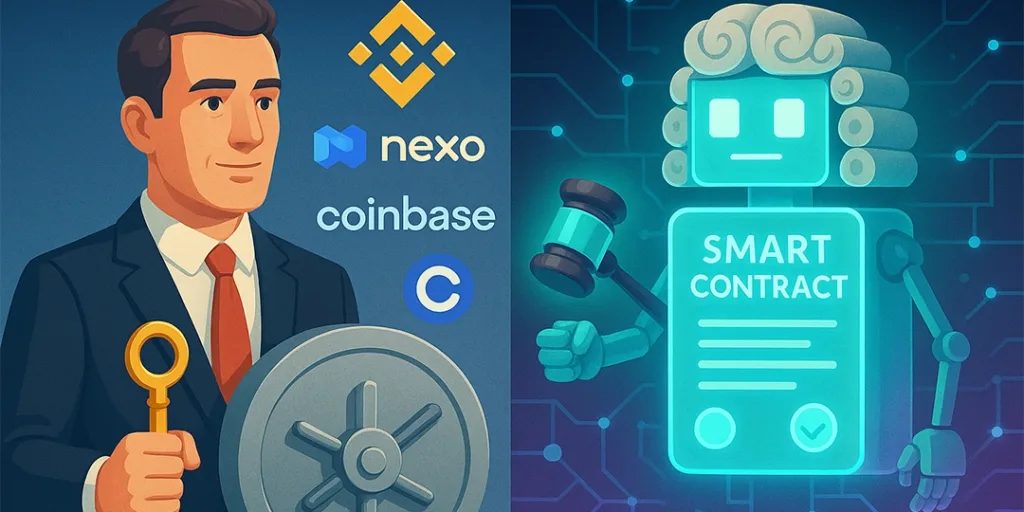
- Centralized (CeFi): These are companies like Nexo or Binance. They act like a bank, holding your crypto and managing your loan. The risk is that they can pause withdrawals if they get into financial trouble.
- Decentralized (DeFi): These are platforms like Aave or Compound that run on automated code, called smart contracts. There’s no customer service to call. The rules are set in stone. If your collateral drops below the required value, the code will automatically liquidate it with no exceptions.
Liquidation isn’t always the end
Some platforms offer “partial liquidation.” This means if your crypto’s value drops, they only sell enough to make the loan safe again, not your entire holding. While this sounds better, it still means you are slowly losing your investment.
Borrowing Stablecoins vs. fiat
Many think a crypto loan means borrowing dollars into your bank account. Wrong. On most platforms, you’re borrowing stablecoins like USDT or USDC. To turn that into fiat, you need to cash out via an exchange, which may mean extra fees, delays, or KYC hoops. Fiat loans exist, but they’re rarer and often more expensive.
The illusion of passive income
Some people take out a crypto loan to reinvest the money elsewhere, hoping to earn more than the loan’s interest. This can work in a good market, but it’s very risky. If your new investment loses value or the market drops, you’re still on the hook for the original loan. Your “passive income” can quickly become an active financial migraine.
Why take a crypto loan at all?
With all these risks, you might wonder why anyone would use one. Used carefully, a crypto loan can be a useful tool. It can help you:
- Pay for an emergency without selling your crypto and creating a tax bill.
- Get access to cash quickly.
- Keep your long-term investments while using their value today.
The key is knowing what you’re getting into and never borrowing more than you can afford to lose.
What to check before you get a crypto loan
If you’re considering it, always ask these questions:
- What is the true interest rate? Is it fixed, or can it change?
- What are the LTV and liquidation threshold? How much can my crypto drop before it gets sold?
- Is the platform trustworthy? Has it been around through market crashes?
- What happens if they get hacked? Do they have insurance to cover my collateral?
- How do I get my money? Will I receive stablecoins or actual cash, and what are the fees to access them?
The bottom line
A crypto loan is not free money. It’s a financial tool that comes with serious risks, mainly due to the volatile nature of cryptocurrency. The platforms will show you the dream of easy cash, but the reality involves volatility and complex rules.
For most people, the lesson is this: a crypto loan can be a way to access money without selling, but never borrow more than you can afford to lose. Tread carefully and always read the fine print.