



Investing in crypto can yield substantial financial rewards. However, the market is highly volatile and comes with big risks as well. For this reason, most investors fail due to focusing on price movements alone, while ignoring fundamental analysis.
Fundamental analysis in crypto is as important as technical analysis. This analytical method makes sure you get to understand the intrinsic value of a crypto project before jumping in. But how is crypto fundamental analysis done?
Crypto fundamental analysis: What is it?
Crypto fundamental analysis is an analytical method that helps you analyze the value of a crypto project based on various aspects such as technology, team, token economy, and market potential. In contrast to the technical analysis, which forecasts short-term price action, fundamental analysis identifies whether a particular coin is overvalued or undervalued.
The ability to evaluate cryptocurrency projects properly can help you distinguish between the projects with deeper value and those that are speculative. That said, the main objective of fundamental analysis is to help determine a crypto’s long-term potential.
For clarity, fundamental analysis is more applicable to long-term investors, who want to invest in specific assets and hodl them for the long term with hopes to make passive gains due to the growth of the project and price increase.
Short-term and medium-term traders often focus on technical analysis because it examines price patterns and market behavior.
How to analyze cryptocurrency through fundamental analysis
The following is how to use key crypto project fundamentals to quantify the potential of a crypto in the long term.
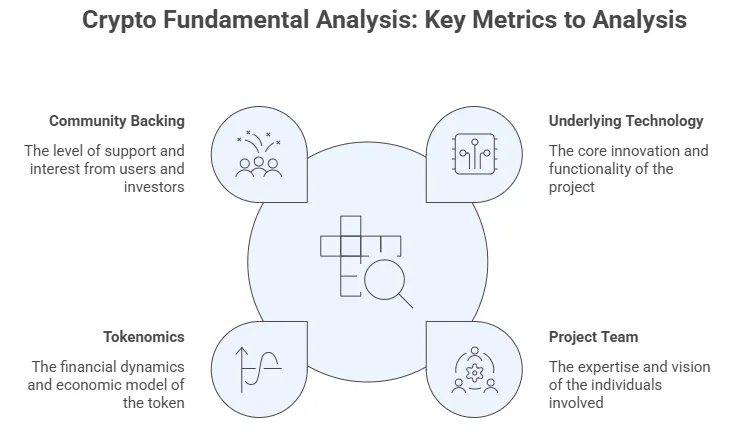
1. Understanding the underlying technology
A cryptocurrency’s long-term potential can be determined by the underlying technology, which often determines the adoption curve.
- Blockchain infrastructure: The underlying blockchain infrastructure determines the adoption rate for a crypto project. For instance, private blockchains are usually chosen by companies because they are faster and offer more control and privacy, though they rely on a central authority.
- Consensus model: Blockchains need a way to confirm transactions and maintain security. A process such as Proof-of-Stake (PoS), used by projects like Ethereum, uses staked tokens and validators to combine efficiency and DeFi innovation, which drives demand.
- Scalability and interoperability: A blockchain is expected to be more practical and used widely if it can scale and increase transactions without delays and high fees. The ability to interoperate with other networks also guarantees that the project can be integrated with other external platforms and services, which increases a project’s adoption potential.
2. Accessing the team behind the project
A good crypto project must be surrounded by a strong and dependable team. Often, teams with prior experience and an innovative approach to solving challenges determine how successful the project could be.
- Experience and expertise: Projects managed by a skilled team comprising experts in their fields, preferably with good results obtained in previous projects and experiences, are most likely to succeed.
- Transparency and effective communication: The team must always be honest with the community and investors and regularly communicate progress, challenges, and updates. Without a transparent and honest team, it is impossible to build trust and awareness around the project.
- Vision and innovation: A team with a forward-looking vision that addresses real-world problems is more likely to succeed and achieve ambitious goals compared to one that focuses on a laid-back approach.
Team analysis promotes confidence in the project by driving conviction that the team will achieve the targeted goals and foster active expansion.
3. Analyzing the tokenomics or token economy
Token economy refers to how crypto projects distribute available token supply to investors, developers, and project owners. Since token distribution determines the credibility of the project, it is a key metric to analyze when conducting fundamental analysis.
- Supply distribution: Crypto tokens usually have a capped supply, like Bitcoin, and it means the token is deflationary. If scarcity increases over time, it drives the price up.
- Distribution model: Determining the distribution of the tokens between founders, investors, and the community is also important. Competitive and fair distribution of tokens to investors often determines whether the crypto will be successful or not, in the long run.
- Utility and use case: The purpose or utility of projects highlights their real-world use, meaning investors prefer projects that solve daily challenges. On the other hand, projects with zero use cannot maintain their value over time.
Analyzing the token economy helps you understand whether a cryptocurrency is positioned for long-term adoption, maintained demand, and active growth.
4. Assessing market demand and community backing
The demand and community interaction also determine the success of a cryptocurrency. High demand and a vibrant community are the leading signs of long-term adoption of a crypto project.
- Market demand: You need to find out whether the project tries to solve a real issue that the users or businesses need to address. The projects with practical and required solutions are widely adopted and developed.
- Community size: A big community shows strong backing for a crypto project, while active engagement shows strong participation to help develop the project further.
- User engagement: Active user engagement means that the users are willing to contribute to the development and adoption of a crypto project, thus positioning it for success through active development.
High demand and popularity increase the chances of a crypto performing successfully over time and are often associated with a stable price increase.
Common pitfalls in crypto fundamental analysis
Even prudent investors are not always accurate in carrying out fundamental analysis. Avoiding general mistakes provides better judgments. However, the following are some of the most common pitfalls.
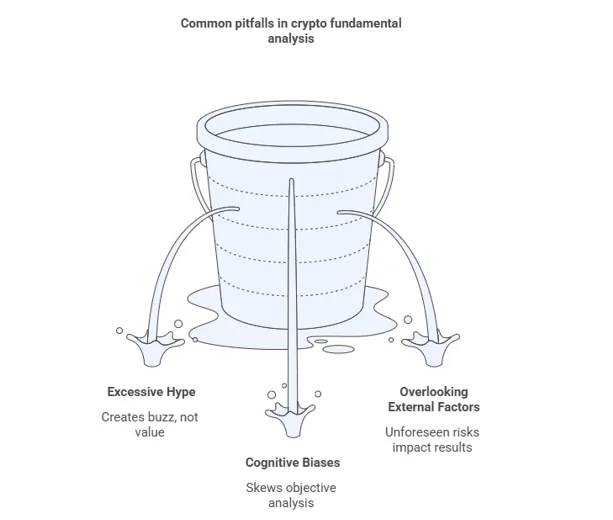
- Excessive hype and marketing: Hype creates a momentary buzz but cannot create long-term value. Projects focusing on hype, rather than strong fundamentals, may be doomed to fail in the long run.
- Cognitive biases: You need to understand confirmation bias, recency bias, and herd mentality. An effective judgment stems from analyzing all information objectively before making decisions.
- Overlooking external factors: Regulations, industry trends, and competition can impact the results of the project. These are some of the aspects that you must take into account in your fundamental analysis to avoid unforeseen risks.
Verdict
Crypto fundamental analysis can be done by assessing the technology, team, tokenomics, and community support. Any project that has a strong base in these aspects would stand a chance to succeed and have a long term growth.
On the other hand, high-risk cryptocurrencies are predominantly powered by hype or speculation and lack innovative technology, powerful teams, poor tokenomics, and strong community backing. Disciplined and systematic fundamental analysis can help you determine the long-term potential of a crypto project.