

You try to send crypto during a busy period. The fee is three times what you expected. The transaction sits unconfirmed for forty minutes. You have no idea why, and nobody explains it.
That’s not bad luck. That’s the scalability of a blockchain network failing in real time, and it happens more often than most project websites will ever admit. If you’re putting money into any crypto project, knowing how to evaluate the network it runs on is one of the most practical skills you can have.
What blockchain scalability actually means
Scalability is a blockchain’s ability to handle more users and more transactions without slowing down, getting expensive, or breaking entirely.
Think of it like a road. Ten cars on a motorway and everyone moves freely. Add ten thousand cars with no extra lanes, and everything grinds to a halt. The blockchain is the road. Every transaction is a car. Most blockchains today are two-lane roads being asked to handle motorway traffic.
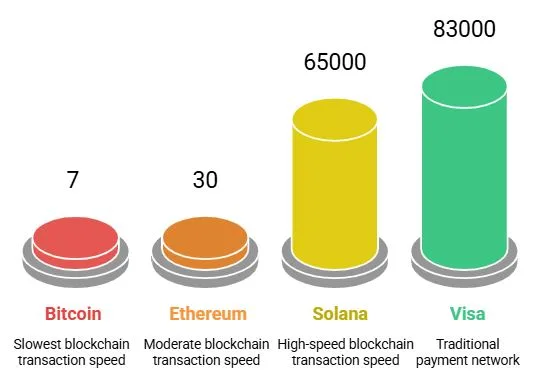
Bitcoin processes 7 transactions per second (TPS) while Visa, a traditional centralized payment network, handles up to 83,000. That single comparison tells you everything about the gap the blockchain still needs to close before it can genuinely compete with traditional finance.
The blockchain scalability trilemma: speed, security, and decentralization
In a 2017 blog post, Ethereum founder Vitalik Buterin identified what became known as the blockchain scalability trilemma. Every blockchain wants three things at once: to be fast, to be secure, and to be decentralized, meaning run by many independent participants rather than a handful of powerful ones. The problem is that pushing hard on any one of these tends to weaken another.
Think of it as a triangle. Push toward two corners, and the third pulls back.
- Bitcoin chose security and decentralization, while speed suffered.
- Solana pushed speed and security, critics argue that decentralization took a hit.
- Ethereum sits in the middle, solving speed through Layer 2 rather than the base layer itself.
The important thing to know is that the trilemma is not a fixed law. It’s an observation, and the entire industry is actively working to break it.
On January 3, 2026, Vitalik Buterin publicly claimed Ethereum has already solved it, pointing to live running code rather than theory, specifically PeerDAS, a data availability upgrade now active on mainnet, and ZK-EVMs, a faster and cheaper way to validate transactions, both at production-level performance. He qualified it by saying full safety hardening is still ongoing, but the claim alone signals how far the space has moved.
How to cut through the noise and measure scalability yourself
When a project claims to be fast and scalable, four numbers are worth checking before you believe them.
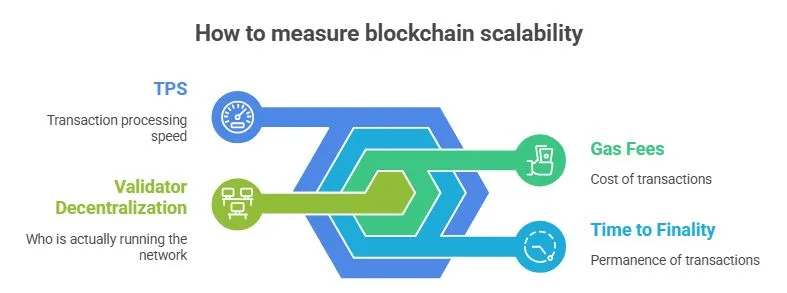
- TPS: Transactions per second
The most cited metric, but also the most misleading on its own. A network can theoretically handle 10,000 TPS, but if those transactions take minutes to settle permanently, the experience is still terrible. TPS tells you the speed limit on the road, not whether the cars are actually moving.
- Time to finality: When is a transaction actually done?
TPS gets all the attention, but finality is what actually matters when you’re using crypto in the real world. Finality is the moment a transaction is permanently locked in, and nobody can reverse it. Think of a bank transfer sitting on pending – finality is when it actually lands and stays. Bitcoin takes around sixty minutes to get there. Solana does it in under a second. For anything involving DeFi, trading, or real-time payments, that difference is not a minor technical detail. It’s the whole game.
- Gas fees: What does it actually cost you?
This is scalability made personal. Ethereum at peak congestion in 2021 charged over $200 per complex transaction. BNB Chain, after its 2025 upgrades, costs fractions of a cent. High fees are not a pricing quirk. They are scalability failing ordinary users, and pricing them out entirely.
- Validator decentralization: Who is actually running this?
The one most beginners completely ignore. A blockchain is run by validators, computers that process and verify transactions.
If running a validator requires expensive professional hardware that only large organizations can afford, the network quietly centralizes over time, even if the transaction numbers look impressive. The more accessible it is to run a validator, the more genuinely decentralized and resilient the network stays.
Blockchain scaling solutions that are actually working in 2026
The industry has not been sitting still. Four approaches are being deployed right now, each attacking the problem from a different angle.
Layer 1 solutions: Rebuilding the road itself
Changes made directly to the blockchain itself. Think of it as tearing up the old two-lane road and rebuilding it with ten lanes from scratch. BNB Chain did exactly this.
Three upgrades in 2025 pushed block times from three seconds down to 0.45 seconds, cut gas fees twenty times over, and the network hit 31 million transactions in a single day without going down once.
Layer 2 solutions: A flyover above the congestion
Building on top of an existing blockchain instead of replacing it. Thousands of transactions happen off the main chain, then the final result gets settled on-chain as one single entry.
Arbitrum, Optimism, and Base all do this on top of Ethereum. Combine that with Layer 1 improvements, and Ethereum could realistically clear 100,000 transactions per second. Not there yet, but closer than most people realize.
Sharding: Opening multiple roads at once
Instead of one lane handling everything, sharding opens multiple lanes at once, each processing its own transactions. Ethereum has it on the roadmap as a serious upgrade, but keeping all the lanes talking to each other cleanly is the hard part. Unlike Layer 2, which is live today, sharding is still being built.
Rollups: Pay the tab at the end of the night
Do all the activity off the main chain, then settle just the final result on-chain. Same idea as running a bar tab all night and squaring up once at closing.
The Lightning Network on Bitcoin and rollups across Ethereum both use this approach, dramatically reducing load on the main chain without touching the security of final settlement.
Where the major blockchains stand on scalability in 2026
No blockchain has fully cracked the trilemma yet, though Ethereum is making the strongest case that it is getting close. Here is where they honestly sit right now:
- Bitcoin: Slow by design, 7 TPS, sixty-minute finality, but the most decentralized and battle-tested network in existence. Lightning Network helps with everyday payments.
- Ethereum: The base layer runs at 30 TPS, but that is almost beside the point. Layer 2 handles the real traffic now at sub-second speeds for fractions of a cent.
- Solana: The speed champion at 65,000 TPS with sub-second finality and minimal fees. The centralization question around validators remains the one thing critics keep coming back to.
- BNB Chain: 0.45-second block times, fees under a cent, targeting 20,000 TPS in 2026. Quietly, one of the most improved chains of the past twelve months.
Understanding these tradeoffs is what separates an informed investor from someone just following price charts.
Why scalability matters even if you never build anything
Scalability is not a developer problem. It’s your problem every time you use crypto.
Every unreasonable gas fee you paid was a scalability failure. Every transaction that got confirmed in under a second was a demonstration of scalability actually working. Every time a DeFi platform felt smooth or clunky, scalability was the reason behind it. The blockchains that solve the trilemma most convincingly will attract the most developers, the most users, and eventually the most capital.
Knowing how to evaluate them before the rest of the market catches on is not a technical skill. It’s an investing skill.
Final thoughts
Remember that stuck transaction from the beginning? That was a network hitting its ceiling. Every blockchain in existence is either actively raising that ceiling or hoping nobody notices it is there.
TPS, finality, fees, and validator decentralization are the four ways to tell the difference. The blockchain that cracks all four without compromise will be one of the most important infrastructure projects of the decade. Now you know how to spot it before the rest of the market does.