



The cryptocurrency industry has gained infamy for erratic and unpredictable price actions that can skyrocket or crash a coin or token into oblivion in no time. An altcoin can surge 20% on one day and crash 35% the next day, leaving investors confused and probably with a notional loss. While traders look at charts for answers to their questions about the token’s price action, one factor often gets overlooked during trading analysis – liquidity.
For anyone investing in cryptocurrencies, especially in low-market cap altcoins, it’s important to understand the numerous concepts associated with liquidity, liquidity pools, slippage, volatility, depth, and impermanent loss. For investors, neglecting liquidity can have potentially devastating consequences, resulting in large capital losses.
What is liquidity’s role in altcoin prices?
In traditional finance, liquidity refers to how quickly an asset can be ‘liquidated’ or converted to cash at a predetermined price. In crypto, the concept largely remains the same. The only difference is with regard to the mechanics of liquidity, due to the presence of automated market makers (AMMs) and decentralized exchanges (DEX).
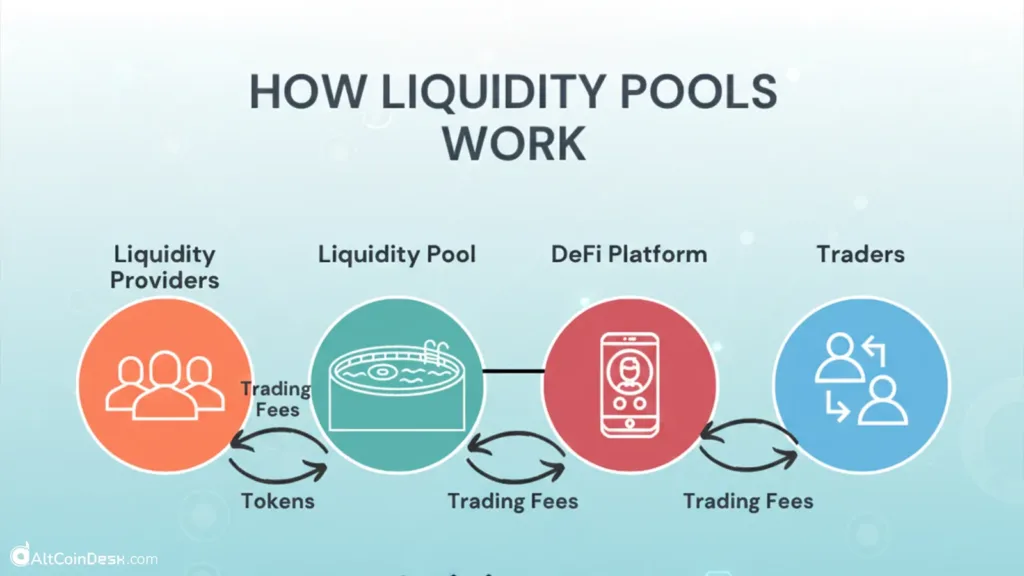
When it comes to altcoins, their liquidity is usually measured through liquidity pools. For the uninitiated, liquidity pools refer to pools of digital assets comprising at least two tokens in a certain ratio. These tokens are locked in a smart contract to facilitate trading.
The larger the pool, the easier it is to trade tokens without causing any major slippages or drastic changes in price. On the contrary, small pools can make it difficult to swap tokens easily without significantly impacting their price.
Diving into liquidity pools
As mentioned earlier, a liquidity pool is essentially a reserve of two or more tokens that enables users to trade between them on a DEX. For example, a USDT/ETH liquidity pool may contain $500,000 of USDT and $500,000 of ETH.
Unlike centralized exchanges (CEX), where traders match orders with buyers and sellers on an order book, DEXes allow traders to tap liquidity pools to swap tokens. In liquidity pools, the price of the underlying token is determined algorithmically, depending on the ratio of tokens in the pool. This trading mechanism was popularized by decentralized finance (DeFi) protocols Bancor and Uniswap.
Two factors significantly impact the health of every liquidity pool – size and balance of tokens. Larger pools with an almost equal balance of two tokens will have minimal slippage and other fees, whereas smaller pools with one token quantity much higher than the other will lead to significant slippage for the trader.
Slippage – the cost of low liquidity
When trading altcoins, slippage occurs when the executed price of a trade is different from the expected price. In markets with high liquidity, fees incurred due to slippages are minimal. On the contrary, markets with low liquidity charge a high amount of slippage, leading to extraordinary price actions in cryptocurrencies with low market cap.
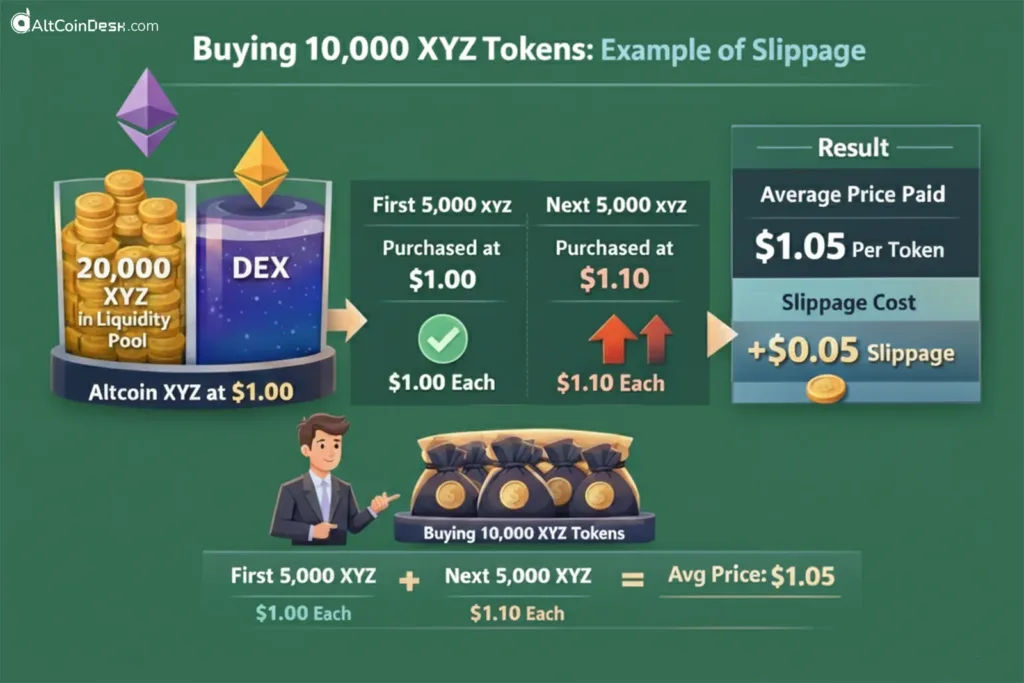
Let’s go through a quick example. Suppose an altcoin XYZ is priced at $1.00, and its liquidity pool on a DEX has a total of 20,000 XYZ tokens, and want to buy 10,000 XYZ tokens.
In this case, the first half of the trade may execute smoothly – 5,000 XYZ tokens at $1.00 – but the other half of the trade may result in the purchase of 5,000 XYZ tokens at $1.10, resulting in an average purchase price of $1.05. Here, the additional $0.05 is a slippage.
Using market depth effectively
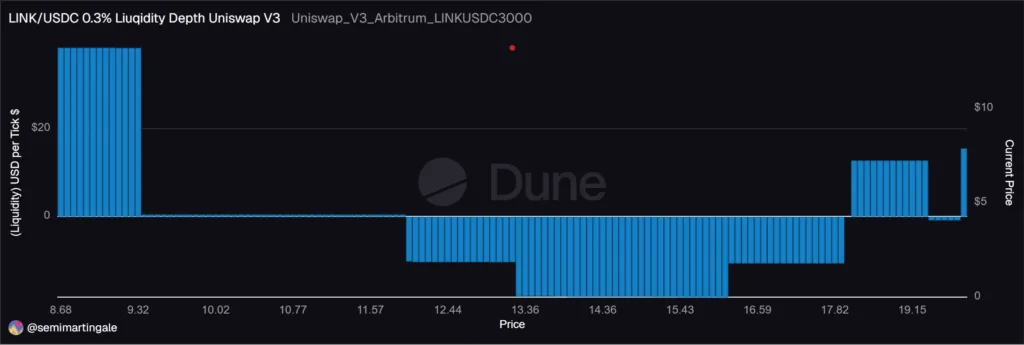
An altcoin’s liquidity is often measured by its depth, which calculates its buy and sell orders at various price levels. On a DEX, depth refers to the size of the liquidity pool across the so-called pricing curve. On a CEX, the depth of an asset is measured by its order book.
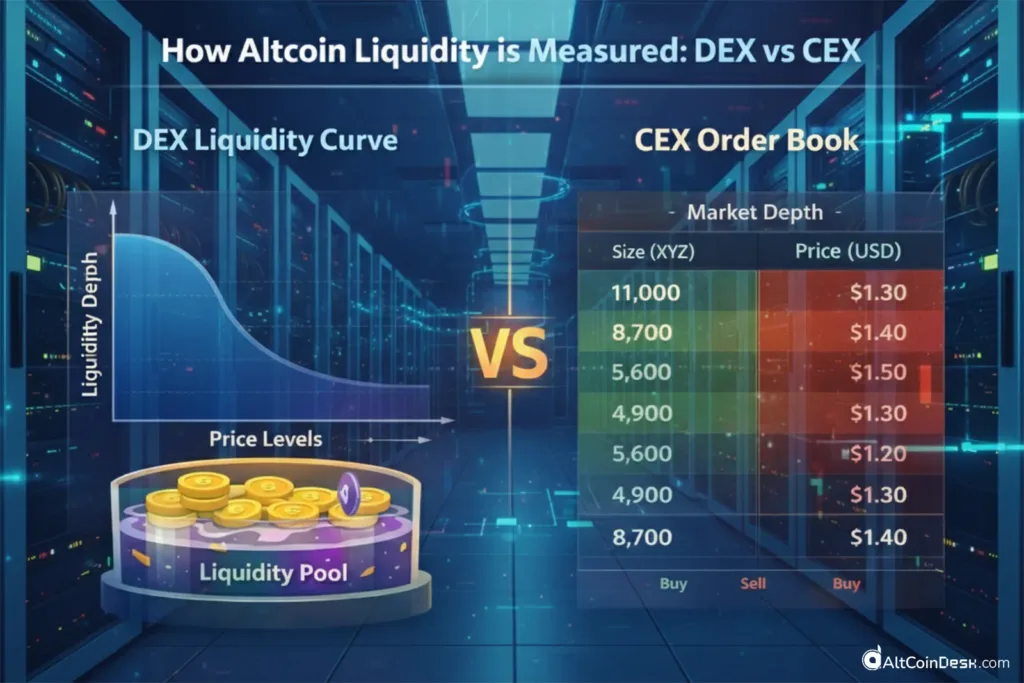
The deeper the market, the higher its capacity to absorb large trades with small price impacts. Conversely, the shallower the market, the more prone it is to volatility and “whale” manipulation.
The depth of an altcoin measures the robustness of its market. For example, even a cryptocurrency with a high market cap can exhibit unstable price action if its market depth is not enough.
Understanding the effect of liquidity on volatility
Volatility refers to the degree of price fluctuation of a token over a given period of time. Volatility can seep in from news, speculation, an influencer’s X post hyping a token, or any other similar event. However, low liquidity can increase such volatility, leading to wild price swings in the underlying token.
Assume there are two altcoins with identical market caps. Coin A has a $50 million liquidity pool, while coin B has a $5 million pool. A $1 million buy order in Coin A will barely nudge the price, but the same order in Coin B could spike the price by 20–30%. Conversely, a large sell order could crash the price just as dramatically.
This problematic relationship explains why low-liquidity altcoins are often at the risk of “pump and dump” schemes and are highly volatile. When entering a trade, traders must account for the associated liquidity, or they might end up losing a significant chunk of their principal amount due to volatility.
Impermanent loss – why liquidity providers should be careful
Just as high or low liquidity can impact traders, it can also have serious consequences for liquidity providers (LPs) that deposit tokens into a liquidity pool to earn fees or on-chain yield. If not careful, LPs can face losses in the form of impermanent loss.
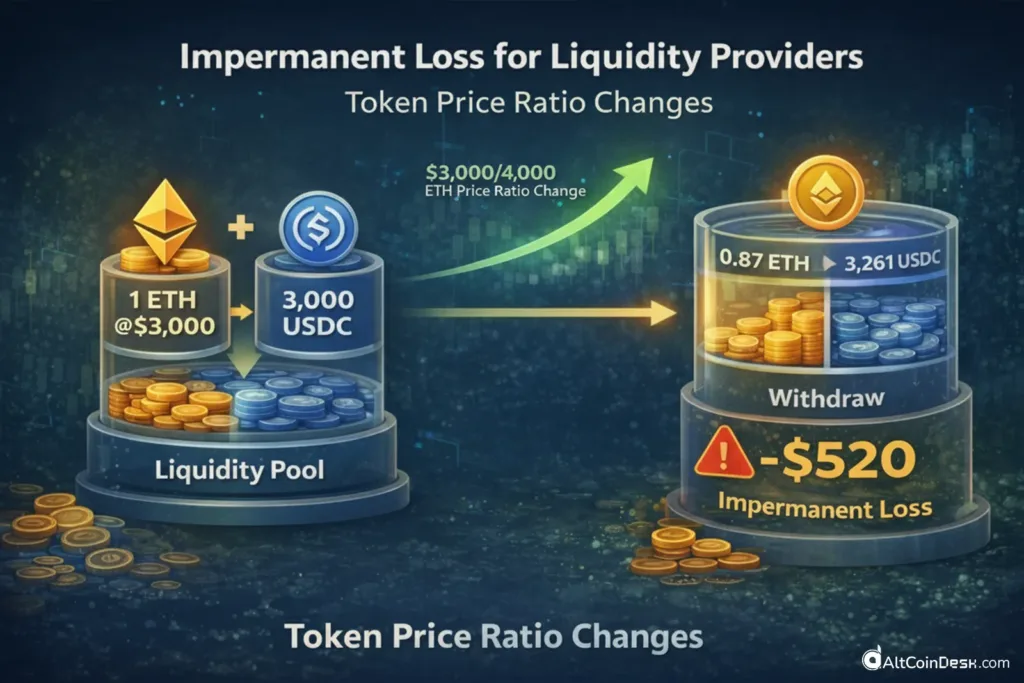
Put simply, impermanent loss occurs when the price ratio of pooled tokens changes, reducing the value of LP tokens relative to the price of tokens had they simply been held. The higher the volatility of the token in the pool, the greater the potential impermanent loss.
Let’s go through a quick example. Assume you add 1 ETH at $3,000 and 3,000 USDC to a liquidity pool, and later ETH rises to $4,000. Your share of the pool is rebalanced, so if you withdraw, you might get less ETH than if you just held it, causing a temporary loss. This loss is “impermanent” because it only becomes permanent if you withdraw while prices have diverged.
Some tricks for mitigating liquidity risks
Although it is close to impossible to eliminate all liquidity risks in a crypto trade, there are some safety checks that investors can employ to mitigate the risks associated with thin liquidity.
Check the token’s pool size: Before engaging in a trade, analyze the liquidity pools on trading platforms. A pool with higher liquidity means less slippage and smoother price action.
Leverage limit orders: When you’re trading on centralized platforms, choose limit orders over market orders to reduce slippage.
Split larger trades: Rather than executing one big trade, split it into several smaller trades for tighter spreads and minimal price impacts on tokens with low liquidity.
Assess depth charts: It’s critical to check the depth of order books to determine how much volume of the digital asset is available at different price points.
Altcoin liquidity is your friend
Liquidity impacts cryptocurrencies far more than most traders would give it credit for. A token’s liquidity is the supporting force behind its price stability, volatility, ability to handle large trades, and the overall cost of living.
Executing an altcoin trade with no understanding of the underlying liquidity is like sailing a stormy sea without a compass. The waves may look predictable on the surface, but the underwater turmoil is likely to disrupt your voyage more than you might anticipate.