


Crypto mining looks simple from the outside. Computers solve puzzles, winners get rewarded, repeat. What that description leaves out is that millions of machines are racing to solve the same puzzle simultaneously, and only one wins.
There was a time when Bitcoin mining from a home computer was genuinely profitable. That time has passed. Today, the competition involves warehouses full of specialized machines running around the clock, and a single Bitcoin miner’s odds of winning alone are roughly comparable to finding a specific grain of sand on a beach.
That’s the problem cryptocurrency mining pools and validators exist to solve.
Proof of work and proof of stake: The foundation
Before figuring out how to choose a mining pool or validator, it helps to understand the two systems they belong to. Everything else flows from this.
Proof of work (PoW)
This is how Bitcoin works. Miners race to solve a mathematical puzzle using specialized computers. First one to crack it gets to add the next block and walks away with a block reward: newly issued bitcoin plus transaction fees.
The catch is that the more miners join, the harder the puzzle gets. A single home miner today is essentially bringing a kitchen knife to a gunfight.
Proof of stake (PoS)
Ethereum switched to a proof-of-stake model, and most newer blockchains were built on it from the start. Rather than burning electricity on puzzles, participants put up their own cryptocurrency as collateral. The network then picks someone from that pool to add the next block, and the more you’ve staked, the better your chances generally, though selection involves weighted randomization rather than pure proportion.
No specialized hardware is needed, but the barrier to entry is still real. Running a solo validator means locking up 32 ETH and keeping a dedicated computer running around the clock.
Both proof of work and proof of stake have the same underlying problem for individuals: meaningful participation is hard to access alone. Pools exist to fix that.
Why crypto mining pools exist
Think of a crypto mining pool like a lottery syndicate. Instead of one person buying one ticket and crossing their fingers, a hundred people throw in together, buy a hundred tickets, and split whatever comes back. Nobody wins big in one shot, but everyone gets something regularly.
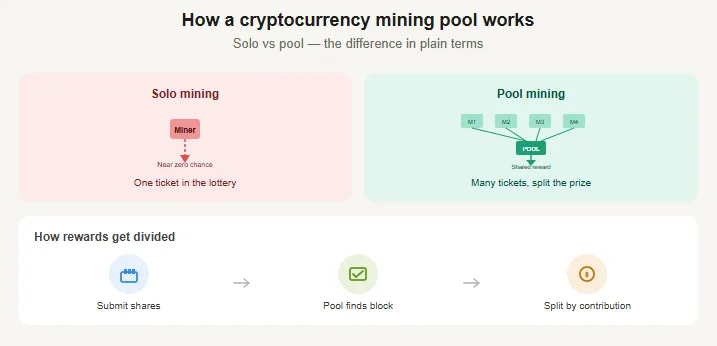
In practice, it works like this. Miners connect their hardware to a shared server, and each machine sends in “shares,” partial solutions that prove it’s pulling its weight. When someone in the pool cracks a full block, the reward gets distributed based on how much each miner contributed. Bring more computing power, take home a bigger slice.
Staking pools on PoS networks work the same way. Smaller holders who can’t meet the minimum stake requirement on their own combine their funds, clear the threshold together, and split the rewards.
How to choose a mining pool
Not all crypto mining pools are built the same way, and the best mining pools aren’t necessarily the most well-known. A few factors make the real difference.
Mining pool size and hashrate
Larger pools find blocks more frequently. Hashrate is how much computing power a pool contributes. More hashrate means faster block finds and more regular payouts.
For anyone who needs a consistent income from their hardware, a bigger mining pool size reduces waiting time. The tradeoff is centralization. When too many miners join the same pool, that pool gains an outsized share of network power, which is a genuine long-term concern for Bitcoin’s health.
Mining pool fees
Pools take a cut of rewards, typically between 1% and 3%. Lower mining pool fees sound better on paper, but aren’t always better in practice. A pool with slightly higher fees but faster servers and fewer rejected shares can pay out more in real terms than a cheaper but unreliable one. What matters is what actually lands in your wallet.
Pool payout scheme
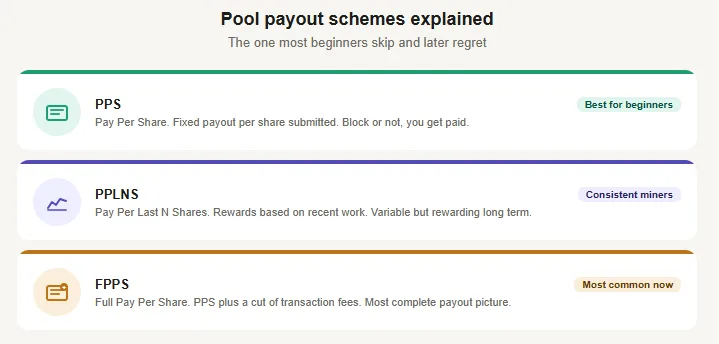
This is the one most beginners skip and later regret. Understanding the pool payout scheme before committing makes a real difference to what you actually earn. Three main options:
- PPS (Pay Per Share): Get paid for every share you submit, full stop. Doesn’t matter if the pool finds a block or not. Predictable and clean. Good starting point for beginners.
- PPLNS (Pay Per Last N Shares): Pay depends on what you contributed right before a block was found. Streaky by nature, but consistent miners tend to come out ahead over time.
- FPPS (Full Pay Per Share): PPS plus a cut of transaction fees from each block. A more complete picture of earnings. Many of the largest pools use this now.
Minimum payout threshold
This is the smallest amount you need to accumulate before the pool sends your earnings to your wallet. A high threshold means earnings sit on the pool’s servers for weeks. A lower threshold means faster access to what you’ve earned, which matters when starting small.
Server location
Work that arrives too late at the pool server gets rejected as a stale share, earning nothing. Servers close to your location reduce that risk.
Transparency
A trustworthy mining pool lets you see your submitted shares, hashrate, and payout history in real time. If a pool makes this information hard to verify, that’s reason enough to look elsewhere.
How to choose a validator or staking pool
Proof-of-stake networks don’t use mining pools, but they have a direct equivalent: staking pools and validators. The core logic is the same (combine resources, share rewards), but the mechanics and what to look for are different.
A validator is essentially the PoS equivalent of a miner. Instead of solving puzzles, validators are responsible for checking and confirming transactions, then adding new blocks to the blockchain. They’re chosen based on how much cryptocurrency they’ve staked, not how much computing power they have. You’re choosing who to trust with your stake and your rewards.
Solo validator vs staking pool
Running a solo validator sounds appealing until you read the fine print. Full control, full rewards, but also full accountability. Leave the node offline too long or let it behave badly, and the protocol doesn’t send a warning email. It just takes a portion of your staked coins. That’s slashing, and it’s automatic. For most beginners, a staking pool is the more practical starting point.
Validator commission rates
Staking pools charge a percentage of rewards as their fee. Validator commission rates vary significantly between providers. Compare them before committing and factor in what you’re actually getting for that fee in terms of reliability and track record.
Uptime record
A validator that frequently goes offline loses rewards and risks slashing penalties. Look at historical uptime before choosing a provider. Consistent, near-perfect uptime is what to look for.
Decentralization risk
Some staking pools control too large a share of their network’s total stake, mirroring the centralization concern in PoW. Choosing a smaller provider costs nothing in returns but helps keep the network healthy.
Slashing history
Check whether a validator has ever been slashed. A single incident doesn’t automatically rule them out. Repeated slashing events suggest a pattern of poor operation that’s worth avoiding.
Liquidity terms
Some staking pools issue a liquid token in return for a deposit that can be used or traded while the underlying stake remains locked and earning. Others lock funds for a set period with no flexibility. Know exactly what you’re agreeing to before depositing anything.
The practical test before committing
For mining pools: don’t commit full hashrate immediately. Point a portion of hardware at two or three candidate pools for a week each and compare actual net payouts. Real data beats whatever the fee page promises.
For staking pools: start with a small amount through a provider with a long, publicly verifiable track record. Most established providers publish their validator performance data openly. Read it before depositing anything significant.
Summing up
Picking a cryptocurrency mining pool or validator isn’t just a numbers game. Fees matter, but so does consistency, transparency, and whether the pool you’re joining is quietly making the network more fragile by hoarding too much power.
For beginners, the right choice is rarely the flashiest one. It’s the one with clear terms, honest data, and a payout structure that makes sense for how you actually plan to participate. Start small, see what the real numbers look like, and scale from there.