



Crypto rewards those who plan ahead and punishes those who don’t. The market is full of stories about single-token bets that wiped out entire savings, and just as many about steady, structured holders who came out well on the other side. The most practical thing a beginner can do early on is to diversify your crypto portfolio in a way that spreads risk without spreading capital so thin that nothing actually performs.
Unlike stocks or bonds, crypto comes with its own rules, and the way diversification works here doesn’t map directly onto traditional investing. Here’s how to approach it properly from the start.
Know your risk level before buying anything
Before picking any token, it helps to be honest about how much volatility is actually tolerable.
A conservative approach means sticking to large-cap coins like Bitcoin and Ethereum, which carry comparatively lower risk than smaller tokens. A moderate approach adds a couple of established mid-cap coins. An aggressive approach takes on more small-cap exposure. And then there’s the fully speculative end, where someone is essentially gambling on early-stage projects and should only use money they’re completely fine losing.
Knowing which category applies shapes every decision that follows. Buying high-risk tokens without acknowledging the risk level is one of the fastest ways to get caught off guard.
Crypto portfolio diversification starts with sectors, not coins
This is where most beginners go wrong. They buy several tokens, thinking they’re diversified, but all of them are doing roughly the same thing.
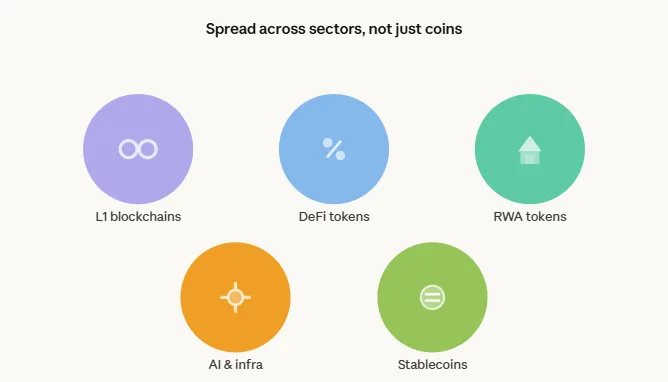
Genuine crypto portfolio diversification means holding assets from different categories that don’t all react to the same triggers. A token spread across genuinely different sectors gives a portfolio real breathing room.
A practical way to think about it:
- Layer 1 blockchains like Ethereum or Solana form a solid base
- DeFi tokens tied to decentralized protocols offer a different return profile
- Real-world asset (RWA) tokens are backed by off-chain assets and tend to behave differently from purely speculative coins
- AI and infrastructure tokens move on their own sector narratives
- Stablecoins like USDC hold a fixed value and act as dry powder, ready to deploy when prices dip
One token per sector is a cleaner approach than five tokens doing the same thing. More sectors, fewer redundancies.
Add gold-pegged tokens for exposure beyond crypto
This is a layer most beginner portfolios skip entirely, and it’s worth knowing about.
Gold-pegged tokens like PAXG are backed one-to-one by physical gold. Holding one means exposure to the price of gold without needing to buy, store, or insure anything physical. It trades on-chain like any other token but tracks an asset that historically moves independently from the crypto market.
When crypto goes through a broad sell-off, gold-backed tokens often hold their value or behave differently from the rest of the portfolio. For a beginner building a crypto portfolio for beginners, adding a small position here is one of the simpler ways to introduce a genuinely non-correlated asset without leaving the crypto ecosystem entirely.
Use dollar-cost averaging to spread entry risk over time
Most conversations about how to diversify crypto investments focus on which assets to hold. Fewer focus on when to buy them, which matters just as much.
Dollar-cost averaging (DCA) means putting a fixed amount into a token at regular intervals, regardless of price. Instead of trying to time the market, a position is built steadily over weeks or months.
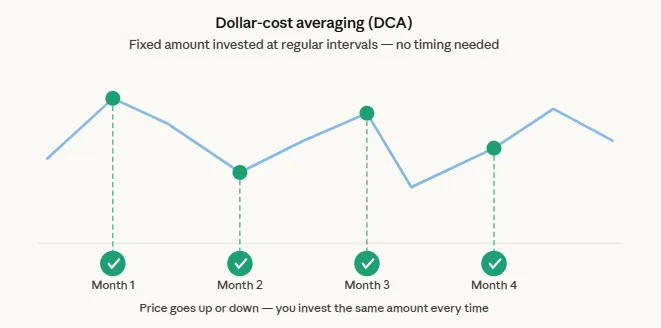
This spreads entry risk across time, which is its own form of diversification. It removes the pressure of getting the timing perfect and makes short-term price swings far less stressful to deal with. For someone new to the space, it’s also a practical way to stay consistent without obsessing over daily price movements.
Understand how digital diversification differs from traditional investing
Rebalancing a traditional investment portfolio takes time. There’s paperwork, processing delays, fees, and sometimes minimum holding periods before anything moves.
In crypto, the same process takes minutes, runs around the clock, and involves no intermediaries. That’s a genuine advantage. But it also removes the natural friction that slows down impulsive decisions.
Because trades execute instantly and fees are often low, beginners tend to overtrade and overcomplicate things faster than in any other market. The speed is useful only when there’s a clear strategy behind it. Without one, it works against the portfolio rather than for it.
Rebalance with a clear trigger, not a feeling
Rebalancing gets mentioned a lot in investing, but the advice to “do it periodically” often isn’t detailed enough to be useful.
A more practical habit is to set a specific trigger. If one token grows to a much larger share of the portfolio than originally intended, that’s the cue to trim, not when it “feels right” or when someone on social media says so.
Checking the portfolio after a major market move, or on a fixed monthly schedule, and bringing allocations back to the original plan is more reliable than reacting emotionally. Locking in partial profits on a strong performer and redistributing that capital keeps the portfolio balanced without exiting positions entirely.
It’s also worth knowing when a sector narrative is running hot. DeFi, NFTs, and AI tokens have all gone through periods of extreme enthusiasm followed by sharp corrections. Trimming into strength rather than holding through a reversal is a discipline worth building early.
Don’t overdiversify
More tokens don’t automatically mean more safety. At some point, spreading capital across too many coins just waters down the wins without doing much to protect against losses.
Think about it this way: if a token doubles but it only holds a tiny share of the portfolio, the overall balance barely moves. On top of that, every extra coin added is another project to research, track, and make decisions about when the market gets choppy.
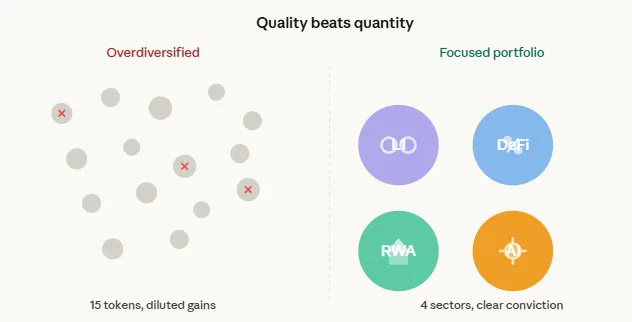
A tighter portfolio with genuine conviction behind each pick tends to do better than a bloated one held together by guesswork. When learning how to diversify crypto investments, fewer well-chosen positions almost always beat a long list of half-researched ones.
Final takeaway
To diversify your crypto portfolio well, the focus should be on what each asset actually brings to the table, not how many assets are sitting in the wallet. Sectors, roles, and correlation matter more than coin count.
A crypto portfolio for beginners holds up better when it’s built around a clear plan from day one. Keep it focused, check in on it regularly, and resist the urge to add more just because something looks exciting in the moment.