


Scalping is one of the fastest and most demanding trading styles in crypto. Traders open and close positions within minutes, sometimes seconds, targeting small price movements across many trades in a single session. Done with discipline, it can generate consistent returns. Done without structure, it can drain an account fast.
Risk management for crypto scalping isn’t a secondary concern for scalpers. It’s the foundation of the strategy. Small wins build slowly, and one undisciplined trade can erase hours of work. This breakdown covers what that looks like in practice and why each rule matters.
What makes scalping riskier than long-term trading?
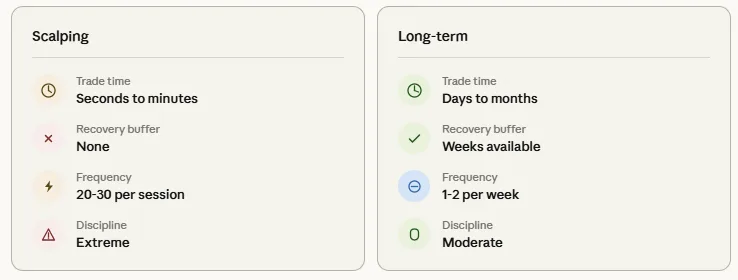
Long-term investing is forgiving in ways that scalping simply isn’t. Buying Bitcoin and holding through a 20% dip is manageable. The price may recover over weeks or months, and the investor still comes out ahead.
Scalping offers no such buffer. Every entry and exit is immediate. There’s no time to wait for a recovery, no margin for emotional decisions, and no second chances on a bad trade. Losses are realized fast, and that speed punishes poor preparation more than any other trading style.
A trader might open and close 20 to 30 positions in one session. Without a consistent crypto scalping strategy risk control system from the start, one bad sequence can compound into serious damage before the trader even realizes what happened.
Which timeframe and which coins work best for scalping?
Most scalpers work on the 1-minute to 5-minute chart, with the 3-minute chart being a popular middle ground. It filters out noise without the lag that comes with longer timeframes. Many experienced scalpers also keep a 15-minute or 1-hour chart open to understand the broader direction before entering shorter-term trades.
Bitcoin is widely considered the safest asset to scalp. It has deep order books, consistently high volume, and price movements that are meaningful without being violently unpredictable. Low-cap meme coins are the opposite. They can spike or crash 30 to 40% in minutes on little to no news, and liquidity can disappear right when an exit is needed most.
The difference between scalping BTC and scalping a low-cap altcoin isn’t just about volatility. It’s about whether a trader can actually exit at the price they intend. Before scalping any altcoin, checking its on-chain liquidity is a necessary step. Thin liquidity means a trader’s own order can move the price against them, destroying the small margins that scalping depends on.
Crypto scalping risk management: The five core rules
Effective risk management for crypto scalping comes down to five consistent habits. Most traders who lose money scalping aren’t wrong about market direction. They’re wrong about structure, and that structural failure is what takes them out.

Scalping stop loss: Define the exit before the entry
A scalping stop loss isn’t optional. It’s the first thing to define before any position is opened. It automatically closes the trade if the price moves against the entry, preventing a small loss from turning into a large one.
Stop losses need to be tight, with a reasonable range of risking 0.2 to 0.5% on a single trade. Place the scalping stop loss at a logical technical level, such as just below a support zone, rather than at an arbitrary price. A single trade left open without one can cause more damage than ten disciplined losing trades combined.
Position sizing in crypto: Control how much is at risk per trade
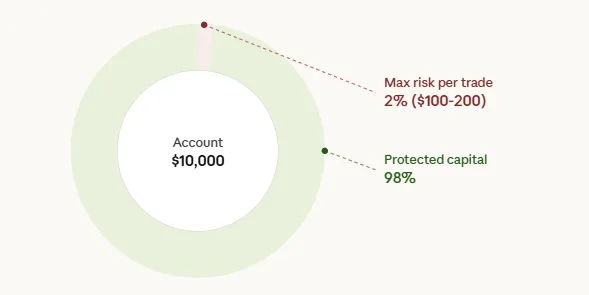
Position sizing in crypto determines how much capital is committed to each trade. The standard rule is to risk no more than 1 to 2% of the total account on any single position. On a $10,000 account, that’s a maximum risk of $100 to $200 per trade.
Many beginners still use oversized positions because they’re trying to generate bigger returns from fewer trades. Position sizing in crypto is a separate discipline from leverage selection, and both need to be managed independently.
Risk reward ratio: Only enter trades where the math works
The risk reward ratio measures how much a trader stands to gain relative to what they risk. A 1:2 ratio means risking $50 to potentially make $100. Scalpers generally target a minimum of 1:2.
Losing 6 trades at $50 each is a $300 loss. Winning 4 trades at $100 each is $400 in gains. The net result is positive despite only a 40% win rate. That’s why the risk-to-reward ratio matters more than win rate alone.
Crypto trading leverage: Use it conservatively
Crypto trading leverage amplifies both gains and losses. Most exchanges offer leverage as high as 50x or 100x, where even a 1% move in the wrong direction can wipe out the entire position through liquidation.
Most experienced scalpers limit themselves to 2x to 10x, depending on the asset. One liquidation at 20x leverage does more damage than twenty controlled losing trades at 2x. Understanding liquidation mechanics and how to prevent it is one of the most important skills for anyone using leverage in crypto trading.
Daily loss limit: Stop before a bad session becomes a bad week
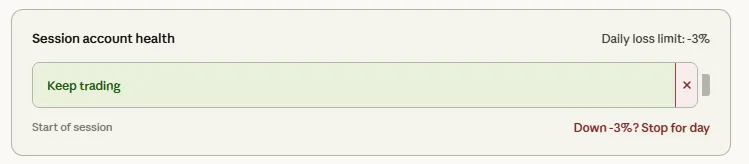
A daily loss limit is a pre-set threshold at which a trader stops for the day entirely. If the account is down 2 to 3% in a session, the day ends. No exceptions.
After consecutive losses, the urge to recover within the same session is powerful. That behavior, commonly called revenge trading, almost always compounds the damage. Decisions made under that pressure are rarely made with the same clarity as decisions at the start of a fresh session.
The benefits of proper risk management in scalping
When the crypto scalping strategy risk control framework is consistently applied, scalping has genuine advantages:
- Positions close within minutes, so overnight news and weekend volatility don’t affect open trades
- Returns come from small, repeatable setups rather than waiting months for a trend to develop
- Both rising and falling markets can be traded, so direction doesn’t limit opportunity
- Feedback is immediate, which accelerates learning far faster than long-term strategies
These benefits only exist when the crypto scalping risk management structure is solid. Without it, the same speed that makes scalping attractive is exactly what makes accounts blow up.
The takeaway
Risk management for crypto scalping isn’t a set of optional guidelines. It’s the strategy itself. A disciplined scalping stop loss, proper position sizing in crypto, a consistent risk reward ratio, conservative use of crypto trading leverage, and a firm daily loss limit are what separate traders who build accounts over time from those who burn through them.
Bitcoin remains the most reliable asset for scalping due to its liquidity and price stability. For any altcoin, always verify liquidity before entering and define the maximum acceptable loss before placing the trade.