

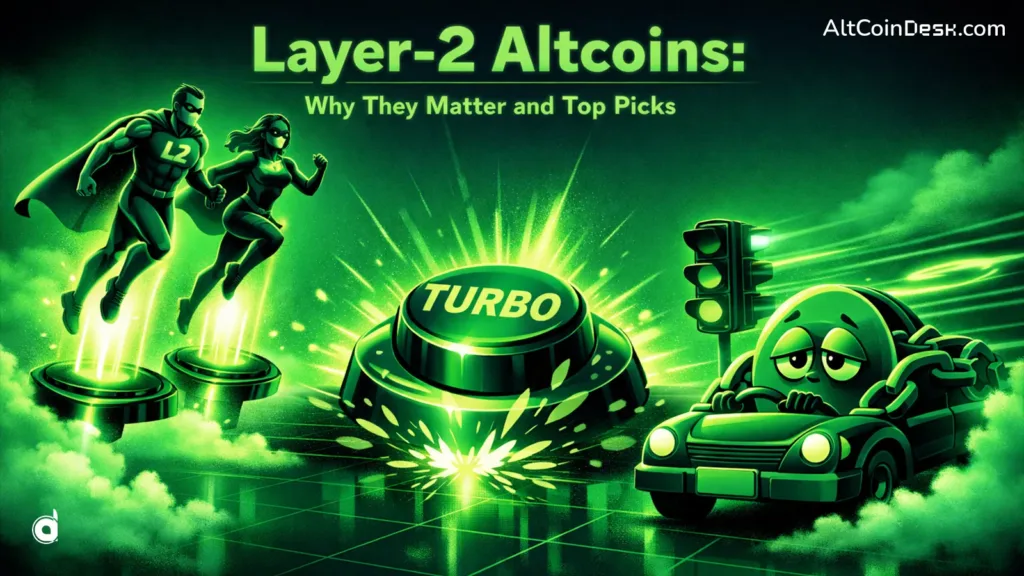

The strange thing about technology is that success can create the next problem. Blockchains learned this the hard way.
Picture a beautiful new highway built for the future. It promises speed, security, and independence from the old financial world. Everyone gets excited. Millions of people jump into their cars. Five minutes later, the highway turns into a parking lot.
That was early blockchain. When networks like Bitcoin and Ethereum became popular, something awkward happened. The technology worked exactly as designed. It was secure and decentralized. But it was also slow and expensive when too many people showed up.
At the worst moments, sending crypto could cost more than a decent lunch. This is where layer-2 altcoins enter the story. Think of them as clever side roads that take traffic off the crowded highway, move cars faster, and then reconnect to the main road at the end. Without layer-2 altcoins, blockchain might still be sitting in that traffic jam today.
A quick history of the great scaling panic
In the early days, blockchains had a philosophical problem. They wanted three things at the same time: Security, decentralization, and speed.
Unfortunately, achieving all three is about as easy as eating soup with a fork. Developers started looking for a workaround. Instead of forcing the main blockchain to handle everything, they asked a smarter question.
What if most activity happened somewhere else first? That idea became the foundation of layer-2 altcoins and second-layer networks. Transactions happen off the main chain, get bundled together, and then settle back onto the base blockchain later. Less congestion. Lower fees. Faster transactions. Crypto finally discovered the equivalent of express lanes.
The different species of layer-2 altcoin magic
Not all layer-2 altcoins use the same technology. In fact, the ecosystem looks a bit like a zoo full of very clever animals trying different survival strategies.
Optimistic rollups: The trust but verify method
Optimistic rollups assume transactions are valid unless someone proves otherwise. The system processes transactions off-chain, then posts the results back to Ethereum. If someone spots fraud, they can challenge it. This model powers networks such as Arbitrum and Optimism. In simple terms, the system says, “We trust you… But we are watching.”
ZK rollups: The mathematical magicians
Zero-knowledge rollups take a different route. Instead of assuming transactions are valid, they produce cryptographic proofs that mathematically confirm everything is correct. Yes, it sounds intimidating. No, you do not need a PhD to use them. Projects like Starknet and zkSync rely on this model. Imagine submitting your homework along with proof that the teacher does not even need to check it. Math already confirmed you did it right.
Channels and Bitcoin-style Layer-2
The concept is not limited to Ethereum. On Bitcoin, second-layer systems allow users to transact quickly without touching the base chain every time. The idea helped inspire projects like Stacks, which brings smart contracts and applications to Bitcoin. Suddenly, the oldest blockchain started learning new tricks.
Why Layer-2 altcoins became essential
Here is the simple truth. Blockchains are designed to move slowly on purpose. Every node verifies every transaction. That is fantastic for security. It is not fantastic for buying a five-dollar coffee.
Layer-2 altcoins fix that problem. Instead of forcing the main network to handle thousands of transactions per second, layer-2 networks process activity elsewhere and then record the result on the base chain.
Today, these systems already handle far more activity than Ethereum itself. In other words, the future of blockchain scaling is already happening quietly above the base layer.
Meet the most important layer-2 altcoins
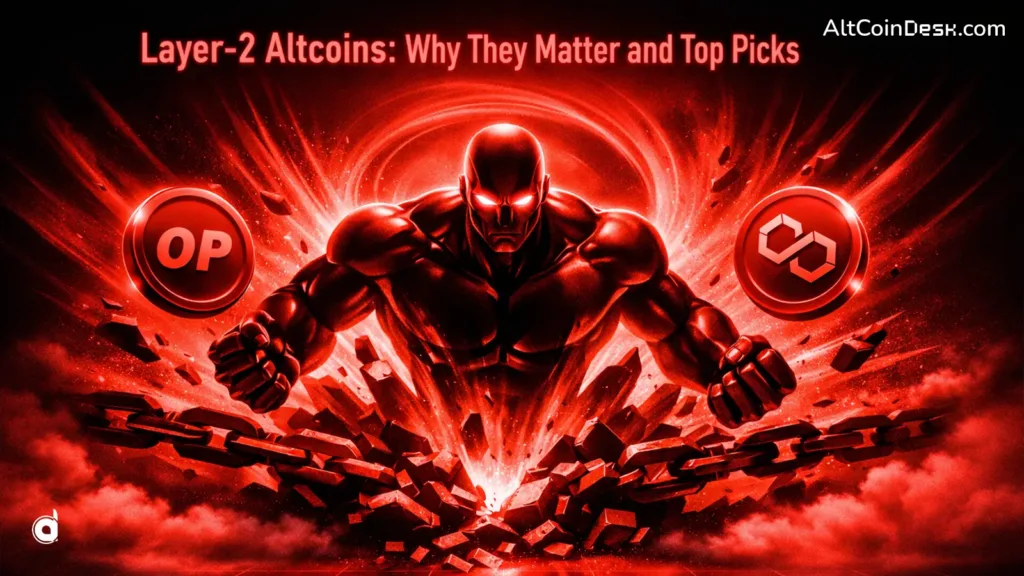
Now comes the fun part. Let us meet the stars of the layer-2 altcoin universe.
Arbitrum and the ARB Token
ARB is tied to the Arbitrum ecosystem, currently one of the largest Ethereum rollups. Arbitrum focuses on decentralized finance and large-scale applications. Billions of dollars in value flow through the network. It is the closest thing to a heavyweight champion among layer-2 altcoins.
Optimism and the OP Token
The OP token powers the Optimism ecosystem. Optimism is building something called the Superchain, which sounds like a comic book but is actually a network of interconnected rollup chains. Imagine multiple cities sharing the same highway infrastructure. That is the Superchain idea.
Starknet and the STRK Token
STRK belongs to Starknet, one of the most technically advanced zero-knowledge rollups. It focuses heavily on cryptographic proofs and advanced scaling. Developers love it. Mathematicians adore it. Normal humans mostly just enjoy the cheaper fees.
zkSync and the ZK Token
ZK represents zkSync Era, another major ZK rollup project. Its goal is simple. Make Ethereum fast enough for real-world usage without sacrificing security.
Mantle and the MNT Token
MNT powers Mantle, a modular scaling network. Technically, it is closer to a validium than a classic rollup, but investors still group it among layer-2 altcoins because it helps scale Ethereum. The ecosystem is growing quickly.
Stacks and the STX Token
STX represents the Stacks ecosystem. Stacks is unique because it connects to Bitcoin rather than Ethereum. It allows developers to build smart contracts and applications that use Bitcoin as the settlement layer. If Ethereum has layer-2 highways, Stacks is building new roads for Bitcoin.
Here is a strange fact: One of the biggest layer-2 networks does not even have a token. Base, launched by Coinbase, has grown rapidly without introducing its own coin. Yes, that means the most important layer-2 altcoin discussion sometimes includes a network that does not have an altcoin at all. Crypto never misses an opportunity to be confusing.
The risks nobody mentions at first
Despite the excitement, layer-2 altcoins come with a few reality checks.
- First, network success does not always mean token success. A blockchain can thrive even if the token struggles.
- Second, many layer-2 networks still rely on centralized sequencers or upgrade mechanisms. Full decentralization is still evolving.
- Third, the technology is moving fast. Some projects that look dominant today could fade tomorrow.
In crypto, history moves at the speed of caffeine.
Why layer-2 is probably the future
If blockchains want to serve billions of people, they cannot operate like crowded highways forever. The solution is clear. The base chain becomes the global settlement layer. The layer-2 networks handle the daily traffic. This design is already shaping Ethereum’s long-term roadmap. Upgrades now focus heavily on improving conditions for rollups and second-layer networks.
In short, the future of blockchain probably looks like a tall skyscraper rather than a single floor. Layer-1 at the bottom. Layer-2 above it. Applications everywhere.