
If you’ve ever used a decentralised exchange (DEX) like Uniswap or Curve and wondered, “How is this working without someone on the other end?” you should learn about liquidity pools. These pools are one of DeFi’s best ideas, and they are the unsung heroes who make sure your crypto trades go smoothly at 3 a.m.
Emily Carter, a blockchain researcher at DeFi Labs, says that “liquidity pools solved one of crypto’s hardest problems.” “They made it possible for decentralised trading to work on a large scale without relying on big centralised exchanges.”
So, let’s open up these digital pots of tokens and see what’s cooking inside.
What is a Liquidity Pool, exactly?
Think of a huge, virtual cookie jar. There are cryptocurrencies in it instead of Oreos. People, also known as liquidity providers or LPs, put their tokens into this jar so that anyone can trade them whenever they want.
A buyer and a seller are needed for a trade in traditional finance. You want to buy shares of Apple? You have to buy it from someone. In DeFi, though, liquidity pools let the code do the hard work. No people needed. It’s just smart contracts and some good old-fashioned crypto magic.
Uniswap, SushiSwap, Curve, and PancakeSwap are all decentralised exchanges (DEXs) that use these pools. This means that users can swap tokens whenever they want, with no bankers or waiting—just pure blockchain hustle.
What do liquidity pools really do?
Let’s look at a quick example to break it down:
- Let’s say there is a pool for ETH and USDC.
- To make or add to that pool, someone has to put in the same amount of money in ETH and USDC.
- These brave people are the LPs, or liquidity providers.
Let’s say you want to buy ETH with your USDC now:
- You put USDC into the pool.
- In return, the pool sends you ETH.
- The balance changes because you took out ETH and added USDC.
- The smart contract changes the price, and now ETH costs more.
- An Automated Market Maker (AMM) takes care of this price change. The most common type uses the formula x × y = k.
In this case, x and y are the two tokens in the pool, and k is a constant. It’s like crypto maths that never stops.
LPs get LP tokens when they put their tokens in. These are like VIP passes; they show how much of the pool you own and give you a share of the trading fees.
Jonathan Lee, a DeFi strategist at BlockEdge, says that “providing liquidity is often described as a way to earn passive income.” “But it’s not without risk, and that’s something new people should know.”
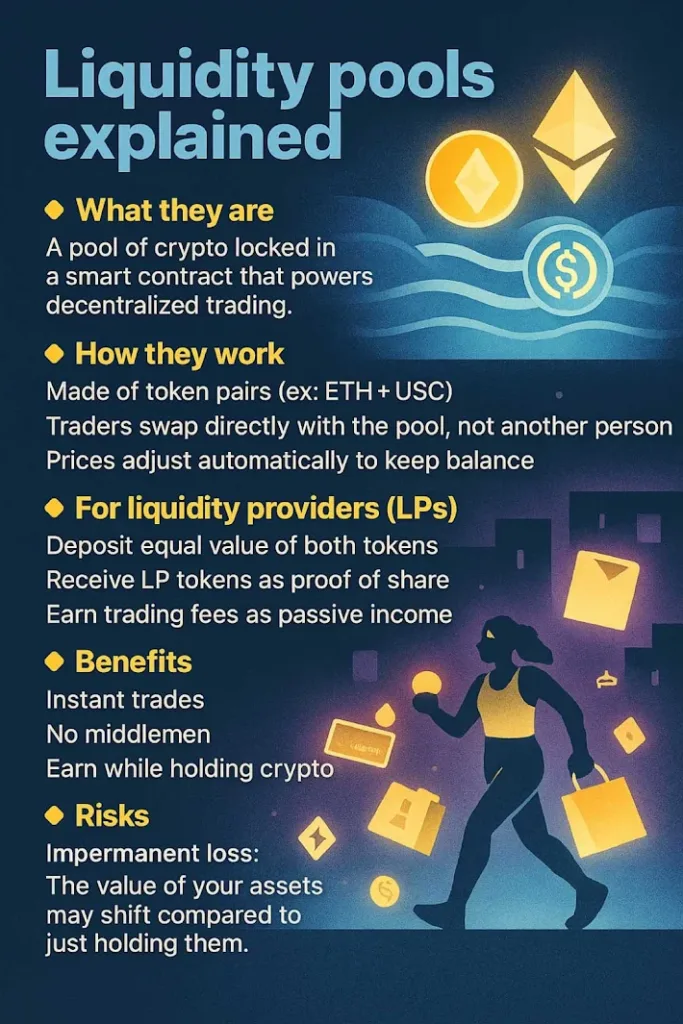
LPs explained: why liquidity pools are very important
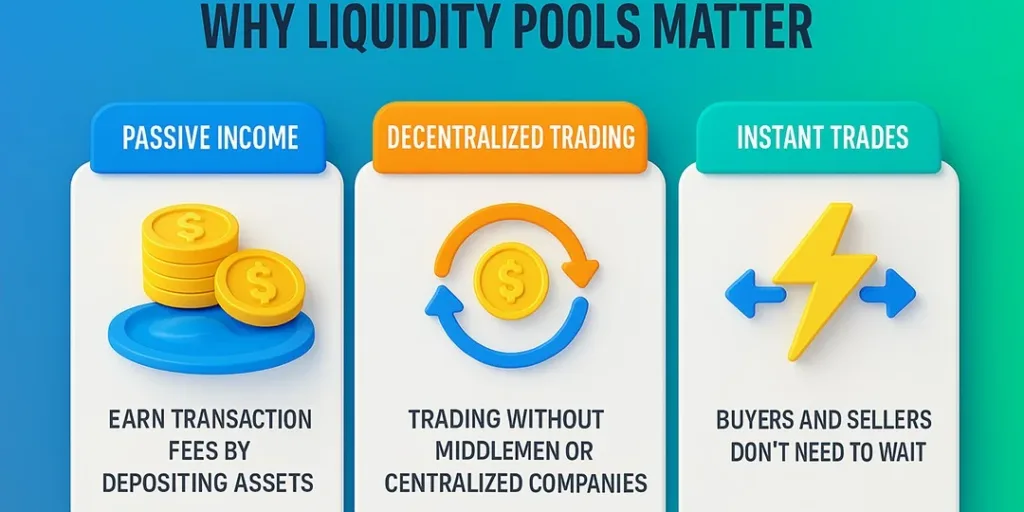
Liquidity pools are what make decentralised trading work. DeFi would be like a concert without speakers — lots of potential but no sound — if they weren’t there. Here’s why they are important:
- Passive Income: LPs get a cut of every trade that goes through the pool.
- No banks, no exchanges: just you, the blockchain, and a smart contract.
- Instant Trades: The pool is always “ready,” so you don’t have to wait for a match.
- Fair Pricing: Prices change automatically based on how much is available and how much people want it.
Ceph from the DeFi community said, “Liquidity pools are the backbone of DeFi.” Say thanks to a liquidity provider the next time you trade tokens.
What are the risks? Yes, there are a few…
You have to pay for this. There is a lot of fine print in liquidity pools, just like there is in any other crypto.
1. Impermanent Loss, or “Wait… Where Did My ETH Go?”
If you put in 1 ETH and 2,000 USDC when ETH is worth $2,000, If the price of ETH goes up to $4,000 while it’s in the pool, the algorithm will adjust your ETH and USDC based on the new price.
You might get back less ETH than you put in when you take it out. Your dollar value might still be higher, but it would have been better to just keep the ETH outside of the pool. That “loss” isn’t permanent… until you take it out.
Sofia Mendes, a DeFi analyst at ChainBridge Research, says, “It’s called impermanent loss because the loss goes away if prices go back to where they were.” “But in real life, markets don’t always go back to where they were.”
2. Risk of smart contracts
Keep in mind that all of this is based on code. Your money could be gone if there is a bug or security hole. Remember the infamous Ronin Bridge hack in 2022? It took more than $600 million in just a few minutes.
3. Slippage happens when there isn’t enough liquidity
If a pool is small, big trades can cause slippage, which means you get a worse price than you thought you would. It’s like trying to buy all the chips at a party; it messes everything up.
4. The price of cryptocurrencies goes up and down
This is crypto, after all. Unpredictable returns can happen when prices suddenly drop (or “moonshot”). You might not even be able to make enough money from the fees to make up for the chaos.
According to crypto educator Ginola, “If the price of one asset in the pool goes up or down a lot compared to the other, the provider may end up with a lower dollar value than if they just held the assets.”
What LPs mean
Advice and tips
Liquidity pools aren’t just cool tech; they’re making finance more accessible to everyone. They let anyone, even you, act like a market maker and make money off of other people’s trades.
But let’s be honest: they don’t always win
Tangem Wallet says that if you put your crypto in liquidity pools, you can make money when trades happen on blockchain networks and sometimes get project rewards. There are, however, some things to keep in mind and some risks to be aware of.
If you’re new to this, start small
- Stay with big platforms like Uniswap, Curve, or Balancer.
- Use tools like impermanent loss calculators to see what will happen before you start.
Emily Carter says, “Liquidity pools are like fuel for the DeFi engine.” “They keep everything going, but you should know how hot the fire can get before you jump in.”
One meme about liquidity pools
If DEXs are the dance floor of DeFi, then liquidity pools are the DJs who keep the music going. Keep in mind that even though the music is great, it’s not all fun and games. Be careful, do your own research, and you might be able to earn some tokens along the way.