


If you hold stablecoins but haven’t put them to good use, you are missing out on an easy opportunity to earn passive income safely.
Traditional finance, for centuries, provided us with benefits such as bonds, and corporate credits that are now nearing extinction. Traditional stablecoins such as USDT (Tether) and USDC, offer price stability but do not inherently generate a yield. On the other hand, the purchasing power of your capital may also get influenced by inflationary pressures.
1. Real-World Asset (RWA) Vaults

Investing in tokenized treasuries and money market funds is one of the easiest ways that investors can leverage real-world asset vaults to generate yield tokens.
RWA-backed yield tokens excel in bridging the traditional finance and digital asset worlds. You benefit from the yield on real-world assets without the volatility of cryptocurrencies, keeping the benefits of blockchain such as transparency and efficiency.
The demand for steady yield is high, even in the digital asset ecosystem. The growth of tokenized U.S. Treasuries, offering an attractive yield, are driven by issuers like Franklin Templeton. Platforms like Ondo Finance solve the issues of “safe yield” that have long adversely affected crypto. So, Franklin Templeton brought the investment funds to the blockchain, while Ondo Finance provided authentication with KYC and AML to satisfy institutional regulators.
Over time, Ethereum and Stellar have become the go-to blockchains for settlements, as people want yields that they can rely on.
2. The “set and forget” yield-bearing tokens (sDAI, USDY)
Yield-bearing tokens like sDAI (Staked DAI) and USDY (Ondo US Dollar Yield) provide yield by bridging traditional finance (TradFi) returns with decentralized finance (DeFi) accessibility.
Don’t get confused; these are simply your digital savings accounts.
The set-and-forget feature is because the yield generation process is automated. That is, users deposit funds into non-custodial vaults managed by smart contracts, which automatically deploy funds into the highest-yielding strategies across protocols such as Aave, Compound, and Curve.
The contracts auto-compound rewards by reinvesting them into the asset to maximize the yield.
3. The classic “crypto bank” centralized earn programs
Centralized crypto earn programs work with users earning passive income on their digital assets by lending them to earn an income on their asset. However, there is a centralized entity playing a role here, where an agent can pitch in strategies to provide methods of earning a passive income on their assets.
The model comes with both benefits and drawbacks. In a CeFi, or centralized finance model, the users do the same as they do in traditional banking – adding deposits. They develop strategies to generate returns, such as lending, staking or even active trading.
A portion of the profits as a fixed or variable interest rate is given back to the users, while they take their share for the risk management as well as trading complexities.
The drawbacks include the risk of bankruptcy and fraud or even security breaches such as cyberattacks and hacks.
4. The “market maker” strategy: Liquidity pools

The “market maker” strategy is where you are involved in a liquidity pool but as a liquidity provider (LP) first. In DeFi, the liquidity pool acts as a “robot counterparty.”
Here, yield on stablecoins in liquidity pools is generated in two ways – one through trading fees, generated as users swap tokens, and the other through additional incentive rewards or liquidity mining incentives that are provided by the platform itself.
These come with risks. For instance,the value of the stablecoins can fluctuate, and the liquidity pool can face losses. The value of the assets in the pool is also subject to changes. Unfortunately, this kind of yield generation requires technical expertise. Investors should be aware of the risks and challenges involved.
5. The decentralized bank: Lending protocols (Aave, Compound)
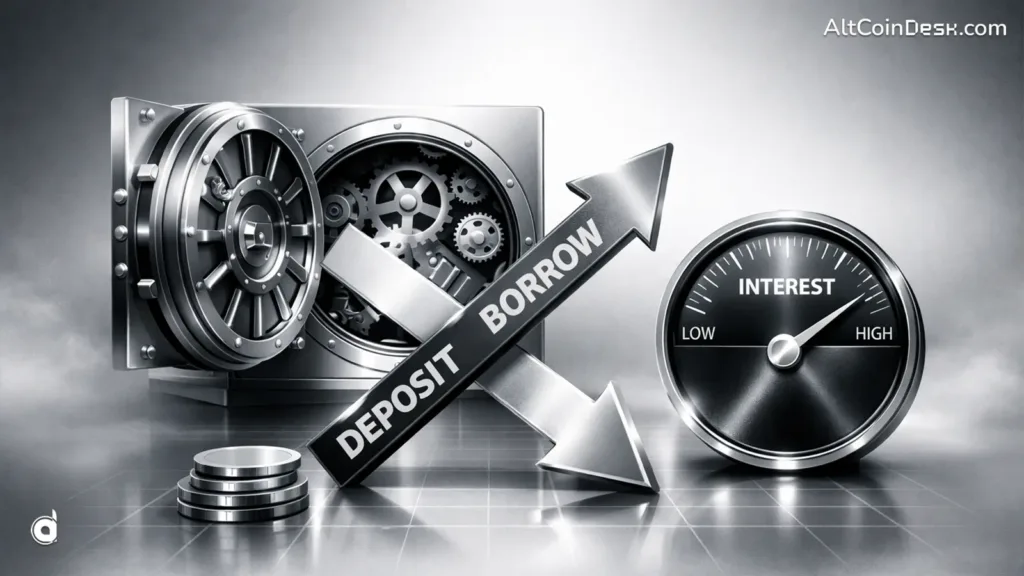
Lending protocols such as Aave and Compound function as decentralized banks in the crypto ecosystem, where the users can earn yield on borrowing demands rather than trading fees.
Here, smart contracts replace banks entirely. The deposits of stablecoins like USDC are made into Aave or Compound, and a special token such as aUSDC or cUSDC representing your deposit is provided in return.
These tokens can then automatically earn interest for as long as they’re held. They can always be exchanged back in 1:1 for your original stablecoins.
6. Revenue-sharing stablecoins (GHO)

GHO is a decentralized, overcollateralized stablecoin central to the Aave Protocol that has a 1:1 value peg with the U.S. dollar. The native stablecoin of Aave Protocol helps earn yield for the Aave DAO treasury, derived from the interest paid by users who borrow funds against their collateral.
You don’t earn interest simply by holding the base GHO stablecoin in a wallet, as its price is designed to remain constant at $1. Instead, passive income is generated through specific engagement in the Aave ecosystem, such as staking AAVE and GHO.