


In crypto, trading isn’t the only way to make some profits. Decentralized finance (DeFi) allows investors to lock up their crypto assets to earn passive rewards, without losing control of their tokens.
The two most common strategies used to lock up assets for passive rewards include staking and yield farming. These methods differ in terms of various aspects, such as how each works, advantages, and risks.
Staking involves giving up a certain amount of your crypto assets to facilitate smooth operation of a blockchain network. These tokens are often used for operations such as securing the blockchain network. On the other hand, yield farming is about putting your assets into decentralized platforms so they can support trading, lending, or swapping.
Understanding the differences between the two is essential for anyone serious about making their crypto productive. In this piece, we’ll perform a comparative analysis of staking vs yield farming to help you understand the option that would suit you best.
What does staking mean and how does it work?
Staking is a decentralized finance strategy where investors lock up their cryptocurrencies to be used for blockchain network operations in order to earn rewards. Since most blockchain networks, such as Ethereum, Solana, and Cardano, use the Proof-of-Stake (PoS) consensus mechanism, the need for staking to support transaction processing and network security is high.
Validators are tasked with verifying transactions and creating new blocks using the staked assets. However, the process does not necessarily involve running complex infrastructure for the end user. Investors usually hand over the assets to the validators through wallets or crypto exchanges. The validators then perform the technical work of transaction validation and give out rewards to users for the staked tokens.
How staking works
Staking varies slightly based on the blockchain network. However, the process is very similar: you stake your tokens, the validator does the technical work, and you get rewards in return.
The typical staking process involves:
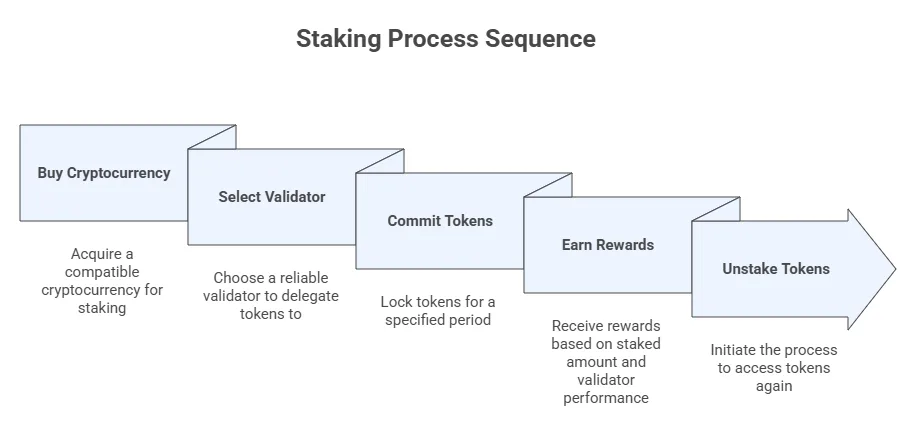
- Buying a compatible cryptocurrency: Only blockchains built on Proof-of-Stake or similar models allow staking. Examples include Ethereum, Cardano, and Solana, among others.
- Validator selection: Investors must pick validators or staking platforms where they can stake their tokens. It’s good to note that the rewards, in most instances, differ depending on the performance of the validator.
- Freezing of tokens: Once staked, tokens are frozen to allow the validator or exchange to use them for transaction validation.
- Rewards: The validators provide the rewards based on a fixed percentage after the lapse of the staking period or when the investor unstakes their tokens.
- Unstaking: Investors may either wait until the staking period is over or unstake whenever ready. This verifies based on the staking platform.
Staking rewards are generally predictable. Even though the returns depend on the validator’s network participation, it is a comparatively passive activity compared to other DeFi activities.
What is yield farming?
Yield farming refers to the act of locking tokens to provide liquidity to decentralized finance protocols. Unlike staking, which focuses on transaction validation and network security, yield farming facilitates trading, borrowing, and token swapping.
This method requires you to commit your tokens to liquidity pools. Once investors successfully lock up their tokens to provide liquidity, a portion of the fees that the platform makes is awarded to them. Most DeFi protocols also offer additional tokens as incentives. The additional tokens may be exchanged, sold, or even staked on a different staking platform.
Yield farming may yield higher returns than staking. However, it is more engaging and requires the investor to monitor pool performance, platform changes, and the relative value of their tokens to make decisive moves.
How yield farming works
While yield farming is almost similar to staking, it varies slightly and features various steps. The steps below show how the yield farming process happens:
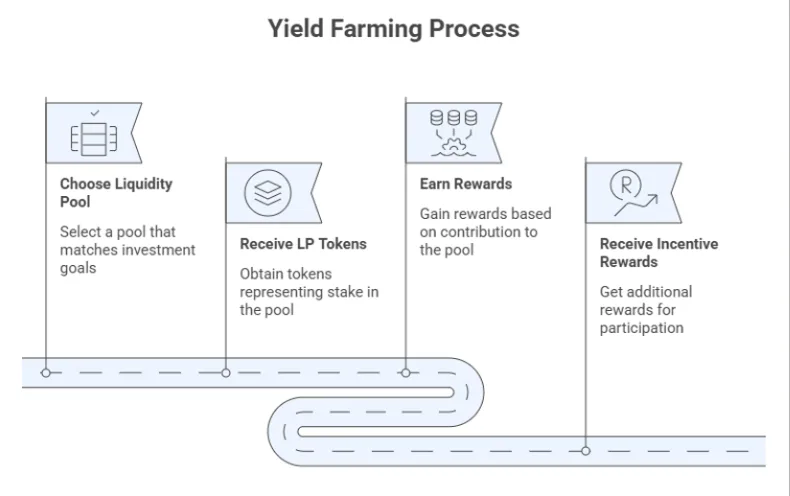
- Choosing a liquidity pool: Investors start by picking a liquidity pool where they would like to commit their tokens.
- Receiving LP tokens: Once the investor deposits their tokens, they get liquidity provider (LP) tokens that show their share of the pool.
- Rewards: The protocol collects fees and interest on loaned out assets, and redistributes them to the members of the pool based on their pool share.
- Incentive rewards: Some platforms issue additional incentives to motivate users to commit more tokens or continue yield farming.
Rewards earned in yield farming differ significantly based on pool activity, the level of liquidity, and the protocol’s incentive scheme. Often, new pools are associated with higher returns. However, returns may reduce rapidly with the influx of additional members. The total returns may also be impacted by price fluctuations of underlying tokens.
Staking vs yield farming: How they differ
Staking and yield farming represent practices of putting your tokens to work for various blockchain or DeFi activities, with the objective of getting some rewards. Here’s how staking and yield farming differ.
| Staking | Yield farming | |
| Purpose | It involves committing tokens to securing blockchain networks and validating transactions. | Involves promoting liquidity for DeFi platforms to support trading, lending, and token swaps. |
| Complexity | Very straightforward. Investors only have to delegate tokens to validators who handle the rest. | Demands active participation from investors and requires monitoring of liquidity pools. |
| Rewards | Offers predictable and consistent rewards. | Rewards vary according to liquidity pool performance, the number of members, and the value of underlying assets |
| Risks | Involves price volatility risks, and validator performance determines returns. | It exposes investors to smart contract risks, and platform changes may affect yields. |
| Management | Very passive and requires minimal effort | Requires active investor participation |
Choosing between staking vs. yield farming
When it comes to choosing the perfect DeFi strategy to earn rewards, personal preference serves as the ultimate decider. In that case, staking is a great option for investors looking for passive rewards. On the other hand, yield farming requires active participation and calls for individuals willing to engage actively in liquidity pools.
However, yield farming may result in more rewards to farmers, compared to staking. Nonetheless, staking is less complex.
The types of assets an investor possesses also play a big part in determining the type of strategy. Staking requires tokens based on the Proof-of-Stake consensus mechanism, whereas yield farming requires DeFi-oriented tokens.