



Here’s a data-driven guide to finding the best time to buy crypto without guessing the bottom.
Let us settle this gently. The best time to buy crypto is almost never a dramatic single day circled on a calendar. It is not a heroic moment where someone shouts that prices will never be this low again. The best time to buy crypto usually appears when three quiet things line up together. Your time horizon makes sense. The asset is not wildly overpriced. Your risk plan can survive a storm.
History keeps teaching the same lesson. Investors who chase the exact bottom often miss it. Investors who wait for perfect certainty usually enter much later at higher prices. Data shows that staged entries beat emotional guesses. The best time to buy crypto tends to be a process, not a performance.
Even Bitcoin itself has been evolving. It once behaved like a rebellious teenager, swinging wildly through predictable four-year cycles. Now it acts more like a maturing asset with deeper liquidity. Fidelity notes that Bitcoin’s market value is now about twice its 2021 peak size, nearly ten times its 2017 peak, and more than two hundred times its 2013 peak. When an asset grows that large, old patterns lose precision. That is why the best time to buy crypto today cannot rely only on past cycle folklore.
Where the market stands right now
Glassnode provides useful on-chain signals that help us judge whether the market is overheated or calm.
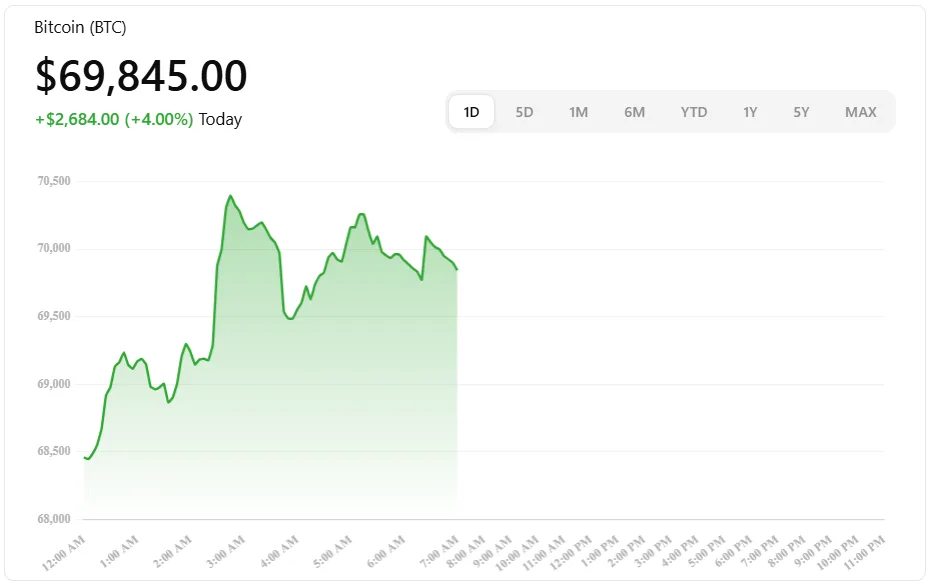
As of March 10, 2026, Bitcoin trades near 69,845 dollars. Its realized price, which reflects the average on-chain cost basis of holders, sits near 54,465 dollars. That means the market price is about 28.2% above what investors collectively paid. This is not a panic zone where assets trade below cost. It is also not a euphoric bubble where the price floats dangerously far above fundamentals.
Glassnode’s MVRV Z Score sits around 0.49. In simple terms, that reading suggests the market is closer to neutral recovery than overheated mania. So the best time to buy crypto may not look like a screaming bargain today, but it does not resemble a speculative frenzy either.
The evidence-based approach most investors miss
If there is one principle that repeats across cycles, it is this. Buy gradually. Buy more when markets fall deeply. Avoid going all in when excitement is loud.
This works because crypto volatility is intense. Consider the damage in previous cycles. From November 2021 to November 2022, Bitcoin fell from about 69,000 dollars to roughly 15,500 dollars. That was a painful 77.5% drawdown. An earlier crash between December 2017 and December 2018 saw an even deeper fall of about 83.8%.
Waiting for confirmation during those periods often meant buying much higher. Throwing all capital in at once was equally dangerous. The best time to buy crypto in those environments belonged to patient accumulators, not impulsive traders.
Strategy 1: The quiet power of dollar cost averaging
If you do not possess insider knowledge or trading expertise, dollar cost averaging remains one of the safest entry methods.
Instead of investing all your capital at once, you spread purchases across time. A sensible crypto plan might divide your allocation across six to eighteen months. This cushions you against sudden drops and reduces emotional decisions.
If prices dip, your overall buying price improves on its own without you doing anything extra. If prices rise, you are already in the market instead of standing aside and missing the move. In uncertain conditions, the best time to buy crypto usually comes from following a steady plan rather than making bold forecasts.
Strategy 2: Buy real weakness, not random dips
Not every red candle deserves celebration. True opportunities usually appear after meaningful drawdowns.
Bitcoin reached a peak of 126,200 dollars in 2025. At today’s level of around 69,845 dollars, it trades roughly 44.7% below that high. That is a real weakness, though still milder than past cycle collapses.
A practical framework looks like this:
- Maintain normal recurring purchases throughout the year.
- Add modestly when prices fall 20 to 30%.
- Add more aggressively when declines reach 35 to 50%.
- Treat altcoins more cautiously since smaller assets often fall harder and recover more slowly.
The best time to buy crypto is not every dip. It is moments of structured fear where strong assets are discounted.
Strategy 3: Let valuation guide you
One advantage crypto offers is transparency. On-chain metrics reveal how investors behave.
The realized price shows the average acquisition level of coins. Buying near or below that level historically improves long-term returns.
MVRV ratios compare market value to realized value. When readings are extremely high, markets may be overheated. When very low, markets may be undervalued.
Today’s readings suggest balance. The market is not screaming cheap, yet it is far from speculative extremes. That is why the best time to buy crypto right now favors gradual accumulation rather than reckless deployment.

Strategy 4: Cycles still matter, but less than before
Bitcoin’s history shows clear waves of excitement and cooling off. Major peaks appeared in 2013, 2017, 2021, and 2025, while the deepest slumps settled around 2015, 2018, and 2022. Analysts often connect these rhythms to supply reductions, shifting liquidity cycles, and the emotional behavior that drives investor decisions.
However, cycles are maps, not clocks. They guide direction but not precise timing. The best time to buy crypto rarely comes from counting years alone.
Two emotional traps should be avoided. Going all in after long vertical rallies. Refusing to buy anything after painful bear markets. Both are fear-driven decisions disguised as logic.
Strategy 5: Forget cute calendar tricks
Some studies say that Bitcoin works differently on some days of the week. But these effects aren’t always the same or reliable. Buying at the same time every Tuesday is not a good strategy. Not calendar superstition, but valuation, liquidity, and risk control should guide when you buy crypto.
What is changing in 2026
Market structure is evolving. On-chain data shows mixed but stabilizing signals. Transaction volumes are improving. ETF flows remain steady. Active addresses and fees remain soft, suggesting cooling speculation rather than explosive mania.
Demand is also changing because of institutional adoption. Spot Bitcoin ETFs are now important ways for money to get in and out. Bigger pools of slower money can help smooth out extreme cycles and make growth phases last longer.
Innovations that may influence timing
RWA.xyz reports tokenized real-world assets reaching about 26.43 billion dollars. Tokenized US Treasuries exceeded 2.2 billion dollars in some segments and surpassed 10 billion dollars overall by early 2026. Yield-bearing blockchain assets allow capital to earn returns without leaving the ecosystem, which may reduce panic-driven selling.
Stablecoins are expanding rapidly. Total stablecoin value stands near 301 billion dollars. Larger stablecoin ecosystems improve liquidity and make capital movement faster.
Layer two scaling continues to expand blockchain capacity. L2BEAT shows a total value secured near 32.41 billion dollars, led by networks like Arbitrum and Base. Lower fees encourage wider adoption.
Adoption is spreading globally. Chainalysis reports Asia Pacific crypto activity rose 69% year over year, with value received jumping from 1.4 trillion to 2.36 trillion dollars. This is steady expansion, not decline.
Risks that can destroy good timing
Volatility remains extreme. Crypto can fall 20% quickly and over 70% across cycles. Regulatory oversight is tightening. FATF warns about stablecoin misuse and discusses controls such as freezing or denying the listing of suspicious assets.
Altcoins also present liquidity risks. Smaller tokens move sharply and unpredictably. Many investors, therefore, treat Bitcoin as a core holding and smaller assets as limited satellite positions.
A practical plan that respects reality
- Invest a fixed amount regularly.
- Increase buying during meaningful drawdowns.
- Use on-chain valuation to judge market temperature.
- Avoid large lump sums after rapid price surges.
- Keep reserve capital ready for panic periods.
This approach removes emotional guesswork and replaces it with structured discipline.
Timing is a habit, not a heroic moment
Fireworks don’t usually announce the best time to buy crypto. It appears quietly during fearful periods, through steady accumulation, and with respect for risk. Perfect entries are myths. Repeatable strategies are real. The smartest moment to enter crypto is for calm investors sticking to a strategy, not thrill seekers hunting flashy reversals.