

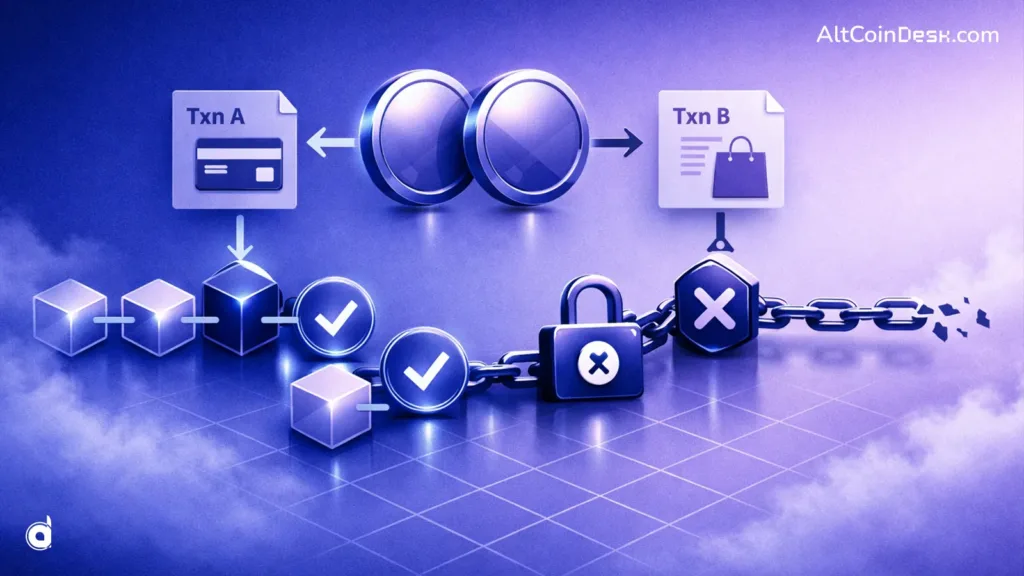

When money starts behaving like a copy-and-paste file, you begin to question everything, and that is exactly how double-spending in crypto nearly broke digital money before blockchain quietly fixed it.
The idea that one digital coin could be sent to two people at the same time. Not by accident, but by design or manipulation. It sounds like a cheat code for infinite wealth, but in reality, it is a nightmare. Because if money can be duplicated, then it stops being money.
Before blockchain showed up, this problem was so serious that it quietly blocked the idea of true digital cash. Not digital payments. Those existed. But digital cash without a middleman? That kept failing.
Let’s say a slightly uncomfortable truth is that digital things love being copied. Songs, photos, memes, and that PDF you said you would read later. All of them can exist in ten places at once without complaining.
So the real question is not what double-spending in crypto is. The real question is how we stopped it without putting a bank in charge.
The original crime scene: When digital cash had no referee
Before crypto, every digital payment system relied on a trusted party. Think banks. Think payment processors. Think the quiet spreadsheet in the background deciding who owns what.
They solved double-spending in crypto before crypto existed by simply saying, “We are the source of truth.” If you tried to spend the same money twice, they would reject one of the transactions. Simple. Effective. Centralized.
But here is the catch. The moment you remove that central authority, the system starts asking uncomfortable questions. Who decides which transaction came first? Who stops someone from sending the same coin twice? Who keeps the official record?
This is where early digital cash experiments struggled. Brilliant ideas came and went, but they all leaned on some form of central control. Then came Bitcoin, which looked at the problem and said, what if no one is in charge, but everyone agrees?
Double-spending in crypto: The simplest explanation you will ever hear
Imagine you have one digital coin. You send it to your friend. At the same time, you secretly send that same coin to yourself or someone else. Both transactions are floating around the network.
Now the system must answer one question: which one is real? That situation right there is double-spending in crypto. It is not about copying a coin image. It is about creating conflicting transactions and hoping the system accepts the wrong one. And yes, people have tried this. Humans are very creative when money is involved.
Meet the usual suspects: How people try to cheat the system
Let’s keep this simple and slightly entertaining.
The Speed Trick
This is the race attack. You send one payment to a merchant and quickly send another conflicting one elsewhere. You hope the merchant accepts the first before the network decides which one wins. It is basically financial speed dating. Whoever gets the confirmation first wins.
The Sneaky Pre-Mine Move
This is known as a Finney attack. You prepare a block in secret, then make a public payment, and later reveal your hidden version of events. It is like rewriting history after collecting your reward.
The Big Boss Move
The famous 51 percent attack. If someone controls most of the network’s power, they can rewrite recent transactions and attempt double-spending in crypto at a larger scale. This is not a casual weekend hobby. It is expensive, risky, and very public.

The real hero: How blockchain says “nice try”
Now we get to the part that changed everything. Blockchain did not just stop double-spending in crypto by saying no. It built a system where cheating becomes extremely hard, visible, and expensive.
Here is how it works:
- Everyone sees everything; in blockchain, transactions are broadcast to the network. Nothing is quietly happening in a corner. If you try to spend the same coin twice, both attempts become visible. That alone is a huge shift. No more hidden moves.
- The network agrees on the order; The real magic is not visibility. It is an agreement. Blockchain forces the network to agree on a single version of events. Which transaction came first? Which one counts? Once that decision is made, the other attempt becomes invalid. One coin. One winner.
Blocks, chains, and time
Transactions are grouped into blocks. Each block links to the previous one. That is where hashing in blockchain comes in. A hash function crypto uses turns transaction data into a unique fingerprint. Change even one tiny detail, and the fingerprint changes completely.
This process, known as cryptographic hashing, locks each block into place. If someone tries to rewrite history, they must redo all the work for that block and every block after it. That is like editing a book where every page is glued to the next. Good luck.
Proof of work: Making cheating expensive
On networks like Bitcoin, adding a block requires computational work. This is not just busy work. It is a security feature. To reverse a transaction, an attacker must redo that work and catch up with the rest of the network. Meanwhile, everyone else is still building forward.
This is why double-spending in crypto becomes impractical on strong networks. It is not impossible in theory, but in practice, it is like trying to outrun a train while building your own track.
Confirmations: The longer you wait, the safer it gets
Here is a simple rule. A transaction is not truly settled the moment you see it. Each new block added on top of it makes it harder to reverse. This is called confirmation.
Zero confirmations means visible but risky. One confirmation means better. Six confirmations means you can finally breathe. This is why serious transactions wait. Because double-spending in crypto becomes less likely with each layer of confirmation.

Proof of stake: A different kind of discipline
Not all blockchains use heavy computation. Some use proof of stake, where validators lock up funds as a guarantee of honest behavior. If they cheat, they lose their stake. So instead of burning electricity, the system uses financial penalties to keep everyone in line. Different method, same goal. Stop double-spending in crypto before it becomes profitable.
Reality check: It is not perfect, but it works
Blockchain does not magically erase the possibility of double-spending in crypto everywhere. Smaller networks with less security have been attacked. Some lost millions. That is the uncomfortable side of this story.
But on large, well-secured networks, the cost of attacking the system often outweighs the reward. That is the balance. Not perfection, but strong resistance.
Here is where things get intriguing, and nobody talks about it enough. Double-spending in crypto is no longer just about blockchains. It is creeping into new areas. Cross-chain systems. Bridges. Offline digital money. The moment you step outside a single, secure network, the problem starts peeking back in. It is like a villain that never fully leaves the movie.
Key takeaway: The quiet reason crypto works at all
If you strip away all the hype, charts, and headlines, crypto depends on one thing. Trust that your coin cannot be spent twice. That is what double-spending in crypto threatened. And that is what blockchain solved in a way no one had before. Not by trusting a company. Not by hiding the ledger. But by making the system open, verifiable, and economically secure.
So the next time someone talks about crypto, remember this. Before price. Before hype. Before everything else. The real breakthrough was simple. Money that cannot be cloned. And somehow, against all odds, a bunch of computers agreed on it.