

Why does time-weighted average price still matter in stocks, crypto, and DeFi?
In an era dominated by speed and algorithmic complexity, one benchmark endures through its simplicity. It does not chase volume. It does not react to sentiment. It simply respects the clock. The time-weighted average price has no interest in outsmarting the crowd. It only cares about one thing: showing up, on schedule, until the work is done.
What is the time-weighted average price?
When people say time-weighted average price, they are usually referring to one of two things, and sometimes they use the same term for both. That can cause confusion, so let us separate them clearly.
- The first meaning is a benchmark. A measuring stick. You take the price of an asset at regular time intervals, add those prices together, and divide by the number of intervals. That gives you the average price over that period. No volume. No crowd behavior. Just time.
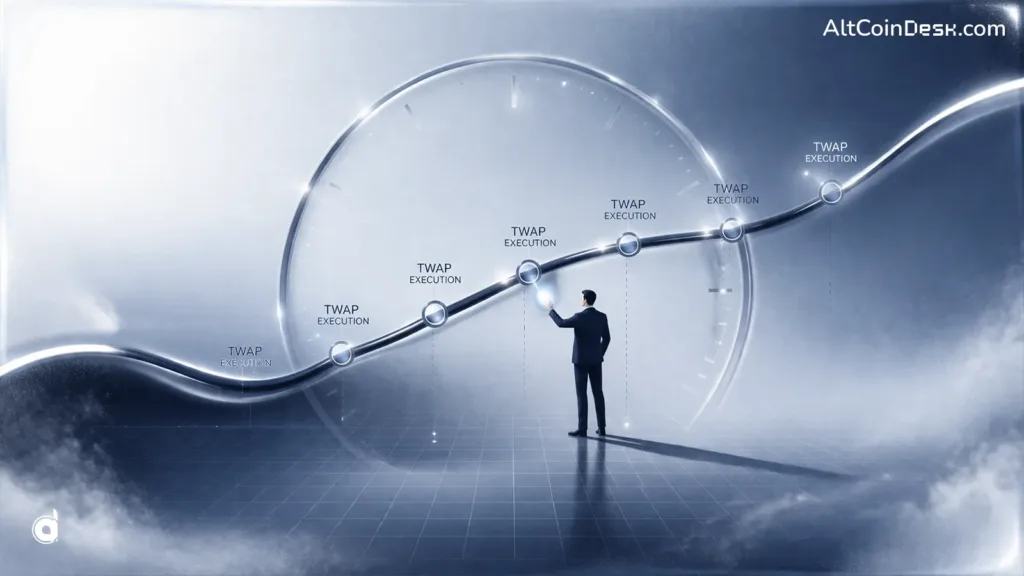
- The second meaning is an execution strategy. A way to trade. You have a large order. Instead of placing it all at once, you slice it into smaller pieces and feed those pieces into the market at consistent time intervals. Every five minutes. Every thirty seconds. The rhythm is steady.
Both meanings share the same core principle. Time is the only thing that matters. Volume does not enter the equation. Sentiment does not matter. The clock moves forward, and the algorithm follows.
Mathematically, the intuition is simple. In the most common textbook form, you sample prices at equal time points and take the arithmetic mean:
TWAP = (P1 + P2 + … + Pn) / n.
Historical evolution: Where it came from
The history of the time-weighted average price is not a story of sudden invention. It is a story of observation becoming routine.
Before electronic trading, the institutional trader who needed to buy a large block of stock would walk to the floor and give a simple instruction to the broker. Buy a little every hour. That was not called an algorithm back then. It was just common sense. You did not want to spook the market by showing your full hand.
When electronic trading platforms emerged, someone realized that this common-sense routine could be automated. The time-weighted average price became one of the first algorithmic strategies for a simple reason. It did not need complex data. A clock and a price feed were enough. That made it easy to implement, easy to trust, and easy to explain to clients.
By the late 1990s, academics began formalizing what practitioners already knew. Bertsimas and Lo published work showing that slicing an order into equal pieces over equal time intervals could be optimal under certain conditions.
Almgren and Chriss later added risk aversion to the framework, showing why traders might sometimes deviate from a flat schedule. But those academic papers did not diminish the practical value of the time-weighted average price. If anything, they elevated it. They gave it a theoretical backbone.
Comparative analysis: The fork in the road
If you spend any time around a trading desk, you will eventually hear the question. TWAP or VWAP?
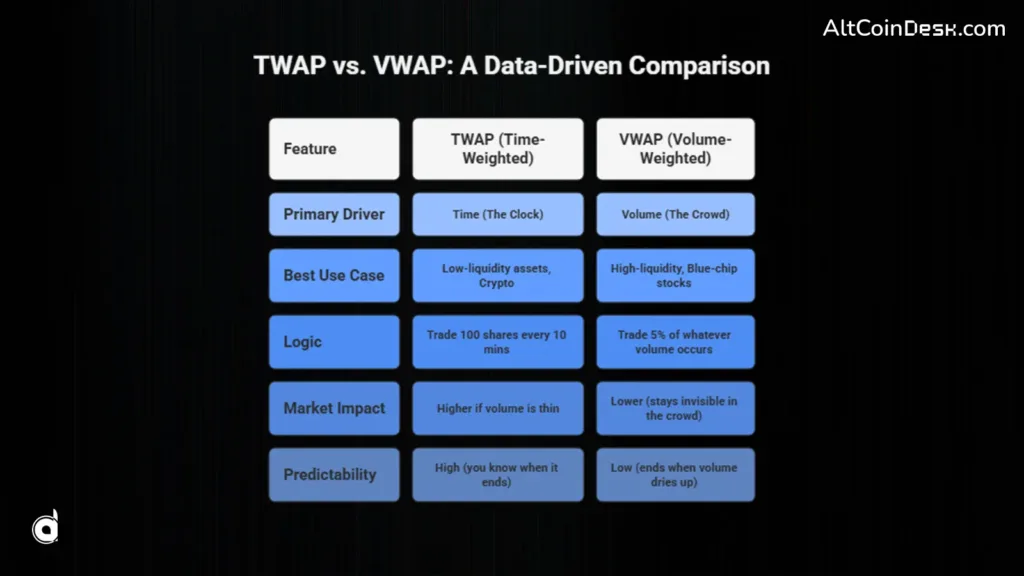
The volume-weighted average price is the natural competitor. It follows the crowd. It looks at historical volume patterns and tries to execute when the market is most active. In a highly liquid stock, that approach works beautifully. Your orders get lost in the natural flow.
But the time-weighted average price does something different. It ignores the crowd entirely. It executes on schedule, regardless of whether the market is busy or quiet. That can be a disadvantage in liquid names, where the volume curve is predictable. But it becomes a strength when volume data is unreliable.
This is why digital assets brought time-weighted average price back into the spotlight. Crypto markets never close. Liquidity is scattered across dozens of exchanges. And volume data can be faked, washed, or manipulated. In that environment, the clock is the only honest reference point. You cannot fake time.
Contemporary applications: A third role
There is another use of time-weighted average price that most people outside decentralized finance do not know about. It serves as an oracle.
In DeFi protocols, someone needs to provide a reliable price that smart contracts can trust. If you simply use the last traded price, you open the door to manipulation. A flash loan attacker can borrow a huge amount of capital, push the price up for a single second, and drain the protocol before anyone can react.
But if the protocol uses a time-weighted average price over the last thirty minutes, that attack becomes nearly impossible. To move the average, the attacker must sustain the manipulation for the entire window. The cost rises with time. The attack stops being profitable. The same logic that helps a trader avoid market impact helps a protocol avoid theft. Time acts as a filter. Noise falls away.
Future trajectories: The modern implementation
If you look at how the time-weighted average price is implemented today, you will notice something interesting. The old version was perfectly predictable. One hundred shares every five minutes. That predictability became a vulnerability. High-frequency trading firms learned to spot those regular orders and jump ahead of them.
So the strategy evolved. Modern platforms now introduce randomness. The timing might vary by a few seconds. The size of each child order might shift within a bounded range. The overall schedule remains time-weighted, but the pattern becomes invisible.
Some firms are now experimenting with adaptive versions that use machine learning to decide exactly when to trade within the time window, based on real-time order book pressure. The core principle does not change. The execution remains anchored to the clock. But the wrapper around it becomes smarter.
And there is talk of cross-chain execution. A single time-weighted average price strategy that spans multiple blockchains at once, aggregating prices and executions across Ethereum, Solana, and private networks. That is the next frontier.
Why it endures
When asked why the time-weighted average price remains relevant when there are algorithms that seem more sophisticated, the answer is always the same because sophistication is not the same as reliability.
In an environment where regulators demand transparency, clients demand accountability, and courts demand an audit trail, time-weighted average price offers something that complex black box algorithms cannot. It offers clarity. Anyone can understand it. Anyone can verify it.
That does not mean it is always the best choice. In fast-moving markets with deep liquidity, other strategies will outperform it. The academic literature has been clear about that since the late 1990s. But being the best in every condition is not the point. The point is to provide a baseline. A benchmark. A defensible fallback.
When you strip away the complexity, what remains is a simple idea. Do not smash the whole order into the market at once. Spread it over time.
Final thoughts on time-weighted average price
I think there is a broader lesson here that extends beyond trading. We live in an age that worships speed. Reaction times measured in microseconds. Algorithms that anticipate our behavior before we are aware of it ourselves. In that world, the decision to slow down, to break a large problem into small pieces, to show up on schedule and simply do the work, can feel almost radical.
The time-weighted average price is not trying to be radical. It is just old. It has survived because it works. Not perfectly. Not in every circumstance. But reliably enough that institutions continue to rely on it, decade after decade.
The clock keeps ticking. The orders keep executing. And the gardener keeps watering, one measured interval at a time.