



Digital assets were once seen as speculative assets, but are slowly being integrated into the global finance sector. As a result, these assets are widely used on a daily basis for cross-border payments and more. However, their transfer between banks and exchanges still faces several challenges, such as slow transfers, banned accounts, and an unclear regulatory environment.
Nevertheless, crypto-friendly banks are emerging to solve this issue by bridging the gap between banks and crypto exchanges. These fiat on-ramp banks provide crypto banking services, which meet regulatory standards.
What are crypto-friendly banks?
Crypto-friendly banks are financial institutions that provide crypto banking services in a regulated environment. These banks enable investors to deposit and withdraw money from licensed crypto exchanges in a swift and efficient manner.
This is mainly supported by the integration of traditional banking systems with crypto systems. Anti-Money Laundering (AML) and Know-Your-Customer (KYC) are also employed in these banks to enforce regulatory compliance. They also collaborate with exchanges, custodians, or blockchain service providers to meet customers’ needs.
Generally, these banks provide a well-managed space where users are free to transfer between fiat and crypto without being regularly put off and having their accounts compromised.
How crypto-friendly banks differ from traditional banks
Mainstream banks tend to approach crypto transactions as high-risk activities. Because of this approach and unclear regulatory framework, these banks restrict crypto transactions and, on some occasions, ban them completely. The infrastructure of traditional banks also lacks proper support for frequent interaction with exchanges, making it difficult for users to make daily fiat-to-crypto transfers or vice versa.
Banks that support crypto, on the other hand, are designed to solve these challenges by supporting efficient and smooth crypto transfers. These banks feature user-friendly interfaces that make crypto transactions faster and easier to perform.
Fiat on-ramp banks are, however, differentiated according to regulatory frameworks, crypto banking services, and clientele served.
Top 4 crypto-friendly banks in 2026
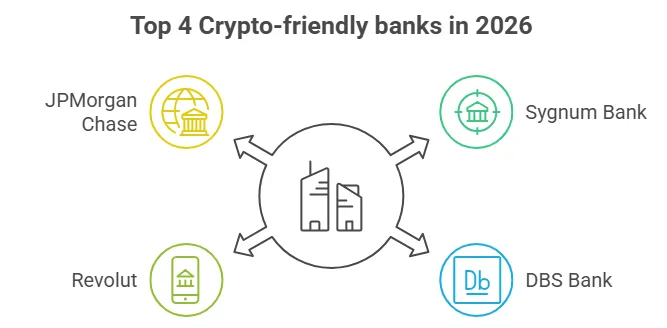
1. Sygnum Bank
Sygnum is a fully regulated digital asset bank. Currently, it is one of the most developed banks offering crypto banking services. This bank provides its clients, including institutions and high-net-worth individuals, with custody, trading, staking, and tokenization services.
It also integrates crypto directly into its core infrastructure, unlike banks that have third-party integrations. Sygnum allows clients to keep their assets off-balance sheet in institutional-grade custody and support staking and yield products. This arrangement lowers the counterparty risk, and at the same time, does not violate stringent financial laws.
Pros
- Wholesome crypto banking products in a regulated form.
- A high level of asset segregation and institutional-grade custody.
- Offers staking and tokenization on the same platform.
Cons
- There are high entry requirements.
- Complex onboarding.
- Not aimed at small accounts and retail users.
2. DBS Bank
DBS has established itself as one of the most progressive conventional banks in the crypto industry, especially with its DBS Digital Exchange and custody offerings. It targets certified investors and organizations that need bank-guaranteed access to digital assets.
The bank uses crypto as part of the larger wealth management system, with the products being trading, custody, and tokenized investment products. It is also aligned with the Monetary Authority in Singapore and has a clear framework. This reduces uncertainty for large clients joining crypto.
Pros
- Firm institutional support through regulatory support.
- Formal custody and dealing in a large banking company.
- Cryptocurrencies and tokenization of assets and structured products.
Cons
- Poor access for retail users.
- A restricted choice of assets compared to international exchanges.
3. Revolut
Revolut bridges the gap between traditional finance and crypto by serving as an all-in-one multi-asset app. The banks allow customers to handle fiat, foreign exchange, and cryptocurrencies via a single interface. Revolut offers crypto trading solutions as well as the daily banking services associated with cards and international payments.
Although Revolut does not have the self-custody feature by default, it helps retail users handle crypto exposure with ease, as it removes technical control. It also features tiered plans, whereby the user may pay to trade and get access to more features.
Pros
- Supports several currencies to offer broader access
- Offers a smooth and efficient integration between banks and exchanges
- Gives new crypto users simple access
Cons
- More costly than specialized crypto exchanges
- Users have limited control over private keys in some regions.
4. JPMorgan Chase
JPMorgan is an institutional and infrastructure-based cryptocurrency bank. Rather than providing direct access to crypto trading or custody services to regular retail customers, JPMorgan aims to incorporate the digital assets into the conventional financial infrastructure in the form of blockchain payment, tokenization, and crypto-linked financial products.
It has a blockchain arm that drives real-time settlement rows for large customers. The fact that it is increasingly accepting crypto ETFs and tokenized assets allows institutional investors to have exposure without evading regulated financial rails. This has JPMorgan as one of the most significant banks that influences the role of crypto in global finance, despite being selective with regard to direct access.
Pros
- Good crypto integration with the conventional financial infrastructure.
- Offers investors a wide-range of crypto services such as ETF-products
- Provides innovative blockchain payment and settlements
Cons
- Only accessible by institutional and high-net-worth clients.
- Its conservative approach slows down the adoption of broader crypto services.
Why are crypto-friendly banks gaining popularity in 2026
With digital assets now making their way into mainstream finance, the demand for banks that support crypto is rising due to the following reasons.
Regulations are forcing banks to adapt
Jurisdictions across the world are working to have transparent regulatory structures for crypto. This has eliminated a lot of uncertainty that kept banks at the fringes. As a result, rather than ignoring crypto completely, various organizations are now providing institutionalized crypto banking services with a set of compliance limits.
Rising demand for crypto-bank bridges
The demand for crypto-friendly banks is rising as users seek regular and predictable access to both traditional finance and digital assets. Institutions are also after regulated crypto products, creating the need for efficient movement of funds between fiat and crypto.
De-banking risk pushes the need for safer options
Reliability issues across conventional banks are forcing investors to opt for more efficient payment rails. As a result, investors are moving into banks that support crypto to avoid challenges such as delays and account termination.
The benefits of crypto-friendly banks
Access to stable financial rails has become a significant factor to consider for an individual who takes part in crypto markets. This makes the selection of the appropriate bank have a direct impact on the ability to move capital, manage risk, and operate across different platforms.

Fewer payment disruptions
With fiat on-ramp banks, one has a high probability of a reduction in blocked transfers, delayed wires, and abrupt account audits. This stability is important when the timing and liquidity have a direct influence on the trading, investment, or business activities.
Enhanced transfers between crypto and fiat
These financial institutions enable users to interact with the fiat and crypto-related transactions in a more interconnected system. In the case of businesses, it increases operational effectiveness in payroll, invoicing, and cash flow that involves intercourse with exchanges and blockchain platforms.
Better regulatory and security frameworks
Crypto-friendly banks operate within defined financial regulations and therefore present some kind of oversight and protection to the systems that are entirely decentralized. This is particularly vital in the hands of users who are dealing with large amounts of capital.
Conclusion
Choosing the best crypto-friendly bank should be more than a feature comparison. All the banks listed above cover a specific market niche, including institutional-quality custody platforms and retail banking services. Your pick must be based on personal priorities, be it ultimate integration, convenience, or guaranteed availability of international payment rails.