


Social media has had a trust problem for years. Accounts get suspended without explanation, algorithms quietly bury content, and every click feeds an advertising machine users never agreed to power. The top decentralized social media platforms were built as a direct response to that frustration, shifting control away from corporations and back to the people actually doing the posting.
Decentralized social media platforms distribute control across open networks rather than parking everything on one company’s server. On Web3 social media, users own their content, their identity, and their audience. After years of big platforms making unilateral decisions about who gets heard and who gets quietly removed, that kind of ownership is worth paying serious attention to.
What is decentralized social media?
On platforms like Instagram or X, everything a user creates sits on that company’s servers. The company sets the rules, changes them whenever convenient, and monetizes the data regardless of how users feel about it. Getting banned is a bit like being a street performer whose entire livelihood depends on one venue owner staying in a good mood.
Web3 social networks work differently. Content lives across distributed networks, and no single authority gets to decide who stays and who disappears without warning.
A few terms worth knowing:
- Web3: The next version of the internet built around user ownership rather than corporate control
- DeSo blockchain: The infrastructure layer powering decentralized social applications and making user ownership technically possible
- Censorship-resistant social networks: Platforms where no single authority can remove content or silence a user
- Creator monetization: Earning directly from an audience without a platform claiming the largest share
- Blockchain-based social apps: Applications built on blockchain infrastructure that hand data control back to users
The top 5 Web3 social media platforms redefining how people connect online
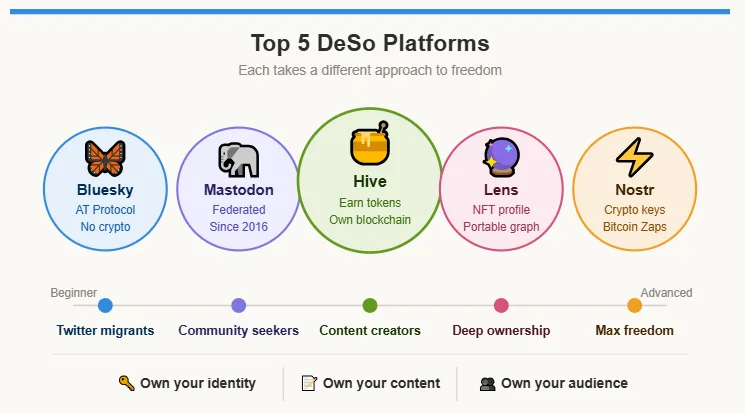
Each of the top decentralized social media platforms on this list has a real community, active development, and a different approach to what censorship-resistant DeSo should look like. They range from the easiest possible starting point for a newcomer to the most extreme version of digital freedom currently available.
1. Bluesky: The most accessible entry point into censorship-resistant social networks
Bluesky looks exactly like X/Twitter. Short posts, a chronological feed, hashtags. But it runs on the AT Protocol, an open system where no company can quietly shadowban content or remove accounts because someone upstairs had a rough morning.
A user’s Bluesky account works like a social media passport. Followers, posts, and identity all travel across any app built on the same protocol. If a better app launches tomorrow using AT Protocol, switching doesn’t mean starting from scratch. Everything carries over automatically.
Bluesky recently closed a major funding round backed by Bain Capital Crypto and brought in new leadership modeled around the same vision that made WordPress the backbone of the open web. No crypto knowledge required, completely ad-free, and the most beginner-friendly of the five by a comfortable margin.
Best for anyone done with X/Twitter who wants more control without needing to learn what a blockchain wallet is.
2. Mastodon: The original decentralized social media platform run entirely by its community
Mastodon has been around since 2016, making it the elder statesman of Web3 social networks. It runs on thousands of independent servers called instances, each with its own community and rules, all able to communicate with one another.
The logic works the same way as email. A Gmail user can message a Yahoo user without either thinking twice about the infrastructure underneath. Someone on a photography-focused Mastodon server can follow and reply to someone on a completely separate tech server with no friction at all.
No blockchain, no crypto wallet, nothing to buy or stake. Mastodon is community-owned and community-run. Discovery can feel like navigating a large city for the first time, but once a user finds their corner of it, the experience genuinely clicks. No built-in creator monetization, but for decentralized social without any crypto complexity, it’s the most accessible path here.
Best for beginners who want community ownership without touching crypto at all.
3. Hive: The blockchain-based social app that actually pays creators for posting
Hive is where the earn-while-you-post model holds up in practice. Built on its own blockchain, it’s a platform where upvotes translate into real cryptocurrency. Post quality content, get upvoted by the community, and receive HIVE tokens. No brand deal required, no follower count threshold, no application sitting in someone’s inbox.
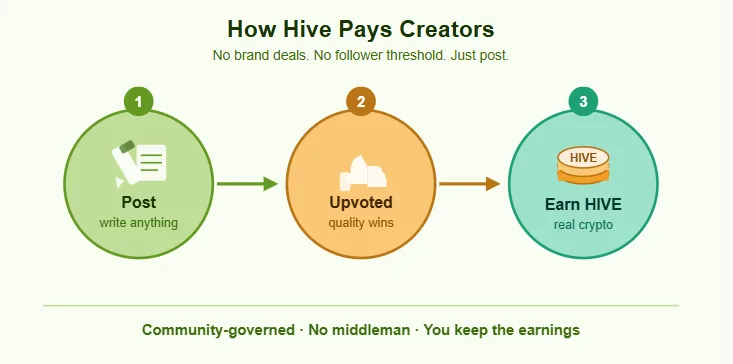
Hive is governed collectively through the Decentralized Hive Fund, where the community votes on how resources get allocated. Apps like PeakD, HiveBlog, and the blockchain game Splinterlands all sit within the Hive ecosystem, making it a full environment rather than just a blogging tool.
Blockchain-based social apps built on Hive represent one of the most functional earn-to-post models in the space. Token value moves with the broader crypto market, but for a platform where users collectively own the infrastructure and share in its value, it’s one of the strongest working examples of censorship-resistant DeSo actually delivering on its promise.
Best for bloggers, writers, and creators who want their content to carry actual financial weight.
4. Lens Protocol: Own your social graph as a digital asset on the DeSo blockchain
Lens Protocol pushes ownership further than any other platform on this list. A user’s profile, followers, and posts exist as NFTs on the blockchain, portable across any app built within the Lens ecosystem.
Say a better app launches tomorrow and it’s built on Lens. A user can log in and their entire social presence is already there. No re-following hundreds of people, no lost content, no rebuilding an audience from scratch. The social graph belongs to the person, not whichever platform they started on.
Lens launched its own dedicated blockchain in 2025, completing one of the most significant profile data migrations in blockchain history. Creator monetization on Lens goes deeper than tips or tokens – profiles are NFTs, posts can be collected, and the model is built around creators earning directly from their community. Getting started requires a crypto wallet, which adds a setup step that keeps casual users at arm’s length.
Best for content creators who want the deepest possible ownership over their audience and work.
5. Nostr: The most censorship-resistant DeSo platform with no central authority anywhere
Nostr is the most radical of all decentralized social media platforms on this list, and given the company this list keeps, that’s saying something. It’s an open protocol, not an app. Anyone can build on top of it, no company runs it, and there’s no central point to pressure or shut down.
Users don’t create accounts the usual way. They get a cryptographic key pair. The public key is the identity, shareable with anyone. The private key signs every message and proves ownership. One key pair works across blockchain-based social apps built on Nostr, from social feeds to music platforms to blogs, with no separate logins needed.
Creators on Nostr receive Zaps, which are small Bitcoin payments sent directly from fans through the Lightning Network. No platform takes a percentage, no approval process stands between a creator and their earnings. Censorship-resistant social networks don’t get more literal than this. Jack Dorsey, the original founder of Twitter, personally backed Nostr’s development with a significant Bitcoin investment, which says quite a bit about where at least one prominent tech mind thinks this is heading.
Best for privacy advocates, Bitcoin communities, and anyone wanting the most censorship-resistant option currently available.
Which of these top decentralized social media platforms is right for you?
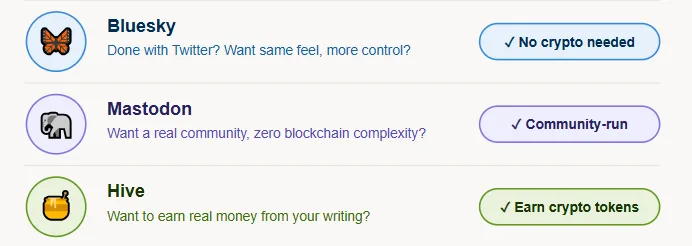
Choosing between these five comes down to what matters most. For a cleaner Twitter alternative, Bluesky. For community without crypto, Mastodon. For earning from content, Hive. For true ownership at the blockchain level, Lens Protocol. For complete freedom from any central authority, Nostr.
The DeSo blockchain ecosystem is still maturing, and Web3 social networks are laying the foundation that could define how people connect online for years to come. Web3 social media is moving fast enough that waiting too long to pay attention carries its own kind of risk.