

Every application you use today is controlled by someone. Instagram controls what stays up. Coinbase can freeze your funds at the worst possible moment. Your bank determines when you can access your money. You don’t actually own any of it. You’re basically a guest in someone else’s house, except the house is your data and money.
That’s exactly why understanding what decentralized applications (dApps) are is such a big deal. A dApp runs on a blockchain instead of a company’s server, so no single entity owns it, controls it, or can randomly decide to ruin your day by shutting it down. And if you’re getting into crypto, this is honestly one of the first things you should actually understand, because dApps are the backbone of almost everything happening in the space right now.
What is decentralization, and why should you care?
Most people never stop to question who actually controls the apps they use every day. Every app you use right now is centralized. Instagram, WhatsApp, your banking app, Google Drive, all of them run on one company’s servers, in one company’s data centers, answering to one company’s decisions.
And what does that actually mean for you? Your data gets owned, analyzed, and sold to advertisers without much fanfare. Your account can disappear whenever the owner feels like it. If their servers crash, you lose access. If they get hacked, your data is out there. If the company folds, everything goes with it.
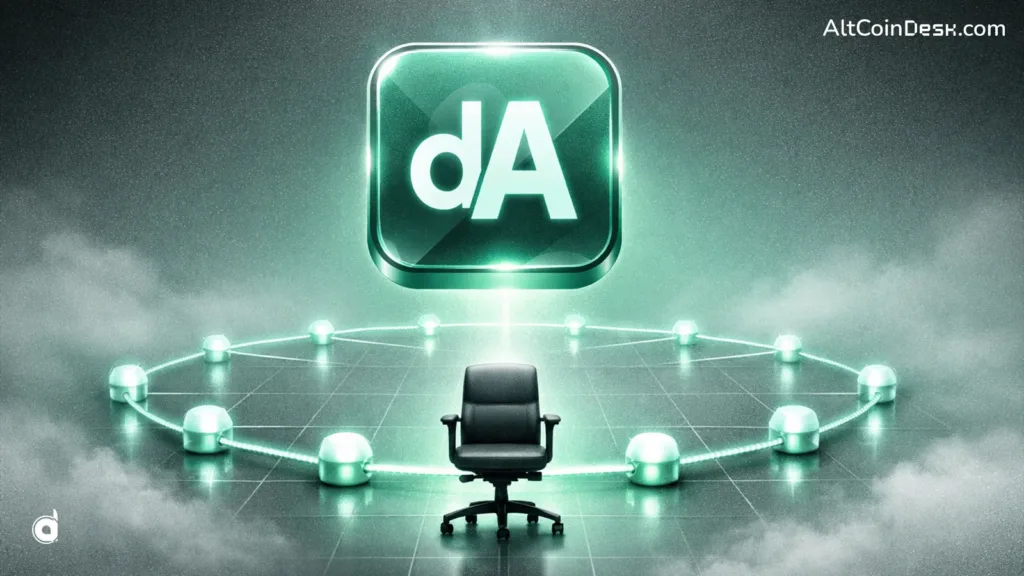
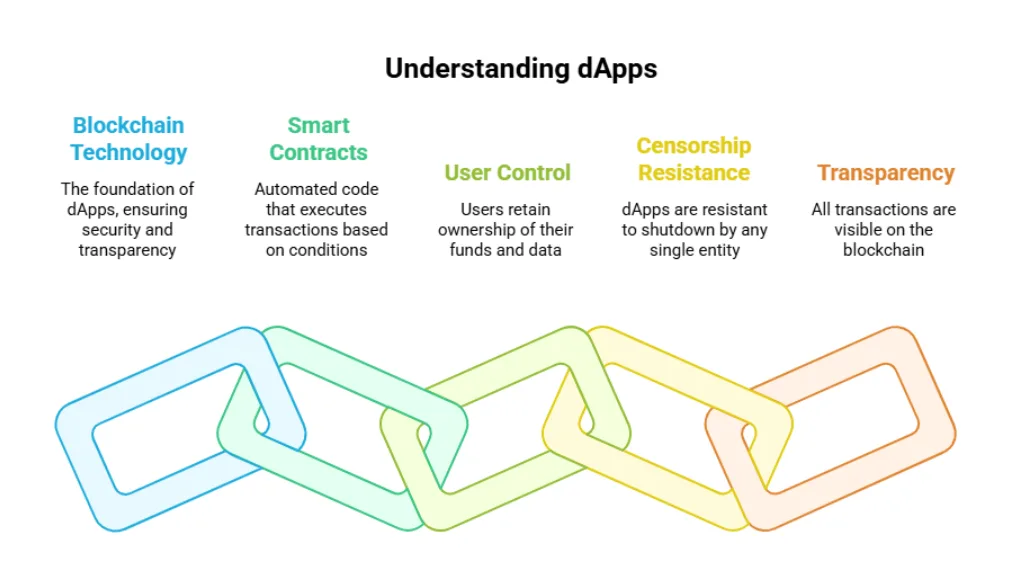
Decentralization flips all of that. Instead of one company’s server, a decentralized app runs on thousands of computers around the world, all running the same code and checking each other’s work. Nobody’s in charge. Nobody owns it. One computer goes down, the rest keep running. Someone tries to shut it down? There’s genuinely nothing there to shut down.
How dApps differ from traditional applications
On a regular crypto exchange, you deposit your coins, and the platform holds them on your behalf. Sounds fine, right? Except that you’ve absolutely no way to verify what they’re actually doing with your money behind the scenes. You’re just trusting them.
That trust has been broken before, spectacularly. In November 2022, FTX, one of the largest crypto exchanges in the world at the time by trading volume, collapsed after it came out that the company had secretly been using customer funds for risky bets. People who had deposited their crypto lost everything overnight.
Now look at Uniswap, a dApp that does the exact same job. The difference is that Uniswap never holds your coins. You keep them in your own wallet the entire time, and a smart contract handles the swap and sends everything back immediately. There is nothing for anyone to misuse, because the platform never had your money in the first place.
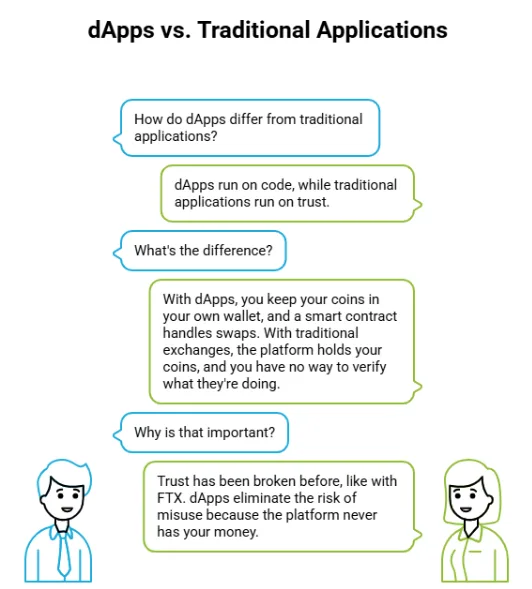
And that’s how dApps differ from traditional applications. One runs on trust. The other runs on code. Code doesn’t lie. The rules are locked in, automatic, and nobody can override them, not even the people who built the app. No CEO, no board, no “we’ve updated our terms of service” email.
Smart contracts and dApps: The engine under the hood
Smart contracts and dApps go hand in hand, and you can’t understand one without the other. They’re what makes the whole thing actually run.
So what is a smart contract? Basically, it’s a set of rules written in code and stored on the blockchain. When you interact with a dApp, you’re not dealing with a person or a support bot that takes three business days to respond. You’re triggering code that checks whether certain conditions are met and just… runs. No human signs off on anything.
The easiest way to picture it is a vending machine. You put money in, press a button, and it dispenses your snack without calling anyone for approval. Smart contracts work the same way, just swap the snacks for crypto.
Aave is a good real-world example. It’s a dApp that lets you borrow crypto without involving a bank at all. You drop in some Ether as collateral, and the smart contract figures out your limit and releases the funds. That’s it.
When you pay it back, you get your collateral returned automatically. No loan officer sat across a desk making you explain yourself, no paperwork, no “we’ll get back to you in 5 to 7 business days.”
One thing worth knowing: once a smart contract is deployed, it’s nearly impossible to change. That’s actually the point; nobody can tamper with the rules after the fact. But it also means bugs are hard to fix, which is why security audits matter a lot in this space.
How do dApps work? A step-by-step process
To understand how dApps work, let’s walk through a real transaction. Take Uniswap. You want to swap Ether for USDT. You open Uniswap, and it looks like a completely normal website. Instead of creating an account, you connect a wallet like MetaMask. No email. No personal info. Just your wallet.
You select 1 ETH and choose USDT as the destination. Uniswap shows you the rate and gas fee. You confirm, and the smart contract takes over. It checks your balance, applies the rate, deducts the fee, and sends USDT back to your wallet in seconds. No employee approved that. The code just ran on its own.
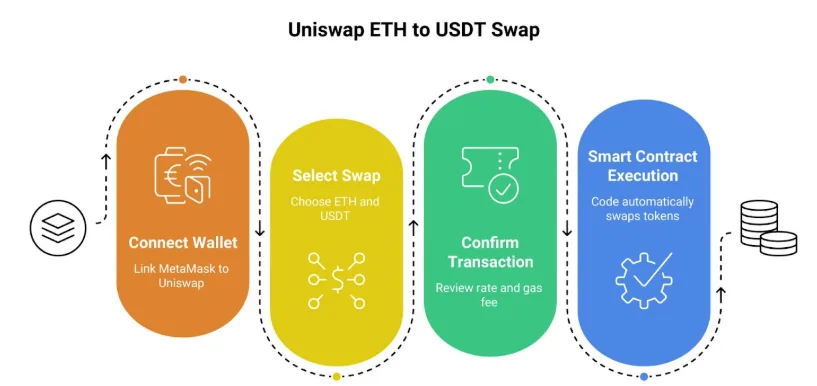
The transaction is recorded on a public ledger that stores every transaction permanently and transparently. Uniswap can’t reverse it even if they wanted to. The whole thing happened without a single person being involved. Just code.
Where are dApps actually being used right now?
dApps are already being used across four main categories, and honestly, some of them are pretty huge.
DeFi is the biggest, think platforms like Uniswap, Aave, and Compound where you can swap, lend, and borrow crypto without a single bank or middleman involved.
Gaming is another big one, where your in-game items are NFTs you actually own, meaning the developer can’t just wipe them out if they feel like it.
The other two are NFT marketplaces and DAOs. Marketplaces like OpenSea let creators sell directly to buyers, and every future resale automatically sends the creator a cut, no chasing anyone for payment.
DAOs – short for decentralized autonomous organizations – are basically organizations that run themselves, token holders vote on decisions, and the smart contract executes the result.
The downside: What dApps still can’t do well
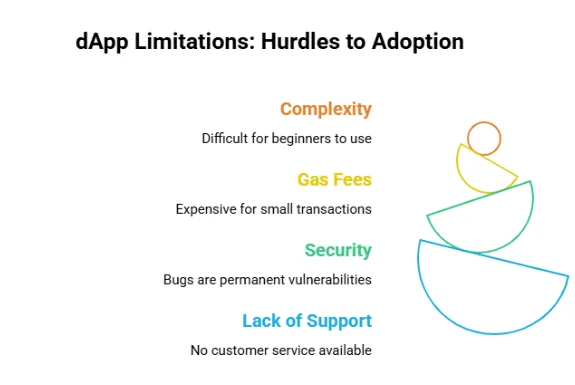
dApps aren’t perfect, and skipping the downsides would be doing you a disservice. For starters, they’re not exactly beginner-friendly.
You need a crypto wallet, a basic understanding of gas fees, and enough comfort with blockchain interfaces to not accidentally break something. That learning curve alone keeps a lot of people away.
Gas fees are another headache. A simple swap on Ethereum during a busy period can cost way more than you’d expect, which makes small transactions feel pretty pointless.
Security can also be a real concern. Because smart contracts can’t be changed once they’re deployed, a bug in the code becomes a permanent vulnerability, which is why you should only use well-audited, established dApps and always verify the official URL before connecting your wallet.
Fake versions of popular dApps exist specifically to drain wallets. And with decentralized applications, if something does go wrong, there is no customer support to call. On the blockchain, mistakes are permanent.
Final thoughts
At the end of the day, what are decentralized applications (dApps)? They’re what the internet looks like when no single company is calling the shots. Your data’s yours, your funds stay in your wallet, and nobody can just wake up one morning and decide to shut the whole thing down. Is it perfect? Not even close.
The fees are annoying, the learning curve is real, and the risks aren’t something you can just ignore. But the core idea, software that plays by fixed rules instead of whatever a company decides is convenient that day, is pretty hard to argue with. The internet built on that foundation looks very different from the one we have now, and honestly, that might not be a bad thing.