


Prediction markets let people put real money on what they think will happen. The price of each bet tells everyone watching what the crowd actually believes. It’s part forecast tool, part financial market, and a very serious guessing game with real consequences.
What started as an academic experiment in a bar in Iowa in 1988 spent decades being used mostly by economists. Then crypto got involved, the 2024 US election happened, and suddenly the industry was processing $63.5 billion in a single year.
What are prediction markets?
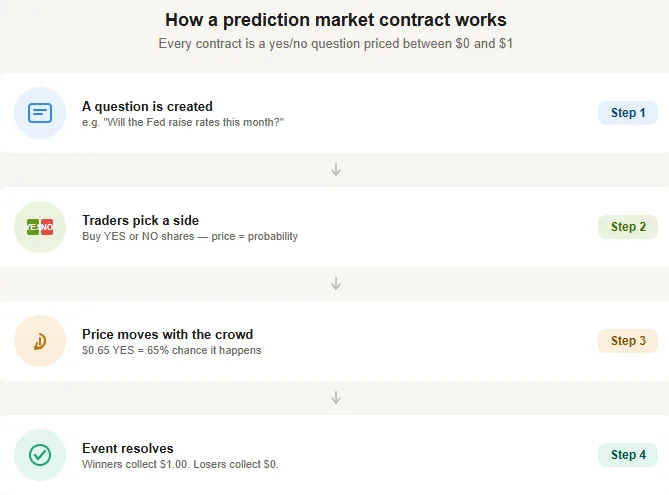
A prediction market is a platform where people trade contracts tied to the outcome of real-world events. Each contract is a yes/no question. The price of a yes contract moves between $0.00 and $1.00, representing the crowd’s estimated probability of that outcome happening.
If a contract for “Will the Fed raise rates this month?” is trading at $0.65, the market is collectively saying there’s a 65% chance the answer is yes. When the event resolves, winners collect $1.00 per contract. Losers collect nothing.
The key difference from a poll: polls ask what people think. Prediction markets ask what people are willing to bet money on. Those are very different questions. When real money is on the line, opinions tend to sharpen up quickly.
Where prediction markets came from
Three economists walked into a bar in Iowa City in 1988 and accidentally invented a $63.5 billion industry. Professors Robert Forsythe, George Neumann, and Forrest Nelson were frustrated that polls had just badly mispredicted a presidential primary. Jesse Jackson had beaten Michael Dukakis in Michigan despite polls showing a clear Dukakis win. Their question was simple: if financial markets are good at aggregating information, why couldn’t the same logic work for elections?
The result was the Iowa Electronic Markets, the world’s first academic prediction market. It worked well enough that the concept held up for decades. It just needed better infrastructure to scale.
Prediction markets in crypto: How blockchain changed everything
Crypto didn’t invent prediction markets. It gave them a distribution network they’d never had before.
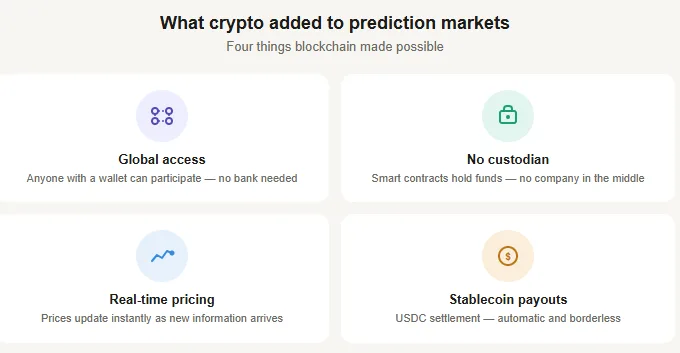
Blockchain-based platforms like Polymarket let anyone, anywhere, participate without a bank account, a wire transfer, or a centralized company holding their funds. Contracts settle in USDC, a stablecoin pegged to the US dollar. Payouts happen automatically when an event resolves, handled by smart contracts rather than a back-office team.
This opened prediction markets to a genuinely global audience. A trader in one country and a fund manager in another could be on opposite sides of the same contract with no intermediary required. That’s a meaningful shift from thinly traded academic markets that required a university login.
How prediction markets gained traction
The COVID-19 pandemic was the first real stress test. With official guidance changing weekly and markets moving on every headline, prediction markets offered something news couldn’t: a real-time probability. The crowd was often pricing outcomes faster and more accurately than press conferences.
The 2024 US presidential election was the moment that made the industry impossible to ignore. Polymarket’s trading volume for the race between Donald Trump and Kamala Harris reached $3.68 billion, the largest single event in prediction market history.
A few days after the June 27, 2024 presidential debate, Polymarket showed a 70% probability that Joe Biden would withdraw from the race. He officially announced his withdrawal weeks later. Polls were still scrambling. The market had already moved on.
That performance converted a lot of skeptics. To put the growth in perspective: the global prediction market industry processed around $0.5 billion in total volume in 2022, grew to $15.8 billion in 2024, and hit $63.5 billion in 2025.
Best prediction markets in 2026: Kalshi and Polymarket
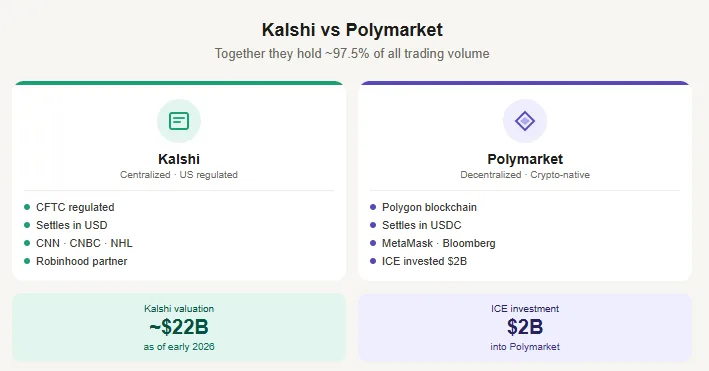
Polymarket and Kalshi together account for approximately 97.5% of all prediction market trading volume. No other platform comes close. The two have carved up the industry between them, with different models, different regulatory histories, and very different origin stories.
Kalshi
Kalshi is the largest prediction market in the United States. It’s regulated by the CFTC as a derivatives exchange, which means it’s treated as a financial product rather than a gambling platform and can operate nationally without negotiating with individual state gaming boards.
It processed tens of billions in trading volume in 2025, has data partnerships with CNN and CNBC, a licensing deal with the NHL, and a Robinhood integration that Citizens Financial Group analysts identified as the fastest-scaling product in Robinhood’s history. Its valuation stands at approximately $22 billion as of early 2026, following a funding round led by Coatue Management.
Markets on Kalshi have covered everything from Fed rate decisions to which song Bad Bunny would sing first at the Super Bowl halftime show. That range tells you exactly where the platform thinks the audience is.
Polymarket
Polymarket runs on the Polygon blockchain and settles contracts in USDC, making it the most crypto-native of the major prediction markets. It was fined $1.4 million by the CFTC in January 2022 for operating an unregistered derivatives platform and was blocked from US users. After the CFTC and Department of Justice dropped their investigations in July 2025, Polymarket received full CFTC approval on November 25, 2025, and returned to the US market.
In October 2025, Intercontinental Exchange, the NYSE’s parent company, invested $2 billion in Polymarket, reflecting a pre-investment valuation of approximately $8 billion. As of March 2026, Polymarket’s valuation is projected at approximately $20 billion. Polymarket is integrated with MetaMask, Bloomberg Terminal, and X.
Centralized vs decentralized prediction markets
Same basic product. Two very different answers to who holds the money and who makes the rules.
Centralized markets like Kalshi take the regulated route. A company is in charge, which means legal protections but less freedom.
- Regulated by the CFTC as a federal derivatives exchange
- Company holds user funds and settles in USD
- Requires identity verification
- Legal protections for users
- Controls which markets are listed
Decentralized markets like Polymarket take the crypto-native route. No single company is in charge, which means more freedom but fewer safety nets.
- Runs on blockchain smart contracts with no company holding funds
- Settles in USDC stablecoin
- Originally required no identity verification
- Globally accessible
- No customer support or legal recourse if something goes wrong
Pros and cons of prediction markets
Like any financial product, prediction markets have real strengths and real limitations worth knowing before putting money in.
Why they work:
- Prices reflect money, not opinions, which filters out a lot of noise
- Often faster to update than polls or media coverage
- Attract participants with genuine expertise who have a financial reason to be right
- Crypto-based markets give global access without a traditional bank account
Where they fall short:
- Large bets can distort prices: Four accounts with around $30 million in Trump contracts temporarily skewed Polymarket’s 2024 election odds, per Wall Street Journal reporting
- Regulatory status is still contested across US states, with Kalshi facing lawsuits in multiple jurisdictions
- Decentralized platforms carry smart contract risk with no consumer protections
- Volume figures can mislead as Polymarket’s numbers have faced scrutiny for potential double-counting
The last note
Prediction markets started as an academic idea built on one simple premise: money makes people think harder. Three decades after a group of economists tried it in Iowa, the same concept is processing tens of billions of dollars a year on blockchain infrastructure that didn’t exist when they started.
Whether the next big event is a rate decision, an election, or a sports final, there will be a contract on it, a crowd pricing it in real time, and a number that reflects what people actually believe, backed by something they’re not willing to lose.