


Most people assume crypto is one big interconnected market. In reality, Ethereum and Solana are completely separate systems that don’t naturally share anything, the same way your bank account in one country doesn’t automatically work in another. Each blockchain runs its own rules, holds its own tokens, and has no built-in way to communicate with the others.
That’s the gap crypto bridges were built to fill. Understanding what is a crypto bridge and how cross-chain transfers work has gone from developer territory to something any active crypto user runs into eventually.
What is a crypto bridge?
A crypto bridge is a protocol that links two blockchains and allows tokens to move between them. Without one, ETH stays on Ethereum forever, and SOL stays on Solana forever, and that’s genuinely limiting.
Different blockchains are good at different things. Ethereum has the deepest DeFi ecosystem in crypto. Solana is fast and cheap to use. Arbitrum makes Ethereum transactions affordable without sacrificing security. If assets are stuck on one chain, everything happening on the others stays out of reach.
Bridges are the roads between those ecosystems. Nobody finds roads exciting, but nothing moves without them.
How a crypto bridge moves assets between blockchains
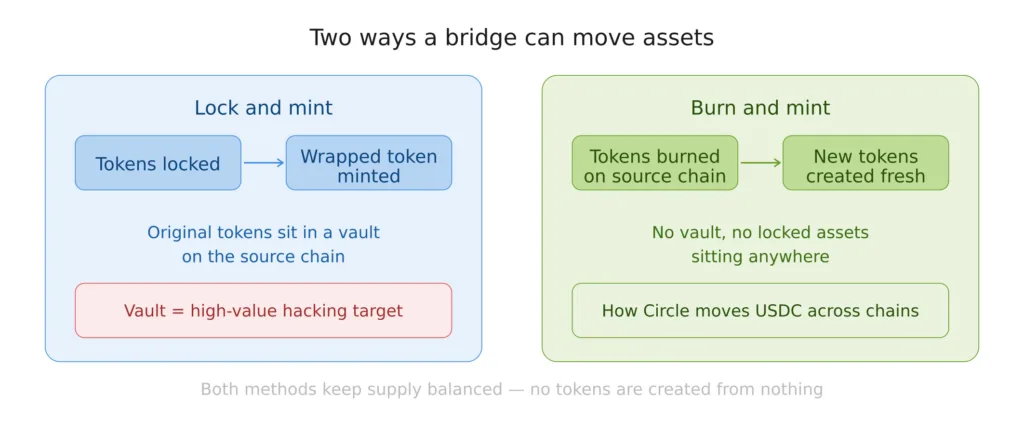
The most common method is called lock and mint. Say someone wants to move ETH from Ethereum to Solana. They send ETH to the bridge’s smart contract on Ethereum, which locks it in a vault. On the Solana side, the bridge creates a new token representing that ETH, called a wrapped token. It’s worth the same as real ETH but works inside Solana’s apps and ecosystem.
To reverse it, the wrapped token gets burned on Solana, the bridge registers this, and the original ETH gets released from the vault on Ethereum. The process sounds complicated, but it’s really just a very elaborate check-in and check-out system.
The second method is burn and mint. The original tokens get destroyed on the source chain and freshly created on the destination chain. No vault, no pile of assets sitting somewhere waiting to be targeted. This is how Circle moves USDC across chains, and it’s a cleaner approach when done properly.
Wrapped tokens: Why your bridged ETH isn’t really ETH
When bridging an asset, the original token doesn’t actually move anywhere. ETH only exists on Ethereum. What appears on the destination chain is a wrapped version, a new token backed 1:1 by the real asset locked on the original chain.
Wrapped Bitcoin, or WBTC, is the most recognizable example. Bitcoin can’t natively work inside Ethereum’s DeFi protocols, but huge demand exists for using its value there. So real BTC gets locked with a custodian, and WBTC gets minted on Ethereum. One WBTC always equals one Bitcoin, and it works inside any Ethereum protocol like a regular token.
Wrapped tokens are only as safe as the bridge holding the original asset underneath them. If that bridge gets exploited and the locked assets disappear, the wrapped tokens on the other side are worth nothing. That’s not a theoretical risk, it has happened, and it’s the most important thing to understand before using any bridge.
EVM vs non-EVM: Why cross-chain transfers get complicated
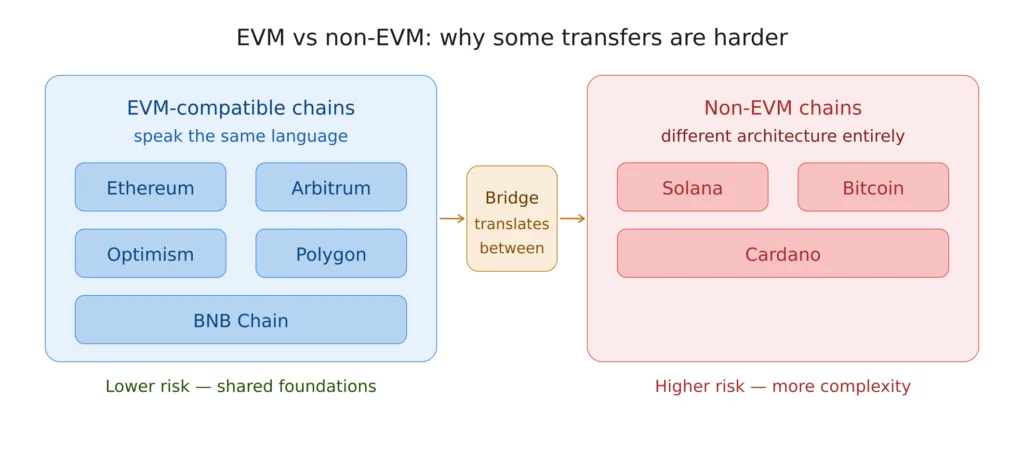
EVM stands for Ethereum Virtual Machine, the system Ethereum uses to run smart contracts. Arbitrum, Optimism, Polygon, and BNB Chain were all built on the same technical base as Ethereum, which means a bridge connecting any two of them has far less translating to do. They speak the same language, which helps.
Non-EVM chains like Solana, Bitcoin, and Cardano were built from scratch on completely different architectures. Bridging between an EVM chain and a non-EVM chain means the bridge has to act as a translator between two systems that share almost no common ground. More moving parts, more things that can go wrong, and historically more successful exploits. The EVM to non-EVM route is where most of the serious bridge failures have happened.
Bridging from Ethereum to Layer 2 networks
Not every cross-chain transfer involves jumping between completely separate blockchains. Moving ETH from Ethereum mainnet to Arbitrum or Optimism is bridging, just without the drama that comes with crossing into a completely different ecosystem.
Ethereum mainnet, called L1, has the strongest security guarantees in the ecosystem, but that comes at a cost – gas fees can get painful during busy periods. Layer 2 networks were built specifically to sit on top of it, handling transactions faster and cheaper without cutting ties with Ethereum’s security underneath. Because of how tightly they’re designed to work together, bridging to an L2 is a lower-risk move than sending assets to an entirely different chain.
One thing worth keeping in mind though: getting money back from an L2 to the Ethereum mainnet can take up to 7 days on some networks. That delay is a feature, not a flaw. The network uses that window to review transactions and catch anything suspicious before it becomes final.
Why crypto bridges are the biggest hacking target in DeFi
Bridges hold large amounts of locked assets inside smart contracts. Anyone who finds a flaw in the code has a direct path to those funds, and that makes them a constant target.
Wormhole, one of the most widely used cross-chain bridges now connecting over 45 blockchains, was exploited in February 2022. A hacker found a bug and minted 120,000 wrapped ETH on Solana without locking any real ETH on Ethereum first. Around $320 million, taken across a series of transactions. Jump Trading, the firm backing Wormhole, stepped in and replenished the stolen funds, which was an extraordinary response, but that kind of outcome is the exception rather than the rule.
The main risks are smart contract bugs that give attackers access to the vault, validator compromise, where hackers take control of enough approvers to push through fraudulent transfers, and liquidity shortages in pool-based bridges that leave funds stuck when too many people bridge in the same direction at once.
Where cross-chain transfers are heading next
Bridging is getting less painful. The newer generation of protocols lets someone say what they want to happen, move these tokens from this chain to that one, and the system figures out the route on its own. No manual steps, no picking between five different bridges and hoping for the best.
The security side is catching up too. Newer bridges are being built with stronger verification systems that don’t put all the trust in a small group of validators, which has historically been where things go wrong. Cross-chain transfers are still a work in progress, but the direction is right, and for a part of crypto that has lost billions to exploits, that matters.