

Conventional corporate or government structures depend on a top-down leadership approach whereby a small group of decision-makers sets the rules and procedures. However, crypto requires communities to vote on proposals online through governance tokens.
Governance tokens, thus, grant the holders the right to vote on proposals, to impact protocol upgrades, and to ensure that the direction of a project is one that is oriented towards the overall community interest and not the whims and fancies of a few developers or investors.
As a result, the use of governance tokens has become a key feature in web3 and provides crypto users with a literal voice when it comes to making decisions that impact dApps and blockchain protocols.
But what is a governance token, really?
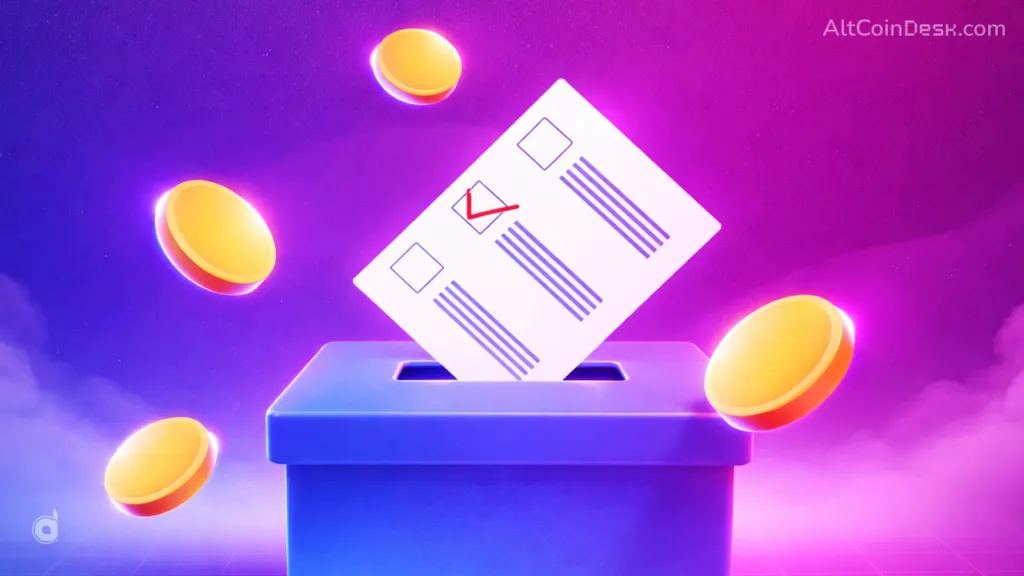
A governance token refers to a form of cryptocurrency that grants its owner voting privileges in any given decision in a decentralized protocol. The tokens act as voting chips, allowing holders to impact certain proposals or upgrades to be made on a decentralized network.
These tokens also place more power within communities and allocate decision-making power equitably among stakeholders. This is unlike other forms of cryptocurrencies, such as Bitcoin or Ethereum, which primarily act as a modern form of money or store-of-value.
On-chain governance tokens are commonly developed on already existing blockchains like Ethereum (ETH), Solana (SOL), or Cosmos (ATOM). The developers provide such tokens to users who participate in the platform by trading, staking, or liquidity provision.
How governance tokens work
Governance tokens are powered through smart contracts or self-executable programs on the blockchain. When a user casts a vote, the result is automatically recorded and enforced without the presence of a centralized intermediary. This system promotes transparency and ensures trust in crypto decision-making.
The majority of dApps with governance tokens structure their decision-making into a decentralized autonomous organization (DAO). Below is how the voting process happens within a DAO.
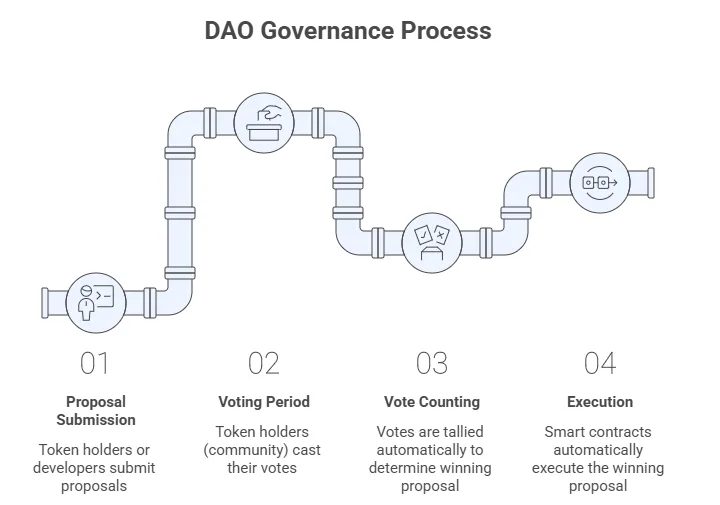
- A token holder or developers submit a proposal to make changes such as software upgrades, transaction fee changes, or feature upgrades, and then other holders move to cast their votes to approve the proposal.
- Since every token typically corresponds to a vote, the community gets an opportunity to determine the result jointly.
- The votes are then counted, and the winning option is automatically executed by smart contracts at the expiry of the voting period.
Some governance tokens also allow users to stake their governance tokens on proposals, which temporarily locks out their voting power in the decision-making process. After the vote is finished, the tokens are returned to the holders, allowing the changes to be made immediately.
How governance tokens and utility tokens differ
All governance tokens are utility tokens, although not all utility tokens carry with them governance authority. Utility tokens support normal blockchain operations, such as payment of transaction fees or as rewards for operations like staking.
On the other hand, governance tokens provide holders with voting rights, allowing them to vote on protocol changes and new funding proposals. Some on-chain governance tokens are a bit different from utility tokens, since some projects mix both roles in a single token. CAKE, for example, acts as both the utility token and the governance token for the Uniswap platform.
Benefits and risks of governance tokens in crypto
Governance tokens have both advantages and disadvantages. Let’s explore some of the benefits and risks below:
Benefits
Governance tokens can offer blockchain and network users a variety of benefits. Besides introducing the immutable right to governance under the code, governance tokens introduce special opportunities for collaboration.
For example, these tokens enable community members to freely cooperate, address issues, and introduce new features in an open, effective way through decentralizing and democratising the governance process.
On-chain governance tokens also enable stakeholders of a project to promptly and efficiently respond to ill attempts by hackers on a blockchain system. In case of a large-scale attack on a blockchain, a vote can be cast, forcing the chain to unwind to a block before the attack.
Risks
Governance tokens can be fully decentralized to a blockchain protocol or project, but they are not free of risks or challenges.
The DAO model eliminates centralized decision-making by requiring token holders to only use smart contracts and on-chain governance tokens to execute their decisions. One big danger that stems from this is the fact that the security and robustness of a DAO can never be stronger than the code that runs it.
Governance tokens face the same risks as Proof-of-Stake blockchains, in addition to the risk of smart contract security. Users with a huge number of governance tokens are more likely to wield greater voting power, and stakeholders with fewer tokens may be overwhelmed by them unless a protocol is designed to use a weighted voting system.
Examples of governance tokens in crypto
There are a number of blockchain protocols that currently implement governance tokens in various applications. These projects include:
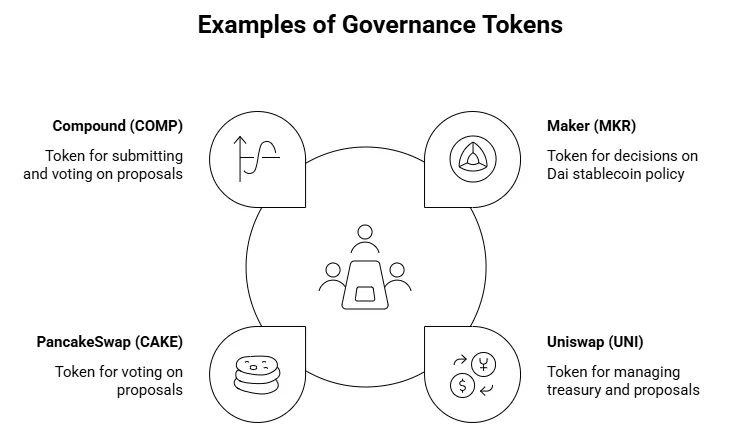
- Maker: The Maker (MKR) token allows token holders to make decentralized decisions on the policy of the Dai stablecoin, introduce new collateral types, or alter the way the Maker governance model works.
- Uniswap: The Uniswap (UNI) governance token allows token holders to participate in managing the Uniswap treasury or create and vote on proposals. UNI can also be committed to a liquidity pool, which can provide holders with a portion of trading fees.
- PancakeSwap: PancakeSwap, one of the biggest decentralized exchanges, is governed by its community. Any CAKE holder can participate in governance of the decentralized exchange project by voting on existing proposals or creating their own proposal.
- Compound: Compound, a decentralized marketplace for crypto investor has its own governance token, Compound (COMP). Users who buy COMP and hold it are able to submit or vote on proposals or delegate voting power to other COMP holders.
How users obtain governance tokens
Crypto investors can access governance tokens through various ways, including:
- Purchasing: Governance tokens are sold over cryptocurrency exchanges such as Kraken, Coinbase, or Binance, just like other fungible tokens (e.g., UNI, AAVE, MKR).
- Airdrops: Projects often issue governance tokens to all early users and community members. For example, Uniswap held an airdrop to distribute UNI to users who traded on its platform before September 2020.
- Rewards: Some protocols reward users with incentive programs due to their contribution to the ecosystem, for active use, creating content, or developing software.
- Early Token Sales (ITOs) or Crowdsale: Projects can offer governance through initial token sales in which users have to acquire tokens and even stake them to obtain the governance token.
The future of the governance tokens
Governance tokens are transforming the nature of interaction between the communities and the digital projects. These tokens promote accountability, transparency, and engagement by positioning the community in a position of power and disempowering the developers and investors.
Decentralized autonomous organizations are also gaining widespread adoption alongside on-chain governance tokens. Advancements in these organizations could shape the future of DeFi governance.
With blockchain technology maturing, governance tokens could become more complex. Future on-chain governance could have advanced voting systems, cross-chain interoperability, and reward systems. Decentralized governance is also expected to become more robust.