
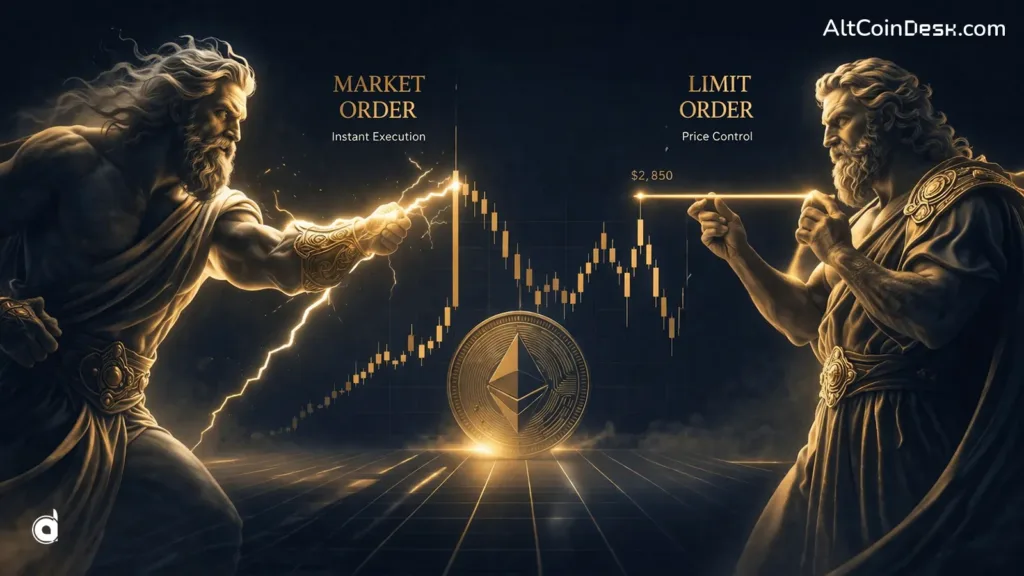

Crypto trading often looks simple on the surface. You open an exchange, choose an asset, and click buy or sell. However, one quiet decision behind that simple click can shape the price you actually receive. That choice is whether to use a market order or a limit order.
These two types of orders define how your trade interacts with the order book and the speed at which it will be executed. Mostly, crypto beginners are preoccupied with the price chart and completely disregard the execution mechanics. However, the entry or exit strategy can have as much impact on the outcome of your trade as the timing.
This makes understanding the difference between a limit order vs market order very crucial. Knowing when to use each can help lower costs, avoid surprises, and enhance consistency.
The mechanics behind crypto order execution
The most effective way to grasp the concept of limit order vs market order is to have a short look at how exchanges trade. All exchanges have matching engines that match the buyers and sellers. Orders interact with this system in terms of priority and price.
However, three mechanics affect the filling of crypto trades:
- Slippage: Slippage happens when the available liquidity at the best price is not good enough to take up the entire size of the order. The rest are then filled by the system at the subsequent levels.
- Partial fills: Limit orders can be executed in parts instead of being executed in a single instance. In the event that only a portion of your request is competitive with available liquidity, the rest of your request remains in the order book.
- Time-in-force settings: These orders specify the duration of an order. There are those orders that remain incomplete until canceled and those that seek to be executed instantly, and cancel the rest.
What is a market order in crypto trading?
A market order crypto-trade instructs the exchange to trade as soon as possible at the best price available. The system finds an order that matches your request that is already in the order book as either a buy or sell order.
When you submit a market buy order, the exchange fulfils your trade by accepting the lowest sell offers in the order. When you have a large order size, you can fill on a number of price levels. However, this may have a minor effect on the end price you get.
This variation between the expected and the executed price is referred to as slippage. The slippage is more evident in low liquidity or high volatility cases. It is frequently observed among rapid price movements by traders.
Market orders are usually applicable in urgent cases. For example, a trader may leave when the price goes down suddenly or may join in case of breakoutut. For market order crypto trades, the speed of execution is more important than optimum pricing.
Another key aspect that is put into consideration is fees. Market orders normally withdraw the liquidity from the order book. Due to that, the exchanges tend to categorize them as taker orders and impose a slightly higher fee.
Nonetheless, in liquid trading pairs like large cryptocurrencies, normal trade sizes may experience small slipage. That is why market orders are a feasible choice to execute fast. Nevertheless, using them blindly can make trading more expensive in the long run.
What is a crypto limit order?
A crypto limit order enables traders to have control over the specific price they want to trade. The order does not go off immediately, but rather waits in the order book until the market hits a given level. This provides traders with greater accuracy.
With a buy limit order, you specify the highest price that you wish to pay. In case of a sell limit order, you specify the lowest price at which you are ready to trade. The trade is only carried out when such conditions are satisfied.
Since the order is in the book, it provides liquidity and does not eliminate it. These are normally considered maker orders, and they tend to be less expensive. With time, this disparity may have major impacts on regular traders.
Nonetheless, there is a trade-off. A limit order is not guaranteed to get executed. In the event that the market does not reach the price that you offer, the trade does not go through.
This is usually the case when there are strong trends. Prices can run fast and never get back to you. The traders also fail to get opportunities because they wait until they get a perfect price, which does not come.
However, a limit order is a necessity to structured trading, despite the risk. They assist in instilling discipline to avoid emotional decision-making.
Limit order vs market order: Major differences
The fundamental distinction between the two types of orders is execution speed and price control. The market orders emphasize the fulfillment in the short term. Limit orders are focused on accuracy and an economical nature.
The following is a simple comparison:
| Feature | Crypto Limit Order | Market Order Crypto |
| Purpose | Trade price control | Direct execution |
| Speed | Conditional | Instant |
| Use Case | Optimal exit or entry | Emergency trades |
| Slippage Risk | Low | High |
| Fees | Often maker | Normally taker |
Understanding the differences between the two can help streamline most crypto trading decisions. Each type of order has its purpose under certain market conditions.
Limit order vs market order: When to use each
Market orders and limit orders can be used at different times for different purposes. Let’s analyze when it’s best to use each.
Limit orders
Key instances when you can use limit orders include:
- Purchasing at the support levels: Traders seek to purchase at levels offering better value.
- Scooping profits at target zones: Limit orders reserve premeditated exits.
- Trading volatile markets or thin markets: It is possible to control the price, which minimizes unforeseen fills.
Besides enhancing control, limit orders could also enhance consistency. These orders make sure you do not act emotionally, but have predefined entry or exit levels.
Market orders
Some of the appropriate instances to use market orders include:
- Leaving a losing trade: Rapidity cuts the risk in quick market actions.
- Placing powerful momentum trades: Breakouts are typically too fast to put on limit orders.
- Buying and selling highly liquid pairs: Slippage tends to be small in the case of a deep liquidity level.
When such instances occur, certainty in execution is more important than a low price increment. Losing the move altogether may be a more expensive affair than paying a few cents more.
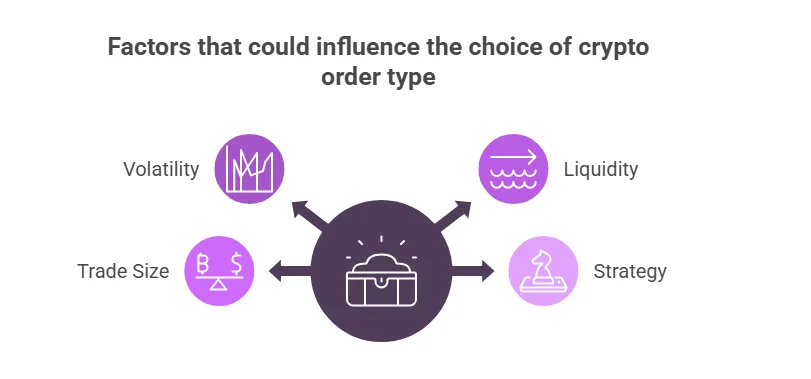
Practical factors that could impact your choice of order type
The following real trading conditions can help in deciding whether to use a market order or a limit order for your crypto trades.
1. Volatility
Cryptocurrency markets are fast-moving and volatile, unlike conventional financial markets. A limit order can also be used to manage risk in a highly volatile situation. It does not allow one to enter the trades at drastic prices in sudden spikes.
2. Liquidity
Liquidity among trading pairs is different. The large assets are associated with order books and tighter spreads. Smaller tokens can also be wide-spread that augment the possibility of slippage with market orders.
3. Trade size
Big orders do not react to the order book in the same way. The reason is that a big market order can push the price levels because of its size. The impact can be mitigated by splitting the orders or by setting a limit.
4. Strategy
Market orders are usually time-saving with short-term traders. On the other hand, limit orders are a common practice among long-term or position traders in order to maximize the entry point.
Conclusion
Limit and market orders play varying functions in crypto trading. One is concerned with speed, and the other one is concerned with price control. Understanding when to apply each one can enhance the results of trade and minimize the unforeseen expenses.
Most experienced traders resort to both of them depending on the circumstances. They mix the rapid implementation of momentum moves and the accuracy of entries at scheduled levels. This equilibrium enables pro-traders to respond to the market dynamics.